









Charts, September 13, 2026. This page put fourth-quarter 2024 rest-of-world revenue at $274 million, in the text and in the geography chart. No filing or release supports it: that quarter's release gives total revenue of $827.5 million and United States revenue of $558 million, which leaves $269.5 million, and the figure below now reads $270 million. The description of the valuation chart also described a different chart from the one published; it now describes the chart as drawn. No other figure changed.
Disclosure. I traded PLTR around this earnings report and closed the position for a gain of just under 20%. I hold no position now, and held none while the research below was done. That is a real interest and you should read the piece knowing about it: I profited from the move I am about to analyze. This is not investment advice. Every figure is cited to a filing or a government database. Where a number is derived by arithmetic from filed figures rather than stated in one, I say so.
Palantir reported the best quarter of its life on Monday. Revenue grew 93% year over year to $1.935 billion, the fastest growth rate in the company's history, at a scale where growth rates are supposed to decay. Operating margin was 47% on a GAAP basis. Free cash flow margin was 63%. The company earned $1.06 billion of GAAP net income with 4,429 employees, which works out to roughly $1.8 million of revenue per person. The stock is up 27% as I write this.
I want to start by conceding the whole bull case, because most critical pieces about this company do not, and the ones that do not are easy to ignore.
It is an extraordinary business. Not extraordinary in the way that phrase gets used about software companies growing 30% with negative earnings, but extraordinary in the older sense: there is no obvious comparison. The classic objection to Palantir, repeated for five years by people who were right about it for four of them, was that the growth was rented from shareholders through stock compensation. That objection is now empirically dead, and I will show you exactly where it died.
So the interesting question is not whether this is a good business. It is. The interesting question is what the price assumes, and whether the thing that makes Palantir uncatchable in Washington is the same thing that stops it everywhere else.
I think it is. I think the filings show the bill arriving already, in a line item nobody reads.
Q2 2026, quarter ended June 30, 2026. Growth rates are year over year. Source: Q2 2026 earnings release and Form 10-Q, filed August 4, 2026.
The quarter was as good as it looked
Here is the quarter without commentary, as filed.
| Q2 2026 | $M | Y/Y |
|---|---|---|
| Revenue | 1,935.5 | +93% |
| Cost of revenue | (296.9) | |
| Gross profit | 1,638.6 | +102% |
| Total operating expenses | (726.6) | +34% |
| Income from operations | 912.0 | +239% |
| Interest income | 77.5 | |
| Other income, net | 91.8 | |
| Provision for income taxes | (15.4) | |
| Net income to common | 1,061.9 | +225% |
The line that matters most in that table is the one that looks least interesting. Operating expenses grew 34% while revenue grew 93%. That is the entire margin story, and it is not an accounting artifact. Sales and marketing grew 39%, research and development grew 43%, and general and administrative grew 20%, against a revenue line that nearly doubled. A company that can add $932 million of quarterly revenue while adding $185 million of quarterly operating expense has genuine operating leverage, which in software is common, and has it at 93% growth, which is not.
The balance sheet backs it up. Cash and marketable securities of $9.41 billion against total liabilities of $1.79 billion, and those liabilities are entirely operating items: payables, deferred revenue, customer deposits, lease obligations. There is no debt. Cash from operations for the quarter was $1.216 billion on $1.935 billion of revenue.
Guidance went up on every line. Full-year revenue to a range of $8.150 to $8.158 billion, adjusted operating income to $4.889 to $4.897 billion, adjusted free cash flow to $4.5 to $4.7 billion, and US commercial revenue to "in excess of" $3.424 billion.
None of that is in dispute. Take it as given for the rest of this piece.
The bear case that quietly died
For five years the strongest argument against owning Palantir was arithmetic rather than narrative. The company paid its people in stock, the share count went up every year, and your claim on the business shrank underneath you even when the business grew. It was a good argument, and for most of those five years it was the right one. What follows is what it looked like, and what happened to it.
| Diluted shares, Q2 | Millions | Y/Y |
|---|---|---|
| 2022 | 2,054.8 | +8.5% |
| 2023 | 2,278.2 | +10.9% |
| 2024 | 2,414.7 | +6.0% |
| 2025 | 2,562.9 | +6.1% |
| 2026 | 2,568.7 | +0.2% |
Diluted weighted-average share count, from Palantir's own XBRL filings. Between 2022 and 2025 the company diluted its owners by 6% to 11% a year. This year it diluted them by 0.2%. The last two sequential quarters the diluted count actually fell, from 2,571.1 million in Q3 2025 to 2,570.9 million and then 2,568.7 million.
Stock compensation did not go away: it was $265 million in the quarter, up from $160 million. What changed is that the company grew into it. At a $7.7 billion revenue run rate, $265 million of quarterly stock comp is 13.7% of revenue, against 15.9% a year ago and far more before that, and the dilutive overhang from options and unvested units has stopped outrunning the offsetting exercises. Whatever you think of the company, if you argued against it primarily on dilution, the filings no longer support you. That argument had a five-year run and it is over.
The company noticed, and made a point of it. Adjusted EPS came in at $0.41 and GAAP EPS came in at $0.41. Identical. For a company whose non-GAAP reporting was a punchline, that reads like a purity milestone.
It is not one, and this is the part worth slowing down for.
Adjusted EPS matches GAAP EPS this quarter because two large adjustments in opposite directions happened to cancel. Palantir adds back $265.2 million of stock compensation and $17.3 million of related payroll taxes, a total of $282.5 million. It then subtracts $297.4 million for income taxes, because the adjusted figure applies what the company calls "an estimated long-term annual effective tax rate of 23.0%." Add $282.5 million, subtract $297.4 million, and you land $14.9 million below where you started. The two numbers are within 5% of each other by coincidence, not by convergence.
Which surfaces the real item. Palantir's actual provision for income taxes in the quarter was $15.4 million on $1.081 billion of pretax income. An effective rate of 1.4%.
That is not aggressive accounting, it is the mechanical result of a large accumulated deficit and a full valuation allowance on US and UK deferred tax assets, both disclosed in the 10-Q. But it means the GAAP earnings everyone is now quoting, including the trailing price-to-earnings ratio of roughly 136 times, are struck against a tax rate that cannot persist. Apply the company's own 23% long-term assumption to this quarter and net income is about $833 million rather than $1,062 million, roughly 21% lower.
The bull case is that this does not matter, because the accumulated deficit is real, the cash is real, and the tax shield has years to run. Fair. But when a company tells you in its own reconciliation footnote what it thinks its long-term tax rate is, and that rate is sixteen times the rate it is currently paying, the honest thing is to use the company's number rather than the quarter's.
Two companies wearing one ticker
Alex Karp opened the release with this: "Demand for AI sovereignty has now been unleashed."
The revenue disaggregation table in the 10-Q, filed the following morning, tells a narrower story.
| Q2 revenue by geography | 2026 $M | 2025 $M | Y/Y |
|---|---|---|---|
| United States | 1,573.0 | 732.6 | +115% |
| Rest of world | 362.4 | 271.1 | +34% |
| Total | 1,935.5 | 1,003.7 | +93% |
Both figures come straight from Note 12 of the 10-Q. The United States grew 115%. Everywhere else grew 33.7%.
This is not a one-quarter wobble. Rest-of-world revenue has gone from 31.2% of the company in the third quarter of 2024 to 18.7% today, and the sequential progression is remarkably flat: $226 million, $270 million, $255 million, $271 million, $298 million, $331 million, $351 million, $362 million. International revenue grew 3.4% in the most recent quarter while the United States grew 23%. (Quarters other than the two shown above are derived by subtracting the US revenue figure in each quarterly release from that quarter's total; the two anchor quarters in the table are stated directly in the 10-Q.)
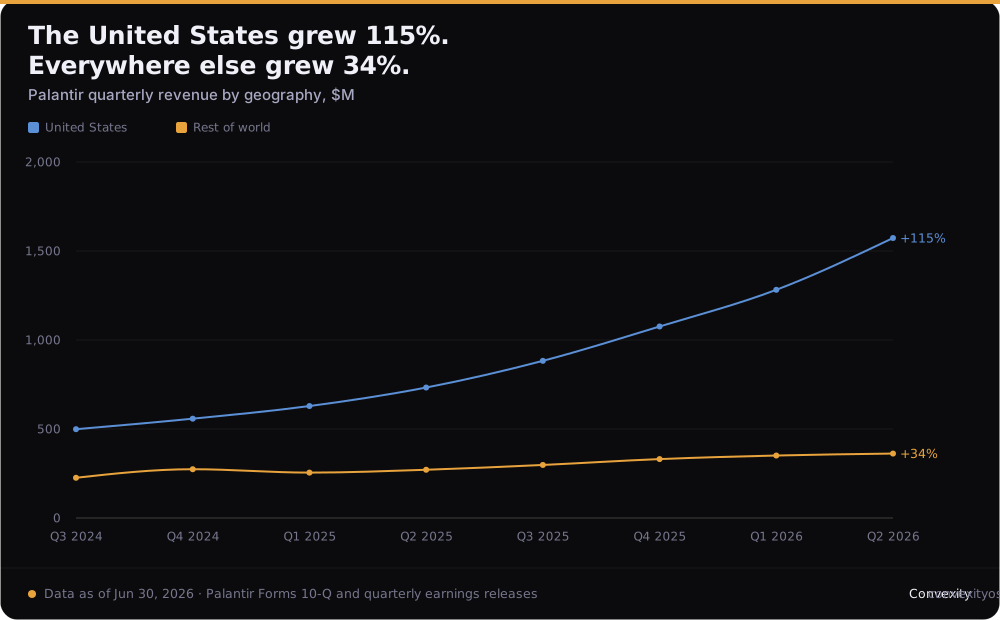
A company selling sovereignty is compounding at 115% in exactly one country, and at roughly a third of that rate in every other country on earth combined.
There are innocent explanations and they deserve air. European IT budgets are smaller and slower. Government procurement outside the United States runs on longer cycles. The dollar strengthened against the euro and sterling, which the 10-Q names as an adverse factor on non-US revenue. Palantir has deliberately concentrated its sales effort on the US commercial market, which is where the AIP boot-camp motion works best, and a company can only point its sales force at one thing at a time.
All true, and none of it explains a gap this wide. A 34% growth rate is not a slow market, it is a good market that somebody else is winning, or a market that has decided something.
The sharper version of the point is this. "Sovereign AI" means a government wanting its data, models, and decisions to stay inside its own jurisdiction and under its own control. Karp's own quote makes the pitch explicitly: customers want "maximal control over their operations, data, and decisions." If that is the product, then the vendor's nationality is not incidental to it. It is the product. And Palantir's nationality is not merely American, it is specifically and famously entangled with American defense, intelligence, and immigration enforcement. For a European ministry, buying sovereignty from Palantir is a difficult sentence to finish.
The metrics that stopped being reported
Two things went missing from the release, and both went missing in a way worth documenting.
The first is customer count. Palantir reported it every quarter for years. In Q3 2025: "Customer count grew 45% year-over-year and 7% quarter-over-quarter." In Q4 2025: "Customer count grew 34% year-over-year and 5% quarter-over-quarter." In Q1 2026, and again in Q2 2026, the line is simply absent.
I checked whether this was a formatting change rather than a removal. The word "customer" appears 17 to 18 times in each of those four releases, so the releases did not stop discussing customers; the specific metric was dropped, in consecutive quarters, immediately after it decelerated 11 points. A company that adds a record-setting metric to its release the quarter it looks good and removes one the quarter after it turns is telling you which direction it expects that number to go.
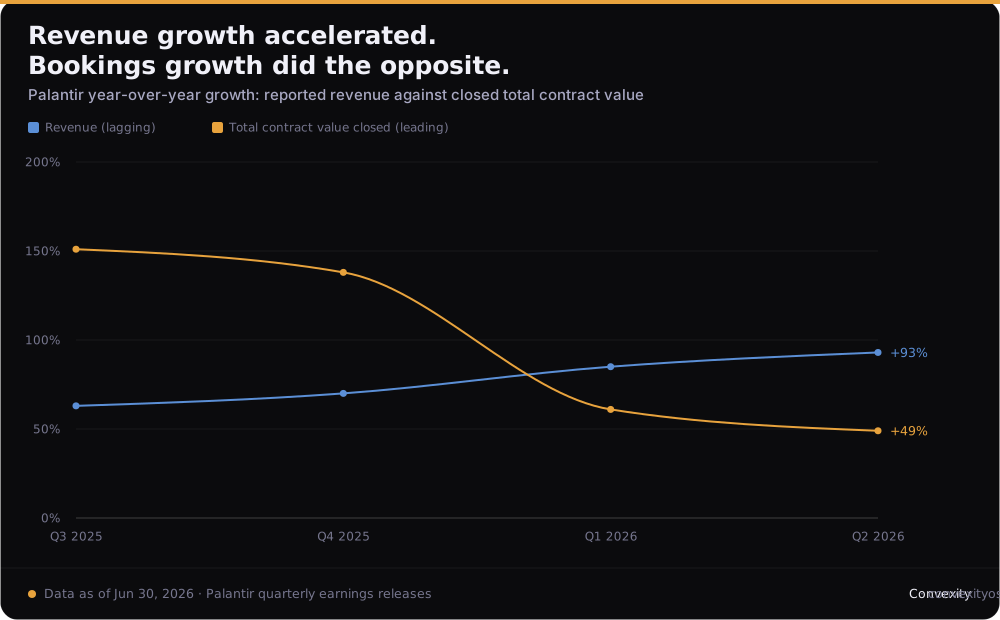
The second is subtler and more important. Compare the growth rate of revenue, which is a lagging indicator, against the growth rate of total contract value closed, which is a leading one.
| Quarter | Revenue Y/Y | TCV closed | TCV Y/Y |
|---|---|---|---|
| Q3 2025 | +63% | $2.760B | +151% |
| Q4 2025 | +70% | $4.262B | +138% |
| Q1 2026 | +85% | $2.410B | +61% |
| Q2 2026 | +93% | $3.373B | +49% |
Revenue growth accelerated from 63% to 93% across those four quarters. Bookings growth decelerated from 151% to 49% across the same four. Reported revenue in the first half of 2026 is substantially the recognition of contract value booked in the back half of 2025, when bookings were growing at triple digits. The bookings line turned two quarters ago.
Now separate the bookings into the part everyone talks about and the part nobody does. US commercial TCV was $2.132 billion, up 153%, which is genuinely spectacular. Subtract it from the $3.373 billion total and the remainder, meaning US government plus all international business, was $1.241 billion against roughly $1.42 billion a year earlier. That is a decline of about 13%.
That figure is derived from rounded percentages, so treat it as a range rather than a point: reworking it across the rounding band gives a decline between 12% and 13%. But the sign is not sensitive to rounding. Outside US commercial, Palantir booked less business this quarter than it did a year ago.
One company inside this ticker is compounding at 149% and booking at 153%. The other one is shrinking.
The contracts are the moat
This is where I want to depart from the usual framing, including the one I started with.
The standard sentence about this company is that it is a great business marred by ethical problems. I do not think "marred by" survives contact with the filings. The ethical exposure is not a blemish on the business. It is the mechanism of the business.
Palantir's federal contract obligations, from USASpending.gov, the government's own award database:
| Calendar year | Federal obligations |
|---|---|
| 2021 | $232M |
| 2022 | $375M |
| 2023 | $327M |
| 2024 | $610M |
| 2025 | $1,303M |
| 2026 (through Aug 4) | $988M |
The individual awards say more than the total does. The largest is a $442.9 million Department of Defense task order under the Chief Digital and Artificial Intelligence Office, begun in October 2025, following a $292.7 million order for the Maven Smart System interface the year before. Homeland Security has put $150.7 million into Investigative Case Management, the system ICE uses to build cases, and another $86.3 million into Enforcement and Removal Operations modernization, an order that began on May 5, 2026, inside the quarter being reported here. A further $45.8 million went to Homeland Security Investigations in June. Agriculture spent $94.7 million in April and $27.9 million more in June, some of it on work touching the Supplemental Nutrition Assistance Program.
Those contracts exist because Palantir will do the work, and that is the actual moat. It is worth being precise about why. The Ontology is genuinely good, but competitors can approximate it. The boot camps are a sales motion, and sales motions get copied within a year. What does not get copied is the position a company reaches after years of building removal-operations software for ICE, targeting software for the Pentagon, and benefits-data infrastructure for the Department of Agriculture: the accreditations, the clearances, the deployments inside classified environments, the institutional trust that comes from having been in the room for a decade. A competitor with a different risk appetite cannot buy any of that at any price. Every controversy is also a barrier to entry.
You cannot subtract the ethics and keep the margins. They are the same fact seen from two sides.
That sentence is doing a great deal of work on behalf of software that helps decide where enforcement teams go in the morning, and I would rather name that than slide past it. Treating this as a competitive-advantage question is a choice about what this particular piece is for. It is not a claim that it is the only question, or even the most important one. Plenty of people are making the moral argument, and some of them are making it better than I would.
What a filings piece can add is the narrower thing. Whether the cost shows up, where it shows up, and whether it is priced.
That cost is real and contested, and the contest is well documented. Representative Robert Menendez of New Jersey's Eighth District wrote to the New Jersey State Investment Council on February 17, 2026, urging it to reconsider the state pension fund's Palantir holding.
His letter describes Palantir's technology as supporting "ICE's enforcement capabilities." It cites the $30 million ImmigrationOS contract reported by Wired in April 2025, and the ELITE targeting platform reported by 404 Media in January 2026, which the letter says draws on Department of Health and Human Services data to map where people can be found. It also cites NBC News reporting that immigration enforcement officers had shot at least 13 people since September 2025, four of whom died. Two of them, Renee Good and Alex Pretti, were American citizens, killed in Minnesota.
Those are the congressman's characterizations and his sources, not findings of mine. Nothing in them establishes that any Palantir product caused any particular death, and I am not going to imply otherwise by setting the two facts side by side and leaving the reader to draw the line. I have set the letter out at this length for a narrower reason. It is the specific case the divestment campaign was built on, and that campaign turns out to be a clean test of whether this kind of pressure reaches a share price at all.
Palantir's own risk factors, restated at length in this 10-Q, concede more than its press release does:
Our relationships with government customers and customers that are engaged in certain sensitive industries, including organizations whose products or activities are or are perceived to be controversial, have resulted in public criticism ... Activists have also engaged, and may continue to engage, in public protests at our properties and other locations, including at the premises of our customers, partners, and third-party service providers. Such activity has, in certain instances, disrupted or threatened to disrupt operations and caused third parties to terminate or seek to limit their relationship with us.
Palantir Technologies, Form 10-Q for the quarter ended June 30, 2026
Note the tense. The filing does not say this could happen at some point; it says it has already happened. And then, two sentences later, the trap in the company's own words: "being perceived as yielding to activism targeted at certain customers could damage our relationships with certain customers, including governments and government agencies." Palantir cannot walk away from the controversial work without losing the business the controversial work built, and cannot keep it without paying somewhere else.
The most consequential sentence in the whole filing is the one that names the mechanism: customer decisions about "whether to award, renew, or expand contracts with us" may turn on the company's "actual or perceived customer relationships and company values," and may do so "regardless of the merits of our products or services."
That is Palantir telling you it expects to lose deals on identity rather than on product. Hold that next to a 34% international growth rate.
Divestment failed, and something else did not
The activist campaign aimed at the discount rate. It tried to make institutions sell. I wanted to know whether it worked, so I pulled the filings rather than the press releases.
New Jersey's Common Pension Fund D reports its holdings quarterly on Form 13F. Menendez's letter cites 777,067 shares worth "over $138,000,000" as of the fourth quarter of 2025. That figure is exactly right; the 13F says 777,067 shares and $138,123,659. Here is what the fund did afterward.
| Reporting period | Shares held | Reported value |
|---|---|---|
| Dec 31, 2025 | 777,067 | $138.1M |
| Mar 31, 2026 | 781,318 | $114.3M |
| Jun 30, 2026 | 704,071 | $82.1M |
After a months-long campaign, a January rally, union pressure, and a sitting congressman's letter, the fund bought 4,251 more shares in the first quarter and then sold 77,247 in the second. It trimmed the position by 9.9%. It did not divest. The timing was unkind on top of that: the selling happened in the quarter Palantir traded down to $106.37, a few weeks before the stock rose 27% in a single session.
Of the $56 million decline in that holding's value, roughly $47 million was the share price falling and roughly $9 million was selling. Divestment moved about one dollar in six, in the wrong direction, at the wrong time.
Meanwhile federal obligations to Palantir went from $232 million in 2021 to $1.3 billion in 2025, with Homeland Security alone rising from $20 million in 2023 to $162 million in the first seven months of 2026. The campaign to make the ethics expensive on the capital side coincided with the ethics becoming dramatically more lucrative on the revenue side.
So the ethical cost is not showing up as a higher discount rate. Institutions did not leave. It is showing up, if my reading is right, in the only place Palantir concedes it could: the award, renewal, and expansion decisions of customers who are not the United States government. One line item, growing at 34%, in a company growing at 93%.
I want to be careful about how strongly I claim this, because it is an inference and not a disclosure. Palantir does not break out lost deals or name a reason for international softness, and the innocent explanations in the previous section are genuinely available. What I can say with confidence: the company states this mechanism exists, states it has already cost relationships, and reports an international growth rate about one third of its domestic one while pitching sovereignty as the product. Those three facts belong in the same paragraph, and I have not seen anyone put them there.
What 52 times revenue requires
At $159.44, with 2,403.1 million shares outstanding as of the 10-Q cover date, Palantir's market capitalization is about $383 billion. On the 2,568.7 million diluted shares used to compute EPS, which is the number an owner should use, it is about $410 billion. Take out $9.4 billion of net cash and enterprise value is roughly $400 billion.
The cleanest way to see what has happened is to compare the same two ratios at the peak and today, using trailing-quarter revenue annualized so that neither number depends on a forecast.
| Nov 3, 2025 | Aug 4, 2026 | Change | |
|---|---|---|---|
| Share price | $207.52 | $159.44 | -23% |
| Revenue run rate | $4.72B | $7.74B | +64% |
| Enterprise value | ~$527B | ~$400B | -24% |
| EV / revenue run rate | ~112x | ~52x | -54% |
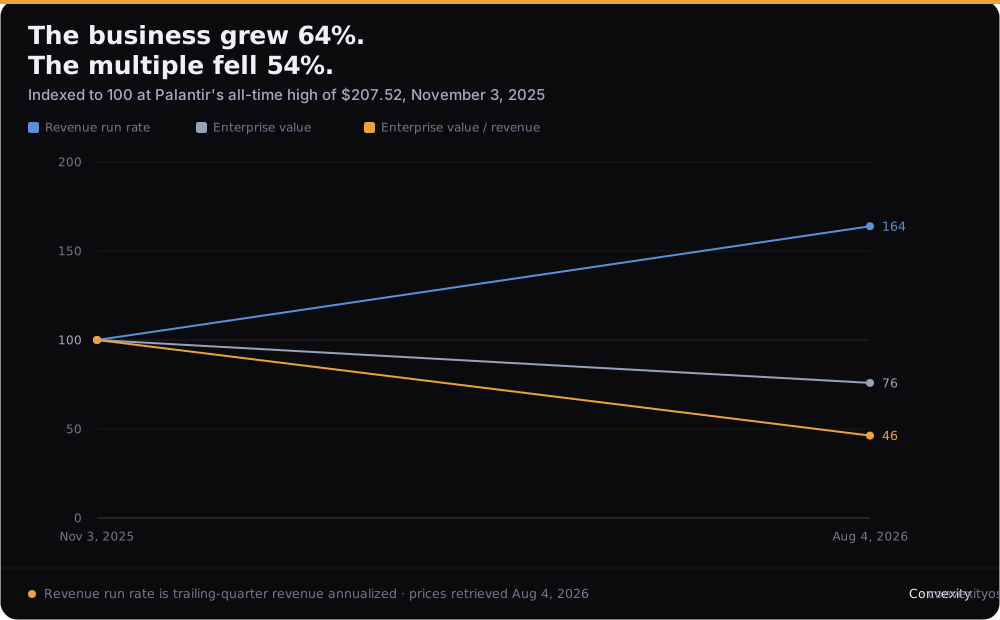
This is the part of your prior I would push back on. The valuation error was real, and it has already been half-corrected, not by the price falling to something sensible but by the business growing into a price that was not. Between November 2025 and June 2026 the stock fell 49% while revenue grew about 70%. Anyone who bought the top and held has lost 23% while owning a company that got 64% bigger. That is what a multiple doing all the work looks like in both directions.
So the live question is no longer "is 52 times revenue too much," which is unanswerable in the abstract. It is what 52 times requires.
Work it backwards. Suppose you want 10% a year for five years from today's $400 billion enterprise value. That requires roughly $645 billion in 2031. Suppose by then Palantir trades at 30 times free cash flow, a premium multiple for a mature software business and well above where Microsoft, Oracle, and Salesforce trade on earnings today. That implies $21.5 billion of free cash flow in 2031. Hold the current 56% adjusted free cash flow margin, which no software company has sustained at that scale, and you need about $38 billion of revenue.
Getting from this year's guided $8.15 billion to $38 billion in five years is a 36% compound annual growth rate, every year, for five years, with margins intact.
Run it the other way and the picture is symmetric rather than damning. If Palantir compounds at 45% for five years and holds its margin, revenue is about $52 billion, free cash flow near $29 billion, and at 30 times that is an $879 billion enterprise value, or about 17% a year from here. At 25% to 30% compounding, the same math returns roughly nothing over five years even with the premium multiple intact.
That is the actual bet, stated plainly: Palantir has to grow in the low-to-mid forties for half a decade. Not 93%, which nobody needs. But nothing close to the 20s either, and the 20s is where enterprise software growth rates historically go to rest.
For context on what the market is paying, here is the peer set as of today: Salesforce at 21 times earnings, Oracle at 22, Microsoft at 26, Nvidia at 32, ServiceNow at 69. Palantir at roughly 136 on trailing GAAP earnings, or nearer 170 if you tax those earnings at the company's own stated long-term rate.
Which brings the two halves of this piece together. The 45% path runs through international. US commercial cannot carry $38 billion of revenue by itself, and US government revenue is a function of appropriations that are large but not unbounded. The growth rate the price requires is the growth rate that is currently running at 34%.
The moat and the ceiling are the same thing. What makes Palantir uncatchable inside the United States is what makes it a hard purchase outside it, and the price now assumes it wins both.
What would prove this wrong
I would rather name the falsifiers than have you find them.
International reaccelerates. This is the whole argument, so it is also the whole falsification. If rest-of-world revenue turns up to 50% or better over the next two or three quarters, particularly in European government, then the gap was a sales-focus artifact and I have overread it. Watch the geography note in each 10-Q rather than the press release, which does not break it out.
The non-US-commercial bookings decline reverses. My 13% figure is derived from rounded percentages in a single quarter, and a single quarter is not a trend. If total TCV growth reaccelerates while US commercial stays hot, the leading indicator I am leaning on was noise.
Customer count comes back. If Palantir restores the metric and it is healthy, the removal was housekeeping and I read intent into a formatting decision. That would be a fair hit.
Tax stays low for longer than I assume. The accumulated deficit is large. If the effective rate stays in single digits for several more years, the earnings discount I applied is too aggressive and the trailing multiple is less misleading than I have made it sound.
Growth simply continues. The most likely way to be wrong here is the least interesting: a company doing 93% may do 60% next year and 45% the year after, at which point the price was right and the ceiling was somewhere I could not see. Every ceiling argument about a compounding business has this failure mode, and most of them have been wrong.
The thing I am most confident about is the smallest: the dilution argument is finished, and anyone still making it has not opened the filings. The thing I am least confident about is the one the piece is named for.
Primary sources
- 10-QQuarterly report for the quarter ended June 30, 2026Geographic revenue split, tax provision, risk factors, share countsAug 4, 2026
- 8-KQ2 2026 earnings release, Exhibit 99.1Headline figures, TCV, guidance, non-GAAP reconciliationsAug 3, 2026
- 8-KQ1 2026 earnings releaseFirst quarter with customer count absentMay 4, 2026
- 8-KQ4 and full-year 2025 earnings releaseCustomer count +34%, the last time it was reportedFeb 2, 2026
- 8-KQ3 2025 earnings releaseCustomer count +45%; TCV +151%Nov 3, 2025
- 13F-HRState of New Jersey Common Pension Fund D, holdings at June 30, 2026704,071 shares after the divestment campaignAug 4, 2026
- 13F-HRState of New Jersey Common Pension Fund D, holdings at December 31, 2025The 777,067 shares cited in the congressional letterJan 30, 2026
- LetterRep. Robert Menendez to the New Jersey State Investment CouncilThe divestment request and its cited sourcesFeb 17, 2026
- DataUSAspending.gov federal award records for PalantirObligations by agency and individual task ordersRetrieved Aug 4, 2026
- XBRLPalantir diluted weighted-average share count, all periodsThe five-year dilution seriesRetrieved Aug 4, 2026
Disclosure, again. I bought and sold PLTR around this earnings report for a gain of just under 20%, and hold no position at publication. I may buy or sell it again. Not investment advice, and nothing here is a recommendation to buy, sell or short any security. Figures come from Palantir's SEC filings, its quarterly earnings releases, USAspending.gov, and Form 13F filings by the State of New Jersey Common Pension Fund D, as cited. The following are arithmetic on filed figures rather than disclosures, and are labeled where they appear: international revenue for quarters other than Q2 2025 and Q2 2026, the non-US-commercial TCV decline, the fully taxed earnings figures, all enterprise values and multiples, and the five-year growth requirements. Share prices and peer multiples were retrieved on 2026-08-04 and are stale the moment you read this. The claims attributed to Rep. Menendez are his and his cited sources', not findings of mine, and I make no claim that any Palantir product caused any death or injury. I have no relationship with Palantir or any party named here.