









Chart title, September 13, 2026. The revenue chart below was titled "The non-AI half of it did not move." Everything other than AI revenue grew from $10.8 billion to $11.4 billion across those quarters, about 5%, as the chart's own caption said, so the title now reads "barely moved." The chart also now shows that the quarter ended November 2, 2025 is not in the series. No figure changed.
Disclosure. Convexity builds research tools for public-market data. This note is analysis, not investment advice, and nothing in it is a recommendation to buy, sell, or short any security. We hold no position in Broadcom, in any company named below, and no relationship with any of them. Financial figures come from the earnings release furnished with Broadcom's Form 8-K on June 3, 2026, from its Form 10-K for the fiscal year ended November 2, 2025, and from the quarterly data it files with the SEC. Statements attributed to management come from the transcript of the fiscal second quarter earnings call held the same day; we have cross-checked every figure in that transcript that also appears in the filed release, and all of them agree. Where a number is our arithmetic rather than a reported figure, we say so at the point of use. Broadcom reports its fiscal third quarter after the close on September 2, 2026, and nothing here anticipates that result.
Broadcom's second quarter was extraordinary and the guidance is more extraordinary still. Revenue of $22,187 million, up 48%. AI semiconductor revenue of $10.8 billion, up 143%. Free cash flow of $10,262 million, 46% of revenue. On the earnings call the company put numbers on what is coming: AI semiconductor revenue of about $56 billion for fiscal 2026, up roughly 180%, and in excess of $100 billion for fiscal 2027.
And the order book is running far ahead of shipments. "During the quarter, bookings for AI semiconductors were over $30 billion against the $10.8 billion we shipped," Hock Tan told analysts. Visibility, he said, "runs all the way to 2028 right now. Just three months ago, I can tell you visibility ran pretty much to 2027."
Later on the same call, he explained part of how those orders get paid for.
To deliver this vision, we are creating the AI XPU platform with Apollo and Blackstone and other leading investors to deploy more than 20 gigawatts of compute capacity through 2028. The first tranche of this platform, valued at $35 billion, is in fact currently being launched by Apollo.
Asked about it again later, he was more direct about the purpose:
What we are doing to enable some of these LLM players to be able to get access to the volume of compute capacity ... is we are, as I announced here today, creating, in partnership with guys with the best balance sheets around, a vehicle to basically have these chips funded for these LLM players, who otherwise might have difficulty getting access to our technology.
That is a supplier organizing third-party capital so that named customers can buy its product. It is disclosed, it is deliberate, and it is the most important thing said on the call.
Second quarter of fiscal 2026, ended May 3, 2026. Revenue and cash figures are from the earnings release; the bookings, vehicle and forward guidance figures are statements made by management on the earnings call held the same day.
What the vehicle is, and what it is not
Take the strongest reading first, because it is a reasonable one. Frontier model developers need compute at a scale that outruns their balance sheets. Broadcom builds the cheapest compute per watt for their workloads. Bringing in infrastructure capital to bridge that gap is how large capital equipment has been financed for a century, from aircraft to shipping to power plants, and Apollo and Blackstone are exactly the institutions that do it. Nothing about the structure is exotic or hidden.
What makes it worth writing about is what it implies about the demand it serves.
A booking from a customer who can pay for the equipment tells you the customer wants it. A booking from a customer who needs a financing vehicle assembled on their behalf tells you the customer wants it and that someone else has underwritten their ability to take delivery. Those are different facts, and only the first is what a backlog normally means.
Hock Tan also drew a distinction that matters here, correcting an analyst who described the Anthropic arrangement as being backstopped by Broadcom chips:
The deal we did with Anthropic is we use our TPU chips that we develop to provide the compute capacity to Anthropic. It was not backstopped in that sense. We were the ones providing the chips to Anthropic. We were the ones providing the compute capacity to Anthropic.
Read that carefully. Broadcom is not only selling silicon to Anthropic; on this description it is providing compute capacity. A company that sells chips has a receivable. A company that provides capacity has an asset, a utilization risk and a counterparty for the life of the arrangement. Those are different businesses with different balance sheets, and the company's own financial model is still presented as the former. Asked directly whether the model was moving to racks, Hock was emphatic: "No racks. It is all a chip business only. We only chips. Only chips."
Both things are being said. The reconciliation between them is not in the filings.
Who needs the vehicle
The call put per-customer detail on the six core accelerator customers that no filing contains. As stated by management:
| Customer | Commitment described on the call |
|---|---|
| April long-term agreement, multiple generations of TPUs and AI networking | |
| Anthropic | over 1GW of TPU-based compute in 2026; April agreement for a further 5GW from 2027 |
| OpenAI | silicon delivered, production late 2026, contractual commitment of 1.3GW in 2027 inside the 10GW 2029 agreement |
| Meta | April partnership, 3GW through end of 2028; initial 1GW order delivering from H2 2027 |
| Two others | shipments beginning late 2026; purchase orders totaling $6 billion to date |
Management said it plans to ship about 10 gigawatts in 2027, back-half weighted.
Now note which customers the financing vehicle is for. Hock named them: the platform exists to deliver capacity "for the leading AI frontier labs, including Anthropic and OpenAI." Google and Meta are not in that sentence, and they do not need to be. They fund capital equipment from operating cash flow. Anthropic and OpenAI do not, and neither files public financial statements. We wrote about that in The AI revenue war's biggest numbers are not revenue: every revenue figure attached to either company is a press report rather than an audited disclosure.
So the two customers with the largest forward gigawatt commitments are the two whose ability to pay required a $35 billion vehicle to be assembled. That is not a criticism of the strategy. It is the strategy, stated plainly by the CEO, and it is the single most useful fact for judging what the $30 billion of quarterly bookings is worth.
The bookings are running at nearly three times shipments
The order book deserves its own arithmetic, because it is the number the financing vehicle exists to support.
| Q2 FY2026 | Bookings | Shipped | Ratio (derived) |
|---|---|---|---|
| AI semiconductors | over $30B | $10.8B | over 2.8x |
| Non-AI semiconductors | over $6B | $4.2B | about 1.4x |
Our arithmetic on the figures management stated: AI booked at nearly three times what it shipped, and even the depressed non-AI business booked at roughly 1.4 times. A book-to-bill approaching 3 is not a normal semiconductor quarter. It is customers reserving capacity years ahead.
Hock was explicit about why, and the reason is not only silicon:
A lot of our large, these six customers, now they realize that lead time to get compute. You need lead time ... And there is not just asking for wafers, to get the chips or memory, to ensure that HBMs are available or DRAM is available. They are also talking about, hey, I have got to have the power.
That is worth connecting to the rest of the buildout. The constraint customers are ordering around is not Broadcom's fab allocation; it is memory availability and electricity. Both are things Broadcom does not control and neither appears in its guidance. It also means a booking placed for 2028 delivery is a claim on a supply chain whose other components are being rationed at the same time.
The gigawatt arithmetic nobody reconciled
There is a tension in the guidance that an analyst raised near the end of the call and that did not get resolved.
Broadcom has previously discussed content of roughly $15 billion to $20 billion per gigawatt of compute, a figure the analyst cited back to the company and management did not dispute. Management also said it plans to ship about 10 gigawatts in 2027.
Our arithmetic on those two statements: ten gigawatts at $15 to $20 billion per gigawatt implies something in the range of $150 billion to $200 billion of 2027 revenue. The company guides fiscal 2027 AI semiconductor revenue to be "in excess of $100 billion."
The analyst put the gap directly. Hock's answer addressed content per gigawatt over time rather than the discrepancy:
Our content per gigawatt will increase, put simply ... the trajectory of content increase will go on. It just does not go up every month, every six months, or every quarter. But it will follow one generation to the next.
There are at least three ordinary explanations. Gigawatts deployed in a year are not the same as gigawatts recognised as revenue in that year, and the 2027 shipments are explicitly back-half weighted. The $15 to $20 billion figure may cover more content than Broadcom itself supplies. And "in excess of $100 billion" is a floor rather than a forecast, which management repeated more than once.
Any of those resolves it. What is worth noting is that the reconciliation was asked for and not given, and that the difference between $100 billion and $200 billion of 2027 revenue is larger than most companies' entire revenue base. When a company guides a range that wide by implication, the guide is doing less work than its precision suggests.
How this company was assembled
The financing vehicle is a new move, but the instinct behind it is not. Broadcom was built by acquisition, and the pattern is consistent enough to be predictive.
Run out of what was Avago under Hock Tan: LSI in 2014 for about $6.6 billion, Broadcom Corporation in 2016 for about $37 billion, which is where the name came from, Brocade in 2017 for about $5.9 billion, CA Technologies in 2018 for about $18.9 billion, Symantec's enterprise security business in 2019 for about $10.7 billion, and VMware in 2023 for about $69 billion including assumed debt.
The move in the software deals is openly stated: buy an incumbent with a deeply embedded enterprise base, cut the cost structure hard, concentrate on the largest customers, raise prices, and harvest the cash. It works because the customers find it expensive and slow to leave.
The revenue line shows what that produced.
| Fiscal year | Net revenue | Cash from operations | Long-term debt |
|---|---|---|---|
| 2020 | $23.9B | $12.1B | |
| 2021 | $27.4B | $13.8B | $41.2B |
| 2022 | $33.2B | $16.7B | $41.0B |
| 2023 | $35.8B | $18.1B | |
| 2024 | $51.6B | $20.0B | |
| 2025 | $63.9B | $27.5B | $62.0B |
From fiscal 2020 to fiscal 2023, before VMware closed and before AI was material, Broadcom compounded revenue at about 14% a year. That is a good result for infrastructure semiconductors and nowhere near what the company is priced at today. The two step-changes since are identifiable: fiscal 2024 jumped 44% as VMware entered the accounts, and fiscal 2025 added 24% as accelerators scaled. The most recent quarter annualizes to roughly $89 billion.
The debt column carries the other half. Long-term debt sat around $41 billion through fiscal 2021 and 2022 and was $62.0 billion at the end of fiscal 2025, so the VMware acquisition added something over $20 billion that is still outstanding. Against $27.5 billion of annual operating cash flow that is comfortably serviceable, and nobody should read it as a solvency point. It is a strategy point: the playbook runs on borrowed money deployed into mature assets, and it works as long as the acquired base can be repriced faster than it churns.
Seen against that history, the Apollo platform is recognisably the same instinct pointed somewhere new. Broadcom has always been willing to use other people's balancesheets to convert a technology position into cash. What is different is that the balance sheet is now being used on the demand side rather than the supply side.
What the non-AI half actually sells
Roughly $4.2 billion of the quarter, by our arithmetic, is non-AI semiconductors, and it grew about 6%.
What sits in it is the accumulated Avago and Broadcom Corporation portfolio: broadband access silicon for set-top boxes and cable and fibre gateways, wireless connectivity and radio-frequency components for smartphones, storage connectivity from the LSI and Brocade lines, and Ethernet switching and physical-layer parts. Several of those markets have been in a genuine trough, broadband especially, through a long carrier capex pause. Management now describes bookings above $6 billion against $4.2 billion shipped as "a clear indication we are on the path towards a full cyclical recovery."
The wireless piece carries the largest single-customer risk in the company's history. Apple accounted for roughly 20% of Broadcom's net revenue in fiscal 2021 and 2022. Bloomberg reported in January 2023 that Apple intended to replace the Broadcom combination chip handling Wi-Fi and Bluetooth with an in-house design, and Apple shipped its own N1 wireless chip in the iPhone 17 line in September 2025. The relationship did not end: Apple announced a separate multiyear, multibillion-dollar agreement for Broadcom to keep supplying 5G radio-frequency components including filters, made in the United States (press reporting, retrieved 2026-08-30).
That is the shape of the risk outside AI. Not that the business is bad, but that its largest historical customer has both the intent and the capability to design Broadcom content out, has already done it once, and the remaining relationship is narrower than the one it replaced.
What this does to the backlog
Broadcom's disclosed customer concentration is already unusual, and it comes from the audited Form 10-K rather than any call.
| Disclosure, fiscal 2025 | Share of net revenue |
|---|---|
| Sales to distributors | 48% |
| Top five end customers, through all channels | approximately 40% |
| One semiconductor solutions customer, which is a distributor | 32% |
A single customer, which Broadcom identifies as a distributor rather than an end user, was 32% of net revenue in fiscal 2025, up from 28%. That is close to a third of the company running through one intermediary, which stands between Broadcom and whoever is actually consuming the parts.
Layer the vehicle on top and the picture is this: a company with a third of revenue through one distributor, six end customers driving all of its growth, two of those funded by a purpose-built capital structure, and an order book stretching to 2028. Every one of those is disclosed. Together they describe revenue whose durability depends on conditions outside the income statement to an unusual degree.
The two halves, and a correction
An earlier version of this note argued something narrower and got part of it wrong, so it is worth showing the work.
Start with what the company actually reported, because the segment table is where this begins.
| Segment | Q2 FY26 | Share | Q2 FY25 | Share | Change |
|---|---|---|---|---|---|
| Semiconductor solutions | $15,009M | 68% | $8,408M | 56% | +79% |
| Infrastructure software | $7,178M | 32% | $6,596M | 44% | +9% |
| Total net revenue | $22,187M | 100% | $15,004M | 100% | +48% |
Note what is not in that table. AI revenue is not a segment line and never appears in the financial statements; it is stated once a quarter in the CEO's quoted commentary, unaudited, management-defined and reconciled to nothing. It is also the single most-quoted number the company produces.
For the most recent quarter the split can be derived carefully, because Broadcom stated the year-ago AI figure in its own release at the time. In June 2025 Hock Tan said "Q2 AI revenue grew 46% year-over-year to over $4.4 billion." A year later he said AI revenue "of $10.8 billion grew 143% year-over-year." Those are consistent: $10.8 billion divided by 2.43 is $4.44 billion. So the prior-year base is reported rather than inferred from a rounded growth rate.
| Line | Q2 FY26 | Q2 FY25 | Change |
|---|---|---|---|
| AI semiconductor revenue (company) | $10,800M | over $4,400M | +143% |
| Non-AI semiconductor revenue (derived) | ~$4,209M | ~$4,008M | ~+5% |
| Infrastructure software (company) | $7,178M | $6,596M | +9% |
| Total excluding AI (derived) | ~$11,387M | ~$10,604M | ~+7% |
The AI line itself has been accelerating for five quarters, which is unusual at this scale.
| Quarter | AI semiconductor revenue | Year-over-year |
|---|---|---|
| Q1 FY2025 | $4.1B | +77% |
| Q2 FY2025 | over $4.4B | +46% |
| Q3 FY2025 | $5.2B | +63% |
| Q1 FY2026 | $8.4B | +106% |
| Q2 FY2026 | $10.8B | +143% |
| Q3 FY2026 (guided) | $16.0B | over +200% |
For scale: Broadcom told investors in September 2024 that it expected about $12 billion of AI revenue for the whole of fiscal 2024, and reported $12.2 billion. The single quarter ended May 3, 2026 did $10.8 billion, which is 89% of that entire year. The full-year fiscal 2026 figure management now guides, about $56 billion, is more than four times fiscal 2024.
Across the five reported quarters through May 2026, the non-AI part of Broadcom was remarkably static while the company grew by half. The revenue column is filed; the AI column is the figure stated in each release; the last is ours.
| Quarter ended | Total revenue | AI revenue | AI share | Everything else |
|---|---|---|---|---|
| Feb 2, 2025 | $14,916M | $4.1B | 27.5% | ~$10,816M |
| May 4, 2025 | $15,004M | over $4.4B | 29.3% | ~$10,604M |
| Aug 3, 2025 | $15,952M | $5.2B | 32.6% | ~$10,752M |
| Feb 1, 2026 | $19,311M | $8.4B | 43.5% | ~$10,911M |
| May 3, 2026 | $22,187M | $10.8B | 48.7% | ~$11,387M |
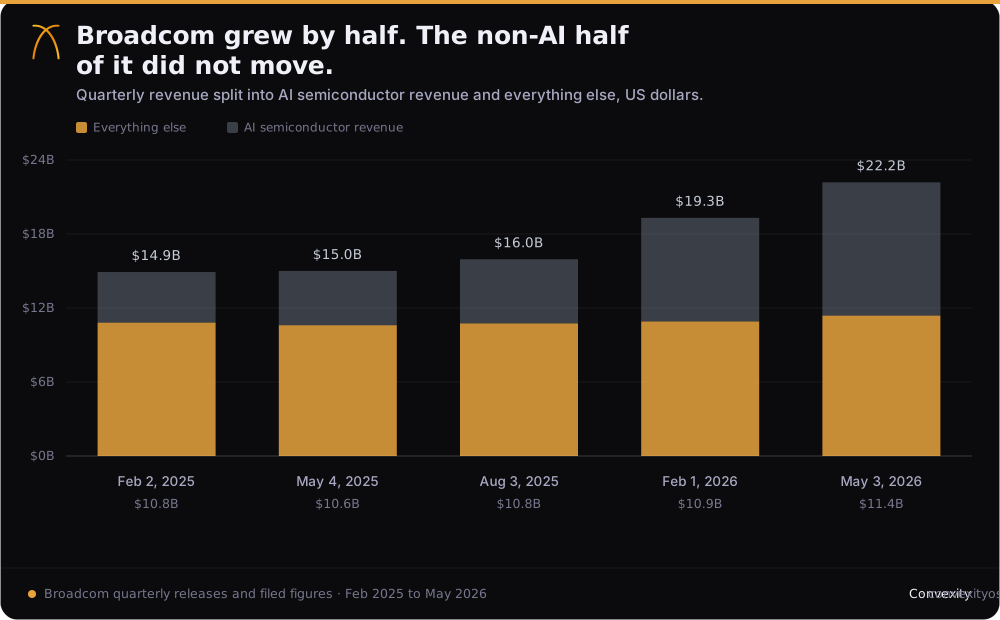
We read that plateau as a business whose growth had finished: infrastructure software at 9% looked like the tail of the forced VMware repricing rather than demand, and we said so.
The company's own guidance says otherwise, and we were wrong to lean on it. On the call Broadcom guided fiscal third quarter infrastructure software revenue to approximately $8.9 billion, up 31% year over year, and non-AI semiconductor revenue to approximately $4.5 billion, up 12%. Software ARR was already growing 17% against reported revenue growth of 9%, which is the leading indicator moving well before the revenue line. Hock attributed the acceleration to high CPU core counts shipping alongside GPUs and to the VMware Cloud Foundation 9.1 release, and said he expects it to continue "for the next multiple quarters."
That also dissolves a puzzle the earlier note raised. We derived that the third quarter guide implied the non-AI half growing 17.7% sequentially and offered three speculations about why, noting the release did not say. The release does not. The call does: $8.9 billion of software plus $4.5 billion of non-AI semiconductors is $13.4 billion, which is exactly the figure we had derived. The arithmetic was right and the interpretation was not.
It is worth being precise about what did happen to VMware, because the repricing was real even though our reading of its consequences was not.
Broadcom discontinued VMware perpetual licences and moved the base to subscription. It consolidated a catalogue reported at around 168 products into a handful of bundles, principally VMware Cloud Foundation and vSphere Foundation, and discontinued the small-business Essentials Plus kit. Trade and advisory coverage describes resulting price increases up to roughly 800%, with some regional cases reported far higher, and one advisory survey describes more than 70% of enterprises actively evaluating alternatives (CIO, Avasant, both retrieved 2026-08-30). None of that comes from Broadcom and we have verified no individual customer's price change.
Our error was inferring from those reports that 9% must be the tail of a finished conversion. A repricing and a demand cycle can run at the same time, and on the company's account they are: high CPU core counts shipping alongside GPU deployments are pulling VMware licences with them, and VCF 9.1 adds heterogeneous compute support across AMD, Intel and Nvidia platforms specifically to serve that. If that is right, the enterprise AI buildout is a tailwind to the software segment rather than a distraction from it, which is close to the opposite of what we argued.
The honest summary is that the five-quarter plateau was a trough, not a plateau, and the falsifier we named has fired on the company's own numbers before the quarter was even reported.
What survives is narrower and still worth holding: Broadcom's growth is overwhelmingly one product line sold to six customers, the non-AI recovery is a cyclical bookings story management describes as "the path towards a full cyclical recovery," and neither of those is the same thing as a diversified compounder.
Why the split matters at all
A blended growth rate is a fine summary when the parts are similar. When one part is compounding at 143% and the other at single digits, the blend describes nothing that exists, and three consequences follow.
Durability is a function of six relationships. All of the growth is one product line sold to six customers, two of whom required a financing vehicle. Whatever the demand signal, that is a narrow base, and the audited concentration disclosure is where its size is visible rather than in any press account of the customer list.
The multiple prices the blend. A company valued as a growth compounder is being valued on a rate produced overwhelmingly by one line. If the non-AI recovery is cyclical, as management describes it, then it is exactly that: cyclical, and cycles turn.
The margin structure differs by half. The segments disclosed on the call carry 70% and 93% gross margins respectively, and the company itself asked investors to stop averaging them. A blended figure is now actively misleading in both directions.
The margins the company wants modelled separately
One more thing from the call that the release does not contain, and that changes how the blended margin should be read. The segments were disclosed individually:
| Segment, Q2 FY26 | Gross margin | Operating margin |
|---|---|---|
| Semiconductor solutions | approximately 70% | 62%, up 460bps |
| Infrastructure software | 93% | approximately 79%, up 310bps |
Consolidated non-GAAP gross margin was 77.1%, down about 230 basis points, and the company guided it down to roughly 74% in the third quarter. The CFO was explicit that this is mix rather than deterioration, and went further: "We highly recommend that investors model semiconductor and infrastructure software margins separately to properly reflect the impact of changes in total revenue mix going forward."
That is unusually direct guidance about how to read the financials, and it supports the two-halves framing even as the growth-rate version of it weakens. A 93% gross margin software business and a 70% gross margin semiconductor business genuinely should not be averaged.
Within semiconductors there is a further split the company acknowledged: accelerators carry lower margins than networking, and networking was "almost 40%" of second quarter AI revenue, a share Hock expects to settle nearer 30%. So AI segment margin will move with the accelerator and networking mix for reasons unrelated to pricing power.
Where the demand actually originates
One exchange late in the call is worth surfacing, because it describes the demand chain more plainly than any slide.
An analyst asked whether enterprise adoption would open XPU access to a much wider set of buyers. Hock said no, and explained why:
Most of the demand, at the end of the day, in terms of compute capacity, which is what we are doing, comes from those few large frontier model developers and the products they generate to supply to consumers and enterprises globally ... It is not really coming from 100,000 companies directly trying to buy XPUs or, for that matter, GPUs. It is not.
He is describing a funnel with a very narrow neck. Enterprises consume AI by buying tokens from a handful of API platforms. Those platforms buy compute. Broadcom sells to the platforms. So enterprise AI demand, however broad it becomes, reaches Broadcom through the same six customers rather than diversifying its base.
That is a coherent and probably correct description of the market. It is also the reason concentration is not a transitional condition here. On management's own account there is no long tail arriving later, because the architecture of the industry routes demand through the frontier labs. The customer count does not broaden as the market grows; it is the market.
Which brings the argument back to where it started. If demand reaches Broadcom through six counterparties, and two of those counterparties needed a $35 billion vehicle assembled so they could take delivery, then the financing structure is not a footnote to the demand story. It is part of the demand story.
What would prove this wrong
The strongest counterargument is that none of this is hidden. Broadcom announced the vehicle on an earnings call, named the investors, sized the first tranche and said what it is for. A company concealing weak demand does not describe the financing structure behind it in prepared remarks.
The specific ways the argument fails:
- The vehicle is ordinary infrastructure finance. Apollo and Blackstone underwrite power plants and aircraft on similar terms. If the capacity is contracted and the assets are real, this is asset finance rather than vendor financing, and the distinction matters. The test is whether Broadcom carries residual exposure, which is not yet disclosed.
- The frontier labs keep raising. The concern is about the shape of the funding, not any observed failure to pay. If Anthropic and OpenAI continue to raise capital and take delivery, this stays hypothetical indefinitely.
- The non-AI half really has inflected. It is guided up 12% with bookings above $6 billion against $4.2 billion shipped. If that holds for two quarters, the cyclical recovery is real and the residual two-halves concern goes away with it.
- Software growth is demand, not conversion. ARR at 17% and a 31% guided quarter are hard to explain as repricing alone. If VMware genuinely grows on GPU-adjacent core counts, the harvest reading was simply wrong.
- Concentration is structural to the industry. A 32% distributor and 40% top-five are normal in semiconductors and have been for years without incident.
- The vehicle never needed to exist. Apollo's first tranche is described as launching, not closed. If the frontier labs raise enough conventionally that the platform is undersubscribed or quietly shelved, the financing framing was reading too much into a contingency plan.
- We are wrong about what a booking means here. Book-to-bill near 3 could equally be read as customers competing for scarce capacity, which is a sign of demand strength rather than of demand that needs underwriting. Both readings fit the same number, and only time separates them.
One last note on method, because it applies beyond this company. Every substantive revision in this piece came from the earnings call rather than the earnings release. The release gave a consolidated revenue guide and three margin percentages. The call gave the segment split behind that guide, the bookings, the per-customer gigawatt commitments, the segment margins, the ARR growth rate and the entire existence of the financing platform. None of that is in the 8-K, and a reader working only from the filing would reach the conclusions our first draft reached. The lesson is not that the release is misleading. It is that a release is a summary, and the questions worth asking about a company are usually one level below the summary.
The fiscal third quarter is reported after the close on September 2, 2026. The lines worth finding first are the infrastructure software number against the $8.9 billion guided, non-AI semiconductors against $4.5 billion, and anything the company says about the Apollo platform's first tranche, its terms, and whether Broadcom retains any exposure to it. That last one is not in any model we have seen.
Primary sources
- 8-KBroadcom Q2 fiscal 2026 earnings release, Exhibit 99.1The segment table, gross margin reconciliation, cash flow and the Q3 outlook sectionJun 3, 2026
- CallBroadcom Q2 fiscal 2026 earnings call transcriptEvery management statement quoted here: the $30 billion of AI bookings, the Apollo and Blackstone platform and its $35 billion first tranche, the per-customer gigawatt commitments, the Q3 segment guidance, the segment margins, and the ARR growth figure. Held June 3, 2026, the same day as the release. Every figure in it that also appears in the filed release agrees with the releaseJun 3, 2026
- 10-KBroadcom annual report for the fiscal year ended November 2, 2025The audited concentration disclosures: 48% of net revenue through distributors, top five end customers approximately 40%, and one distributor customer at 32% against 28% the prior yearDec 18, 2025
- 8-KBroadcom Q1 fiscal 2026 earnings release, Exhibit 99.1The $8.4 billion AI figure and the quarter ended February 1, 2026Mar 4, 2026
- XBRLBroadcom quarterly revenue as filed with the SECThe five-quarter revenue series, from the company facts API rather than retyped from releases
- PressOpenAI and Broadcom announce a collaboration to deploy 10 gigawatts of OpenAI-designed acceleratorsThe joint announcement the 1.3 gigawatt 2027 commitment sits insideOct 13, 2025
- ResearchThe hidden risk in AI circular financingContext on vendor-adjacent financing arrangements across the sector. Retrieved 2026-08-30
- ConvexityThe AI revenue war's biggest numbers are not revenueOur note on why the revenue figures attached to OpenAI and Anthropic are press reports rather than disclosuresAug 27, 2026
Disclosure, again. Convexity builds research tools for public-market data. This note is analysis, not investment advice, and nothing in it is a recommendation to buy, sell, or short any security. We hold no position in Broadcom, OpenAI, Anthropic, Apollo, Blackstone or any other company named here, and no relationship with any of them. Financial statement figures are from the filings cited above. Management statements are quoted from the fiscal second quarter earnings call transcript; that transcript contains evident transcription errors elsewhere in its text, so we have quoted only unambiguous passages and have verified every figure in it that also appears in the filed release. The following are ours, derived by arithmetic and not reported by Broadcom: every "everything else" and non-AI figure in the five-quarter table, the AI share percentages, and the implied non-AI remainder inside the third quarter guide. Broadcom does not report AI revenue as a segment and states it only in narrative commentary. This note corrects an earlier version which argued that infrastructure software growth of 9% represented a repricing that had finished; the company has guided that segment to 31% growth in the following quarter and disclosed 17% ARR growth, and the correction is described in the text rather than made silently. We do not know the terms of the Apollo platform, whether Broadcom retains any economic exposure to it, or how it is accounted for, and we say so rather than assuming.