








Disclosure. Not investment advice, and nothing here is a recommendation to buy, sell or hold any security, or advice about which health plan to choose. Convexity takes no side in elections: this note describes what markets priced and what the new Congress can and cannot do, not which outcome is better. A member of the Convexity team holds the SPDR S&P 500 ETF (SPY), which holds UnitedHealth Group, Elevance Health, Centene, CVS Health and HCA Healthcare, all named below; no other position in any company named here, including Molina Healthcare and Oscar Health, which SPY does not hold. Figures are from the insurers' SEC filings and earnings calls, the statutes, the Congressional Record, a federal court order, CMS, the IRS and Nasdaq's official closing prices. Seat counts are the Associated Press's tallies at midday on November 9, as Yahoo News carried them. The closing note lists what is our arithmetic.
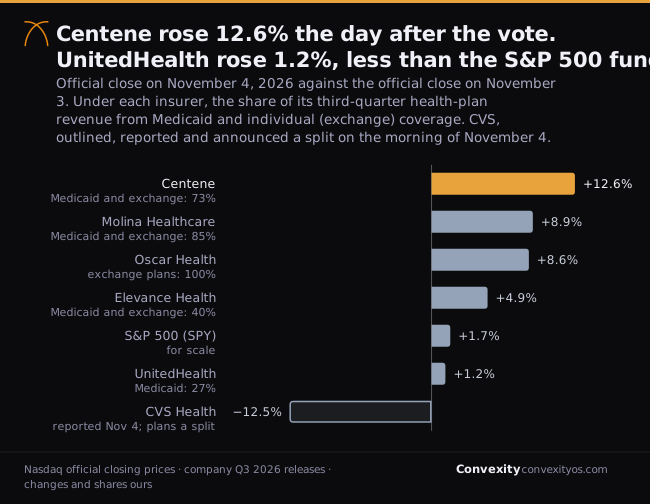
On November 4, 2026, the day after Democrats won control of both the House and the Senate, the health insurers that depend most on government programs had one of their best days of the year. Centene, the largest exchange insurer and one of the largest in Medicaid, rose 12.6%, its second-largest gain of 2026. Molina Healthcare, which takes 85% of its premiums from Medicaid and the exchanges, rose 8.9%, also its second-largest of the year. Oscar Health, which sells almost nothing but individual plans on the Affordable Care Act's exchanges, rose 8.6%. UnitedHealth Group, whose health plans take more than a quarter of their revenue from Medicaid, rose 1.2%, less than the 1.7% of the SPDR S&P 500 ETF.
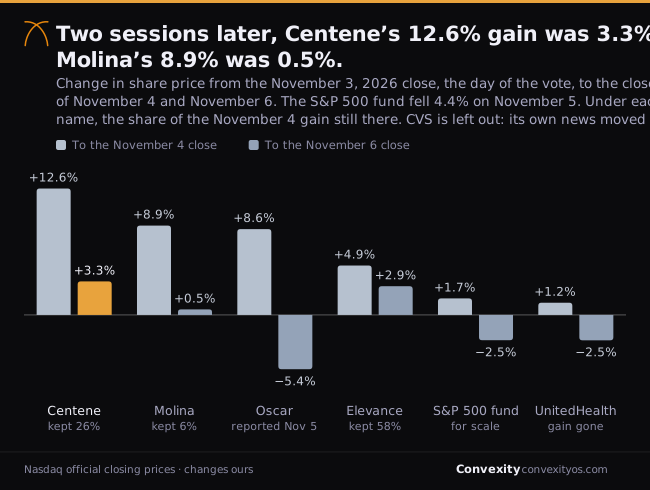
Two sessions later most of it was gone. At the November 6 close Centene stood 3.3% above its November 3 close, Molina 0.5% above its own and Oscar 5.4% below. The S&P 500 fund had fallen 2.5% over the same days, so some of the insurers' gain survived against the market.
Read plainly, the November 4 prices were a forecast: that the money Congress took out of these programs is coming back. Analysts quoted by Reuters that morning explained the move the same way. The enhanced premium tax credits that paid for much of exchange coverage from 2021 expired on December 31, 2025. The budget law signed on July 4, 2025 starts removing people from Medicaid in 2026 and money from it in 2028.
The calendar says 2027 is already written. Open enrollment for 2027 coverage began on November 1, at prices state regulators approved under the law as it stands. The IRS has published the 2027 credit tables, and they end at four times the poverty line, as the law now requires. The law's first broad Medicaid changes are due on January 1, 2027, two days before the new Congress is sworn in. And any change the new Congress makes has to get past two vote counts it does not control: 60 votes to end debate on an ordinary bill in a Senate where Democrats held 54 seats at midday on November 9, by the Associated Press's count, with two races uncalled, and then the signature of a president whose own health plan, published in January 2026, would send subsidy money to people rather than to insurers. What a new majority can do on its own is decline to pass further cuts. It cannot, on its own, undo the ones already in law.
This note set out to test a simple reading: that the market priced subsidies and Medicaid funding coming back, when a Democratic Congress cannot change 2027, so the earliest real change is the 2028 plan year, if it comes at all. The research supports most of that, with one correction that matters. Congress can reach into a year already under way. The American Rescue Plan did exactly that in March 2021, enlarging the credit from January 1 of that year, and the bill the House passed in January 2026 to extend the enhanced credits through 2028 was written to apply to 2026, the year it passed in. What stands between the rally and 2027 is not the calendar. It is the veto, and it is the same on January 3 as it was on November 3. Meanwhile the law's largest Medicaid funding cuts do not begin until 2028, which makes 2028 both the first plan year a deal could realistically reach and the year the most money starts to leave.
- +12.6%
- Centene's gain on November 4, its second-largest of 2026; at the November 6 close it stood 3.3% above November 3
- Jan 1, 2027
- when the 2025 law's six-month Medicaid renewals and work requirements are due to start for expansion adults, two days before the new Congress is sworn in
- 67
- senators needed to override a veto; Democrats held 54 seats at midday on November 9, with two races uncalled. Ending debate on an ordinary bill takes 60
- 6%
- Medicaid membership Molina expects to lose in 2027 under the law as written, it told investors on October 22
Nasdaq's official closes on November 3, 4 and 6; Public Law 119-21; U.S. Constitution, Article I, section 7, and the Twentieth Amendment; Senate Rule XXII as stated in the Congressional Record; Molina Healthcare's third-quarter 2026 earnings call; Associated Press tallies at midday on November 9, 2026, as Yahoo News carried them. The percentage changes are our arithmetic.
What moved, and how much of it stayed
The pattern in the prices is the evidence, so it is worth looking at closely. Each bar below is one stock's official close on November 4 against its official close on November 3, both from Nasdaq. Under each insurer is a rough measure of how much of its business rides on the two programs in question: the share of its third-quarter health-plan revenue that came from Medicaid and from individual coverage, our arithmetic on each company's release.
| Change in closing price, November 3 to November 4, 2026 | |
|---|---|
| Centene | +12.6% |
| Molina Healthcare | +8.9% |
| Oscar Health | +8.6% |
| Elevance Health | +4.9% |
| S&P 500 (SPY) | 1.6%+1.7% |
| UnitedHealth | +1.2% |
| CVS Health | −12.5% |
Oscar sells only individual coverage. Centene's 73% counts its whole commercial line, which is mostly marketplace but also carries about $4 billion a year of employer group business that we have not taken out. UnitedHealth's 27% is Medicaid alone, because it does not break out its exchange business, which its release puts at about a million members.
Across the group the moves follow exposure: the three companies that take most of their revenue from the two programs rose 8.6% to 12.6%, Elevance rose 4.9%, and UnitedHealth rose less than the S&P 500 fund. Within the top three the order runs the other way, and Oscar, the most exposed, rose least of them. Centene, the least exposed of the three by share, is the largest of them in both programs by members, with 11.9 million in Medicaid and 3.4 million in marketplace plans at September 30. The bid reached the hospitals too, whose Medicaid payments the 2025 law also limits: HCA Healthcare rose 10.3%, its largest one-day gain since at least the start of 2025.
Nothing in the insurers' own news explains the day. Centene, Molina and Oscar filed nothing with the SEC on November 4, according to EDGAR, read again on November 9. Centene and Molina had reported their quarters in October, and Oscar did not report until the morning of November 5. None of the three moved on new numbers of its own.
CVS Health is the one large insurer whose day says nothing about this question. Its stock closed 12.5% lower on the day it reported its third quarter and announced a plan to split into two companies, and its Aetna unit had already left the individual exchanges: CVS's release attributes part of the year's revenue change to "the Company's exit of the individual exchange business in 2026." We cover the split in a separate note.
The gains did not last. On November 5 the S&P 500 fund fell 4.4%, a day when the PHLX Semiconductor Index fell 12.2%, and Oscar, which reported that morning and raised its 2026 earnings forecast, fell 5.7%. On November 6 the fund steadied and the exposed stocks did not: Centene fell 6.0%, a drop we can tie to no company news, Molina 3.5% and Oscar another 7.6%. By that close Centene had kept about a quarter of its November 4 gain and Molina about 6% of its own.
| To the November 4 close | To the November 6 close | |
|---|---|---|
| Centene | +12.6% | 3.4%+3.3% |
| Molina Healthcare | +8.9% | 0.6%+0.5% |
| Oscar Health | +8.6% | −5.4% |
| Elevance Health | +4.9% | +2.9% |
| S&P 500 (SPY) | 1.6%+1.7% | −2.5% |
| UnitedHealth | +1.2% | −2.5% |
From the November 4 close to the November 6 close the three most exposed stocks fell 7.7% to 12.9%, against 4.1% for the S&P 500 fund and 2.0% for Elevance. The pattern of November 4 ran in reverse. Against the market less was lost: Centene finished 5.9 points ahead of the fund, down from 11.0 on November 4, and Molina 3.1 points ahead, down from 7.3. Two sessions with a selloff and one company's earnings inside them cannot say what investors believe.
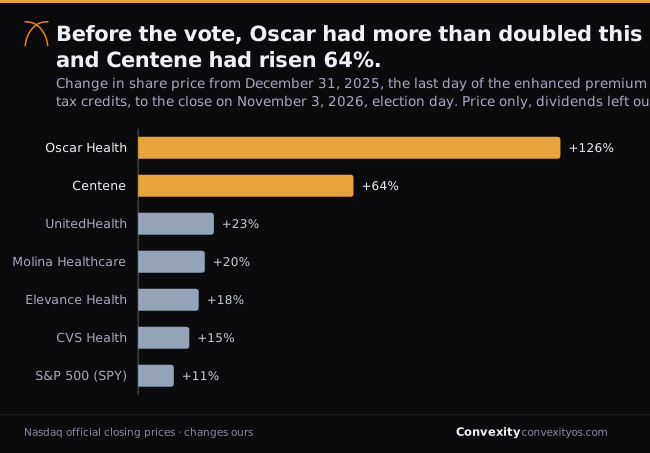
The November 4 move also came on top of a year in which these stocks had already been repriced, and under the law as it stands. Measured from December 31, 2025, the last day of the enhanced credits, to the November 3 close, the day of the vote, Oscar had more than doubled and Centene had risen 64%, against 11% for the S&P 500 fund.
| Change in share price, December 31, 2025 to November 3, 2026 | |
|---|---|
| Oscar Health | +126% |
| Centene | +64% |
| UnitedHealth | +23% |
| Molina Healthcare | +20% |
| Elevance Health | +18% |
| CVS Health | +15% |
| S&P 500 (SPY) | +11% |
Investors who paid those prices were not buying a change in the law. They were buying the repricing that followed the old one. Centene's chief financial officer, Drew Asher, told analysts on October 27 that its marketplace business had gone from a small pre-tax loss in 2025 to a forecast pre-tax margin of about 5% in 2026, which he called 600 basis points of improvement. Molina, Elevance and UnitedHealth each said in October that 2026 is the low point for their Medicaid margins, in outlooks that already include every cut in the 2025 law. Some of what moved on November 4 may have been a bet on a new law. Much of what these stocks are worth does not depend on one.
What the law already does, and when
The two changes the rally seems to be pricing are different in kind. The enhanced credits were never repealed. They were written with an end date, by the Inflation Reduction Act in 2022, and Congress did not move it. From 2026 the older table applies again, and the credit stops at four times the federal poverty line. The Medicaid changes are the opposite: new law, passed through budget reconciliation in 2025, with effective dates spread across six years.
| Date | What changes | Where it is written |
|---|---|---|
| Dec 31, 2025 | Enhanced premium tax credits end; the credit again stops at 400% of the poverty line | 26 U.S.C. 36B(b)(3)(A)(iii) and (c)(1)(E) |
| Jan 1, 2026 | No credit for people who enroll through an income-based special enrollment period; excess advance credits repaid in full | P.L. 119-21, secs. 71304, 71305 |
| Oct 1, 2026 | Medicaid limited to citizens and certain lawfully present immigrants | P.L. 119-21, sec. 71109 |
| Nov 1, 2026 to Jan 15, 2027 | Open enrollment for 2027 on HealthCare.gov | CMS |
| Jan 1, 2027 | Premium tax credits limited to citizens and certain lawfully present immigrants; Medicaid expansion adults renewed every six months; work requirements due, with exemptions possible to the end of 2028 | P.L. 119-21, secs. 71301, 71107, 71119 |
| Jan 3, 2027 | New Congress sworn in; bills not enacted by the old one lapse | Twentieth Amendment |
| Oct 1, 2027 | Ceiling on provider taxes in expansion states starts falling, from 5.5% in fiscal 2028 to 3.5% from fiscal 2032 | P.L. 119-21, sec. 71115 |
| Jan 1, 2028 | Advance credits only after eligibility is verified; grandfathered state directed payments start stepping down 10 points a year | P.L. 119-21, secs. 71303, 71116 |
| Oct 1, 2028 | Cost sharing for expansion adults above the poverty line | P.L. 119-21, sec. 71120 |
| Jan 20, 2029 | The president's term ends | Twentieth Amendment |
Three things in that table matter for the stocks.
The first is that most of the enrollment loss is front-loaded and the funding loss is back-loaded. Work requirements and six-month renewals remove people, starting in 2027. The provider-tax ceiling and the limits on state directed payments, which are how states finance their share of Medicaid and how they pay hospitals more than the base rate, take money out from fiscal 2028 and keep tightening into the 2030s. Molina's quarterly report states the shape plainly: the Medicaid changes are "expected to reduce enrollment in state Medicaid programs, but the timing and magnitude of the reductions may vary by state," and the funding provisions "are scheduled to begin in 2028, and we expect they may take 5 to 10 years to be fully implemented."
The second is that the dates are softer than they look, and not because of Congress. The law lets the Secretary of Health and Human Services exempt a state acting in good faith from the work requirements, and those exemptions can run to the end of 2028. And on October 29, 2026 a federal judge in Massachusetts, in a suit brought by 25 states and the District of Columbia, struck a test CMS had added to the "medically frail" exemption and gave the states six months' relief from enforcement on those decisions. He was explicit that the date itself is out of reach: the stay "has no impact on the Congressionally mandated January 1, 2027, deadline for implementation." CMS said on November 3 that it will appeal. These levers belong to the administration, the states and the courts. None of them belongs to the new Congress.
The third is the date on which the old Congress ends. The House passed H.R. 1834, which extends the enhanced credits through 2028, on January 8, 2026, by 230 to 196. It reached the Senate, was placed on the calendar on February 10, and has had no action since, by the Library of Congress's record read on November 9. Like every bill not enacted by noon on January 3, it lapses with the 119th Congress. The new Congress starts from a blank page.
Why 2027 is already priced
For an insurer, the 2027 plan year was settled before anyone voted. The rates were filed with state regulators in the spring and summer and reviewed through the fall. The IRS published the 2027 applicable percentages in Revenue Procedure 2026-26: a household below 133% of the poverty line is expected to pay 2.15% of its income for the benchmark silver plan, one between 300% and 400% pays 10.22%, and above 400% there is no credit at all. Since November 1 people have been choosing plans at those prices, with those credits.
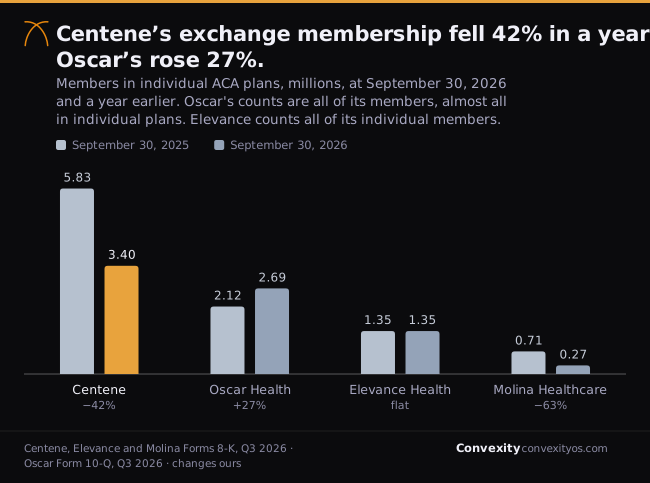
The insurers priced 2027 on the smaller, sicker pool that the expiration left behind, which our October note on 2027 premiums followed through the rate filings. Elevance's chief financial officer, Mark Kaye, said on October 21 that "the rates that we filed and that have been approved really reflect our forward view of medical cost trend and morbidity," and that "we do expect the risk pool to take more than one renewal cycle to normalize following the expiration of those enhanced subsidies." Centene's Mr. Asher forecast its marketplace membership at "around 3.2 million members" at the end of 2026, and its chief executive, Sarah London, declined to forecast 2027: "We need to see the results of open enrollment period."
| September 30, 2025 | September 30, 2026 | |
|---|---|---|
| Centene | 5.83 | 3.40 |
| Oscar Health | 2.12 | 2.69 |
| Elevance Health | 1.35 | 1.35 |
| Molina Healthcare | 0.71 | 0.27 |
The exchange market has already been reshaped by the expiration, and not evenly. Centene has 2.42 million fewer marketplace members than a year earlier. Molina, by its own choice, has 446,000 fewer. Oscar added 0.57 million, by its count of all members, which it attributes to "above market growth during the 2026 OEP and strong retention." But it had about 271,000 more on June 30 than on September 30, a loss its quarterly report puts down to the end of the credits. Elevance's individual book barely moved. These are the books the insurers carry into 2027, and every one of them was priced on the credit as it stands.
Could a law passed during 2027 still change 2027? Yes, and 2021 shows how. The American Rescue Plan was signed on March 11, 2021, and its larger credit applied to taxable years beginning after December 31, 2020, so the whole of 2021. CMS let existing enrollees update their applications from April 1 and cut their premiums "for the remainder of the year," and a special enrollment period was open to May 15. Premiums did not change; the government's share did, and the extra money flowed to buyers through the year. The House's bill of January 2026 was built the same way, effective for "taxable years beginning after December 31, 2025."
So a mid-2027 restoration is possible in law. For an insurer it would arrive as new members, signing up at rates priced for a sicker pool, which is a better trade than the one it has. That is the real upside a buyer could have been paying for on November 4. But it needs the same thing as everything else in this note: a bill the president signs.
What the insurers said about the vote
The plainest answer came two days after the vote, from the company with the most riding on it. "I don't think the midterms are going to have much of an effect, if anything," in the near term, Oscar's chief executive, Mark Bertolini, said on its November 5 call, because "there's a lot of bargaining that would need to go on given that the administration still will hold the veto pen." Bringing back the enhanced credits "would have to be part of a grander deal," he said, and "right now, I don't know that much of anything is going to happen over the next year at least." Molina's chief financial officer, Mark Keim, told an investor conference much the same on November 9, according to an Investing.com summary, the only account we could read: he expects gridlock for a couple of years and is leaving Molina's 6% membership assumption alone until its February guidance.
Before the vote, Centene was the one company asked about the midterms directly, on October 27. Lance Wilkes of Bernstein asked which policy levers a Democratic House or Senate might try to pull. Ms. London did not mention restoring the credits. She said "there is absolutely bipartisan support for government programs as a critical safety net," pointed to choice and to the employer-funded individual plans known as ICHRAs as ways to grow the market, and said of those ideas that "these are bipartisan concepts."
Her answer described what is in the law, not what might replace it, and the other insurers' plans do the same. Molina's chief executive, Joe Zubretsky, said on October 22 that "current Medicaid margins represent the trough in a multi-year cycle" and that "2027 will also be the first year in which our industry is impacted by work requirements," yet "the phased approach that states are taking will delay some disenrollments to 2028." He put the 2027 loss at 6%: "we're still projecting a 6% membership loss next year," he said, and noted that a loss spread through the year hits only half a year of revenue. Elevance and UnitedHealth called 2026 the trough in nearly the same words.
Medicaid membership is already falling at all four, before the law's January changes arrive: Centene's by 6.4% in the year to September 30, Molina's by 5.8%, Elevance's by 4.9% and UnitedHealth's by 10.3% (our arithmetic on their releases).
UnitedHealth made the most direct bet on Congress, and it made it before the election. Its October release says it has "Committed to voluntarily eliminating and rebating profits from individual Affordable Care Act coverage offerings in 2026, returning this money directly to approximately 1 million ACA members as Congress works toward longer-term solutions." That is a statement about 2026 profits, not about 2027 rates.
None of these companies built a restored credit or a reversed Medicaid cut into its 2027 numbers. Their guidance and the stocks' gains through November 3 rest on the law as written. The November 4 move was the first part of the price that did not, and by the November 6 close most of it had gone.
What the new majority can do alone, and what it cannot
The constitutional calendar is short. Members' terms end at noon on January 3, under the Twentieth Amendment, and the president's runs to noon on January 20, 2029, so the Congress elected on November 3 serves its whole two years opposite the same president. Until January 3 the outgoing Congress keeps its current majorities and can still legislate.
A bill becomes law in one of three ways: both chambers pass it and the president signs it; the president does not return it within ten days, Sundays excepted, while Congress is in session; or two-thirds of each chamber vote to pass it over his veto. In the Senate there is a gate before any of that. Ending debate on most bills takes three-fifths of the senators chosen and sworn, which is 60. The Senate tested exactly this question on December 11, 2025. A motion to end debate on taking up S. 3385, a bill "to extend the enhancement of the health care premium tax credit," got 51 votes to 48, and the presiding officer ruled that "Three-fifths of the Senators duly chosen and sworn not having voted in the affirmative, the motion is not agreed to."
There is a route around the 60: budget reconciliation, which needs only a simple majority in the Senate. It is how the credits were enlarged in 2021 and how the 2025 law was passed. Both are titled "An Act To provide for reconciliation." Democrats have said what they want first. "During the first 100 days, House Democrats must act to reverse the Medicaid cuts, restore SNAP funding, extend the Affordable Care Act tax credits," Hakeem Jeffries, the House Democratic leader, wrote to his colleagues on November 4. A reconciliation bill could carry that past a filibuster. It still goes to the president.
So the arithmetic that decides the rally is the veto. With every member present and voting, an override takes 67 senators and 290 representatives. At midday on November 9 the Associated Press had Democrats at 54 Senate seats, with Alaska and Mississippi uncalled, and 254 House seats, with 18 uncalled; NBC News estimated a final House count of 259. Win every uncalled race and they have 56 and 272, which leaves them 11 senators and 18 representatives short (our arithmetic). The president said as much on November 4: "I'll get along, probably, with the Democrats, unless they want to be destructive, but I have the power of the veto." Even H.R. 1834, which drew 17 Republican votes in January 2026, passed the House with 230 of the 426 members voting, 54 short of the two-thirds of those members that an override would have needed (our arithmetic on the House Clerk's roll call).
The president's position is on record. The White House's fact sheet of January 15, 2026, calling on Congress to enact what it calls the Great Healthcare Plan, says the plan "stops sending big insurance companies billions in extra taxpayer-funded subsidy payments and instead send that money directly to eligible Americans to allow them to buy the health insurance of their choice." The same plan would fund cost-sharing reduction payments, which the fact sheet says would lower the most common premiums by more than 10%, citing the Congressional Budget Office; we have not read that estimate. A deal is conceivable between that position and a new majority that wants the credits back. It is not the enhanced credit as it existed, and no bill carrying such a deal had moved in either chamber by November 9. The nearest thing on the books, H.R. 6703, which would fund those cost-sharing payments, passed the House 216 to 211 in December 2025 and has sat in the Senate since.
What a majority in both chambers can do alone is refuse. From January 3 no further cuts to Medicaid or the exchanges can pass without it, whether by ordinary bill or by reconciliation, which needs both chambers too. That is a real change in risk, and it may be most of what November 4 priced. It also holds only from January 3, and it leaves every date in the table above exactly where it is. The leverage a new majority has over spending bills is the subject of our broader note on what the market priced on November 4.
What the rally was pricing
Put together, the November 4 gains can be read two ways, and prices alone cannot tell them apart.
One reading is restoration: that a deal between the new Congress and the president brings back some of the credit, or delays the Medicaid funding cuts, in time to matter. For the exchange business, the earliest year a deal can realistically reach is 2028, unless it passes early enough in 2027 to work the way the 2021 law did. Insurers file 2028 rates in the spring and summer of 2027, so a law passed by then can be priced into them. For Medicaid, the funding cuts that matter most to the states start in fiscal 2028, and the new Congress has until then to bargain over them. On this reading, the stocks were paying on November 4 for a negotiation that had not started, with a counterpart who has said he wants the money paid to people rather than to insurers.
The other reading is protection: that the new majority's power to refuse removes the risk of a second round of cuts, which a unified Congress could have passed by reconciliation. On this reading the gains need nothing from the president, and the majority delivers them alone from January 3.
The two readings make different predictions, which is why they matter. If November 4 priced protection, the gains should survive months without legislation. If it priced restoration, they should fade as 2027 passes without a deal, and the insurers' guidance in late January and February 2027 should show no restored credit in anyone's plan.
The first two sessions leaned toward the second prediction and proved very little. The stocks with the most riding on a deal gave back the most, but the whole market fell hard on November 5 and Oscar was reacting to its own quarter. What is left of the lead over the market is the part worth watching. If it holds with no bill in sight, the protection reading has the better of it.
The case against this note
There are good arguments that the market read November 4 better than this note does.
The first is that a deal is likelier than the veto arithmetic suggests. Four Republican senators voted to proceed to the extension in December 2025, and 17 Republican House members voted for H.R. 1834 in January 2026. The president's own plan wants something done about premiums, and cost-sharing payments plus direct payments to buyers is not far, in dollars, from a smaller enhanced credit. A compromise that pays buyers rather than insurers still puts money in buyers' hands, and buyers spend it on premiums. If such a bill passes in the first half of 2027, the 2028 rates are priced on a healthier pool and the 2021 precedent puts some of the money into 2027.
The second is that this note may understate how much a majority that can only refuse is worth. A second reconciliation bill was not a remote possibility for a unified Congress, and the first one rewrote much of how Medicaid is financed. Removing that risk alone could justify a move of the November 4 size in companies that take more than half their revenue from Medicaid, as Centene and Molina do.
The third is that the dates in the table are softer than any statute reads. Exemptions to the end of 2028 could delay the work requirements in many states without Congress doing anything, and the October 29 ruling has already loosened the test for who is exempt. Either would move enrollment losses later whatever happens in Washington. That helps the same stocks for reasons this note says are outside Congress's hands, which supports the gains while undercutting our framing of them.
We think the second argument is the strongest. It is also the one this note can least test, because protection and restoration look identical on the day.
What would prove this wrong
- A signed bill before mid-2027. If the president signs anything that restores part of the enhanced credit or delays the Medicaid funding cuts before insurers file 2028 rates, the rally priced something the new Congress could get, and the veto was not the obstacle this note says it is. A law that reaches back into 2027, as the 2021 law did, would be the strongest case.
- Action in the lame duck. The outgoing Congress sits until January 3, government funding runs out after December 11, and EY's November 6 newsletter says some Republicans may try a reconciliation bill before the majority changes hands. Any health legislation it passes, in either direction, changes the starting point.
- The insurers' 2027 guidance. Centene said on October 27 that it would give formal guidance in early February 2027, and the others report around the same time. If any of them builds a restored credit or delayed Medicaid cuts into 2027, the companies see something we do not.
- CMS's open enrollment counts. CMS published 23.1 million plan selections for 2026, and we could find no 2027 snapshot by November 9. Snapshots through January 2027 will show whether 2027 enrollment falls further under the law as written. A count near 2026's would mean the pool is holding without a new law, which weakens the restoration reading and strengthens the case that the insurers do not need one.
- The gains themselves. By the November 6 close most of the November 4 gain had gone, in two sessions too short and too noisy to count. The test is the lead over the S&P 500 fund: if Centene and Molina hold what is left of it through their February calls with no bill in sight, the market priced protection rather than restoration, and this note's question about the veto was the less important one.
- State exemptions and the appeal. If HHS grants good-faith exemptions widely, the January 1, 2027 date moves in practice for reasons that have nothing to do with the election. The October 29 ruling says a court could not move the date itself, so CMS's appeal is a fight over who is exempt rather than over when the requirements begin.
The filings, laws and data this is built on
46 documents
- 01CallOscar Health third-quarter 2026 earnings call, transcript (The Motley Fool)Read against the TradingKey transcript below; quoted only where both carry the same wordsNov 5, 2026fool.com
- 02CallOscar Health third-quarter 2026 earnings call, transcript (TradingKey)Second, independently produced transcript of the same callNov 5, 2026tradingkey.com
- 03CallCentene third-quarter 2026 earnings call, transcript (The Motley Fool)Read against the Gloom transcript below; quoted only where both carry the same words. Speakers' titles from the investor relations introductionOct 27, 2026fool.com
- 04CallCentene third-quarter 2026 earnings call, transcript (Gloom)Second, independently produced transcript of the same callOct 27, 2026gloom.sh
- 05CallMolina Healthcare third-quarter 2026 earnings call, transcript (The Motley Fool)Read against the Benzinga transcript below; quotations are wording both carryOct 22, 2026fool.com
- 06CallMolina Healthcare third-quarter 2026 earnings call, transcript (Benzinga)Oct 22, 2026benzinga.com
- 07CallElevance Health third-quarter 2026 earnings call, LSEG StreetEvents edited transcriptPosted by the company; read against the Quartr transcript belowOct 21, 2026s202.q4cdn.com
- 08CallElevance Health third-quarter 2026 earnings call, transcript (Quartr)Oct 21, 2026files.quartr.com
- 09CallUnitedHealth Group third-quarter 2026 earnings call, transcript (Quartr)Read against the Benzinga transcript below. The executive who spoke about Medicaid margins was not introduced with a title, so this note does not name oneOct 13, 2026files.quartr.com
- 10CallUnitedHealth Group third-quarter 2026 earnings call, transcript (Benzinga)Oct 13, 2026benzinga.com
- 118-KCentene Corporation, third-quarter 2026 earnings release, Exhibit 99.1Membership by line of business; premium and service revenue by lineOct 27, 2026sec.gov
- 128-KMolina Healthcare, third-quarter 2026 earnings release, Exhibit 99.1Ending membership and premium revenue by segmentOct 21, 2026sec.gov
- 1310-QMolina Healthcare, quarterly report for the quarter ended September 30, 2026Legislative and regulatory developments: the expected timing of the 2025 law's Medicaid changesOct 22, 2026sec.gov
- 148-KElevance Health, third-quarter 2026 earnings release, Exhibit 99.1Medical membership and Health Benefits revenue by businessOct 21, 2026sec.gov
- 158-KUnitedHealth Group, third-quarter 2026 earnings release, Exhibit 99.1People served in Medicaid; the pledge to rebate 2026 individual ACA profitsOct 13, 2026sec.gov
- 1610-QUnitedHealth Group, quarterly report for the quarter ended September 30, 2026UnitedHealthcare revenue by businessNov 3, 2026sec.gov
- 178-KCVS Health, third-quarter 2026 earnings release, Exhibit 99.1The exit from the individual exchange business in 2026Nov 4, 2026sec.gov
- 188-KOscar Health, third-quarter 2026 earnings release, Exhibit 99.1The raised 2026 outlookNov 5, 2026sec.gov
- 1910-QOscar Health, quarterly report for the quarter ended September 30, 2026Effectuated membership by offering; the effect of the end of the enhanced credits on its membershipNov 5, 2026sec.gov
- 2010-QOscar Health, quarterly report for the quarter ended June 30, 2026Effectuated membership at June 30, 2026; individual coverage as its only offeringAug 7, 2026sec.gov
- 21StatutePublic Law 119-21, An Act To provide for reconciliation pursuant to title II of H. Con. Res. 14Sections 71107, 71109, 71115, 71116, 71119, 71120 and 71301 to 71305, and their effective datesJul 4, 2025congress.gov
- 22Statute26 U.S.C. 36B, Refundable credit for coverage under a qualified health planThe temporary percentages for 2021 through 2025 and the 400% rule. Legal Information Institute textlaw.cornell.edu
- 23StatutePublic Law 117-2, American Rescue Plan Act of 2021Section 9661, effective for taxable years beginning after December 31, 2020Mar 11, 2021congress.gov
- 24StatutePublic Law 117-169, Inflation Reduction Act of 2022Section 12001, which extended the enhanced credit through 2025Aug 16, 2022congress.gov
- 25BillH.R. 1834, as passed by the House and placed on the Senate calendarExtends the enhanced credit through 2028, effective for taxable years beginning after December 31, 2025. Actions read through the congress.gov API on Nov 9, 2026: none since Feb 10, 2026Jan 8, 2026congress.gov
- 26BillH.R. 6703, Lower Health Care Premiums for All Americans Act, as passed by the HouseSection 202 funds cost-sharing reduction payments. 216 to 211 on Dec 17, 2025; received in the Senate Dec 18, 2025. Actions read through the congress.gov API on Nov 9, 2026: none sinceDec 17, 2025congress.gov
- 27CourtMassachusetts v. Oz, No. 1:26-cv-12962-RGS (D. Mass.), memorandum and order on cross-motions for summary judgmentVacates the added test in the definition of "medically frail"; a six-month stay of enforcement; footnotes 8 and 9 on the January 1, 2027 date. Copy hosted by Becker'sOct 29, 2026beckers-cs-assets.s3.us-east-1.amazonaws.com
- 28VoteClerk of the House, roll call 11, on passage of H.R. 1834230 to 196: 213 Democrats and 17 Republicans in favorJan 8, 2026clerk.house.gov
- 29RecordCongressional Record, Senate, cloture on the motion to proceed to S. 3385Rollcall vote 644, 51 to 48Dec 11, 2025govinfo.gov
- 30LawConstitution of the United States, Article I, section 7Presentment, the ten-day rule and the two-thirds override. National Archives transcriptarchives.gov
- 31LawConstitution of the United States, Twentieth AmendmentTerms of members end at noon on January 3; the president's at noon on January 20archives.gov
- 32Rev. Proc.IRS, Revenue Procedure 2026-26The 2027 applicable percentage table, 2.15% to 10.22%, ending at 400% of the poverty lineirs.gov
- 33Fact sheetCMS, Plan Year 2027 Marketplace Plans and Prices Fact SheetOpen enrollment dates for 2027 on HealthCare.govOct 30, 2026cms.gov
- 34Fact sheetCMS, American Rescue Plan and the MarketplaceIncreased savings from April 1, 2021; the special enrollment period to May 15Mar 12, 2021cms.gov
- 35ReportCMS, Health Insurance Exchanges 2026 Open Enrollment Report23.1 million plan selections in the 2026 open enrollment periodMar 27, 2026cms.gov
- 36Fact sheetThe White House, President Donald J. Trump Calls on Congress to Enact The Great Healthcare PlanCites a Congressional Budget Office estimate for cost-sharing payments, which we have not readJan 15, 2026whitehouse.gov
- 37DataNasdaq, historical quotes, official closing pricesCNC, MOH, OSCR, ELV, UNH, CVS, HCA and SPY, January 2, 2025 to November 6, 2026; retrieved 2026-11-09nasdaq.com
- 38DataState Street SPDR S&P 500 ETF Trust, daily holdingsHoldings as of November 6, 2026, for the disclosure; retrieved 2026-11-09ssga.com
- 39NewsAssociated Press seat tallies, as carried by Yahoo News live coverageAs of midday on November 9, 2026: Senate 54 to 44, Alaska and Mississippi uncalled; House 254 to 163, 18 uncalled. The Associated Press race-call pages could not be read by our tools; retrieved 2026-11-09Nov 9, 2026yahoo.com
- 40DataNBC News, 2026 Senate and House resultsSenate 54 to 44; estimate of the final House count, 259 to 176, as updated at 2:33 PM ET on November 9, 2026; retrieved 2026-11-09nbcnews.com
- 41NewsReuters, Health insurers, hospitals rally after sweeping midterm win for DemocratsAnalysts on what the result could mean for the 2025 law's Medicaid provisions and the subsidies, as carried by Yahoo Finance; retrieved 2026-11-09Nov 4, 2026finance.yahoo.com
- 42NewsCBS News, midterm election results live coverageThe president's remarks at the White House on November 4, which TRT World's report carries in the same words; retrieved 2026-11-09Nov 5, 2026cbsnews.com
- 43LetterHakeem Jeffries, Dear Colleague letter announcing his candidacy for Speaker of the HouseThe first-100-days list, as posted by the House Democratic leader's office; retrieved 2026-11-09Nov 4, 2026democraticleader.house.gov
- 44CommentaryEY Tax News, What to expect in Washington (November 6)Reconciliation in the lame duck; the December 11 funding deadline; retrieved 2026-11-09Nov 6, 2026taxnews.ey.com
- 45NewsInvesting.com, Molina Healthcare at UBS Global Healthcare Conference: 2027 rebound in focusA summary, not a transcript, and the one account of Mr. Keim's remarks we could read, so this note paraphrases it and quotes nothing; retrieved 2026-11-09Nov 9, 2026in.investing.com
- 46CommentaryHealth Management Associates, Weekly Roundup, November 4, 2026CMS Administrator Mehmet Oz said on November 3 that CMS will appeal the October 29 ruling; retrieved 2026-11-09Nov 4, 2026healthmanagement.com
Not investment advice. This note is analysis of public filings, laws and data, published for research purposes, and not a recommendation to buy, sell or hold any security, or advice about choosing a health plan. Convexity takes no side in elections. A member of the Convexity team holds SPY, which holds UnitedHealth Group, Elevance Health, Centene, CVS Health and HCA Healthcare; no other position in any company named here, including Molina Healthcare and Oscar Health.
What here is ours rather than the sources'. Every percentage change in a share price is our arithmetic on Nasdaq's official closes, whether for November 4, for the sessions through November 6 or for the year to November 3. So are every comparison of a day's gain with earlier sessions, the share of each November 4 gain still there at the November 6 close (about a quarter, or 26%, for Centene, 6% for Molina and 58% for Elevance), the leads over the S&P 500 fund in points (11.0 and 5.9 for Centene, 7.3 and 3.1 for Molina), and the membership counts rounded to millions. The shares of revenue from Medicaid and individual coverage (85%, 73%, 40% and 27%), and the statement that Medicaid alone is more than half of revenue at Centene and Molina, are our arithmetic on the companies' releases and UnitedHealth's 10-Q. The changes in exchange membership (42%, 27% and 63%; 2.42 million, 0.57 million and 446,000), Oscar's fall of about 271,000 members between June 30 and September 30, and the changes in Medicaid membership (6.4%, 5.8%, 4.9% and 10.3%) are our arithmetic on the releases and Oscar's 10-Qs, and Oscar's 27% matches the increase it states itself. The vote thresholds (67, 290 and 60), the 54 votes H.R. 1834 was short of two-thirds, and the ceilings of 56 senators and 272 representatives, 11 and 18 short of an override, are our arithmetic on the Constitution, Senate Rule XXII, the House Clerk's roll call and the Associated Press's count. Every filed figure, quotation, statutory date and seat count is as its source published it. The reading of what the rally priced, restoration or protection, is ours, and so is the judgment that the veto rather than the calendar is what stands between it and 2027.