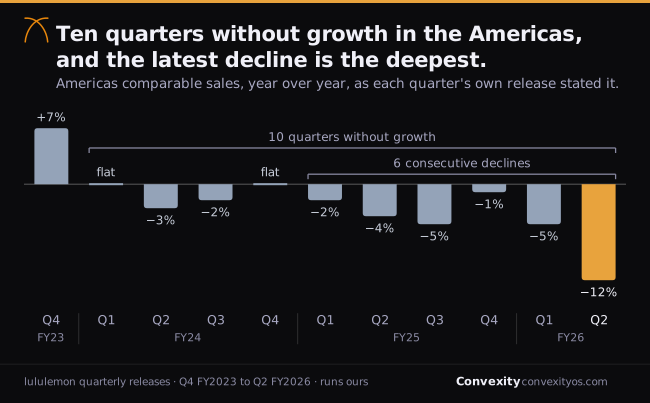
Correction, September 13, 2026. The first version of this note, published earlier the same evening, called the second-quarter fall in Americas comparable sales the ninth consecutive decline. It is the sixth. lululemon's release for the fourth quarter of fiscal 2024 prints that quarter's figures and then the full year's in the same sentence shapes, and we read the full-year figure, a 1% decline, as the quarter, which the release puts at flat. The draft this note replaced made the same misreading and counted eight. The Americas have now declined for six consecutive quarters and gone ten without growth, every mention below says so, and the first chart is drawn from each quarter's own release. The argument does not rest on the count: this quarter's decline is more than twice as deep as any before it in the run.
Disclosure. Convexity builds research tools for public-market data. This note is analysis, not investment advice, and nothing in it is a recommendation to buy, sell, or short any security. We hold no position in lululemon athletica and no relationship with the company. Every reported figure comes from lululemon's quarterly earnings releases, chiefly the one furnished with its Form 8-K of September 3, 2026, from the Form 10-Q filed the same day, or from management statements on the earnings call held that afternoon, all linked at the bottom. The call is cited from a published transcript rather than from the company's own webcast archive, and statements are attributed as that transcript records them. Where a number is our arithmetic on disclosed figures rather than a figure the company reported, the sentence using it says so.
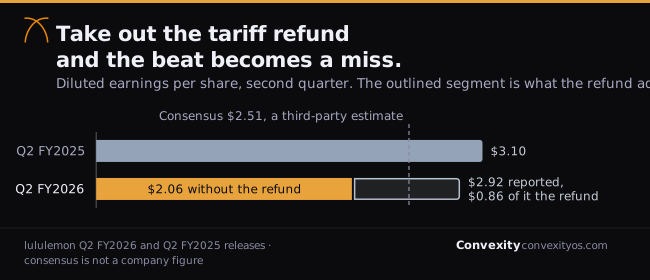
lululemon reported second-quarter earnings of $2.92 a diluted share against roughly $2.51 expected. On the wire that is a beat of about forty cents.
Chief financial officer Meghan Frank, who is also interim co-chief executive, told the call that the quarter included a $134.5 million refund of tariffs collected under the IEEPA, and that the refund added $0.86 a share after tax.
Subtract it. The underlying quarter earned about $2.06 against $2.51 expected, which is a miss of roughly forty-five cents by our arithmetic on her figure. The beat and the miss are the same quarter, and the difference between them is a one-off recovery of money the company had already paid to the government.
This note was drafted before the print, arguing that tariffs were not what had gone wrong at lululemon and that the damage was in brand and product. The quarter did not contradict that. It supplied the sharpest possible illustration of it: the only line that improved was the tariff line, and it improved because the tariffs were being handed back.
Second quarter of fiscal 2026, ended August 2, 2026. Revenue, comparable sales, margin and guidance figures are lululemon's as reported. The per-share figure excluding the refund, the ex-refund margin change and the guided decline against fiscal 2025 are our arithmetic on the company's disclosures and on the $0.86 per share Frank attributed to the refund on the call.
The line the argument rests on
Americas comparable sales fell 12%.
That is the sixth consecutive quarterly decline in the region that supplies most of lululemon's revenue, and its tenth quarter without growth. It is a deterioration rather than a stabilization: before this quarter, no decline in the run had been deeper than 5%.
The rest of the geography splits the way it has been splitting. Americas net revenue fell 8%, with the United States down 8% and Canada down 11%. International net revenue rose 4%, though only 2% in constant dollars, and international comparable sales fell 3%, or 6% in constant dollars. China Mainland revenue rose 4% in dollars and fell 2% in constant currency, with comparable sales down 2% reported and down 8% constant.
Total company comparable sales fell 9%, or 10% in constant dollars. Total revenue fell 4% to $2.4 billion.
There is no reading of that set in which the problem is external. A tariff regime does not reduce comparable sales in your home market by 12% while your international comparable sales fall by 3%. A weak consumer does not do it either, or not by itself, because the same consumer is buying from the same malls.
The international numbers are worse than they look, which complicates this
The easy version of this note is that the Americas are broken and international is fine. The currency-adjusted figures do not support that cleanly, and the difference is worth working through because it changes what kind of problem this is.
International net revenue rose 4%. In constant dollars it rose 2%. International comparable sales fell 3% reported, and fell 6% in constant dollars.
China Mainland is the sharper case. Revenue rose 4% as reported and fell 2% in constant currency. Comparable sales fell 2% reported and fell 8% in constant currency. Rest of World revenue rose 5%, or 6% constant, with comparable sales down 4% reported and down 3% constant.
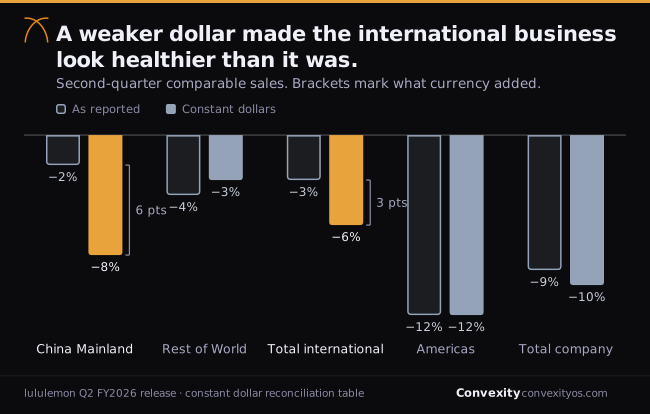
So on a like-for-like basis, adjusted for currency, comparable sales fell in every region the company operates in. The Americas fell furthest by a wide margin, at negative 12%, but international was not growing on a comparable basis either. It was growing because lululemon keeps opening stores there, and the reported dollar figures were flattered by a weaker dollar.
That does two things to the argument. It weakens any claim that this is purely a North American brand event, because a brand event confined to one market should leave the others flat rather than down 6% on a comparable basis. And it strengthens the case that what is happening is about the product, since product travels and brand sentiment is more local than assortment is.
The honest reading is that both are present. The Americas decline is several times the international one, which is consistent with a brand problem concentrated where the brand is most saturated and most discussed. The international decline is smaller and real, which is consistent with an assortment that is not working anywhere. Maestrini named both on the call, in that order, and the geographic split is the evidence for taking him at his word rather than treating brand sentiment as the whole story.
It also means the international business is a smaller cushion than the headline growth rate implies. Four percent revenue growth built on new stores while comparable sales fall 6% in constant dollars is the same arithmetic as the Americas, one stage earlier.
Management named it, in its own words
The most useful thing about this call is that the company did not reach for the macro.
Frank said the pressure is predominantly in traffic, and that conversion is negative year over year but has not worsened. André Maestrini, the other interim co-chief executive, attributed the shortfall to brand sentiment alongside product inconsistency.
Those are the two things the earlier draft of this note argued were the actual causes, and they are being said by the people running the company rather than inferred by us from a bridge. Traffic is the tell that separates a brand problem from a product problem and from a pricing problem. If pricing were the issue, traffic would hold and conversion would fall. If assortment were the issue, traffic would hold and units per transaction would fall. Traffic falling is people not coming, and people not coming is the brand.
Conversion being negative but not worsening is a small piece of good news buried in that, and worth stating fairly: the people who do come are converting at a stable, lower rate. The store experience is not deteriorating. Fewer people are entering it.
What the refund did to every margin line
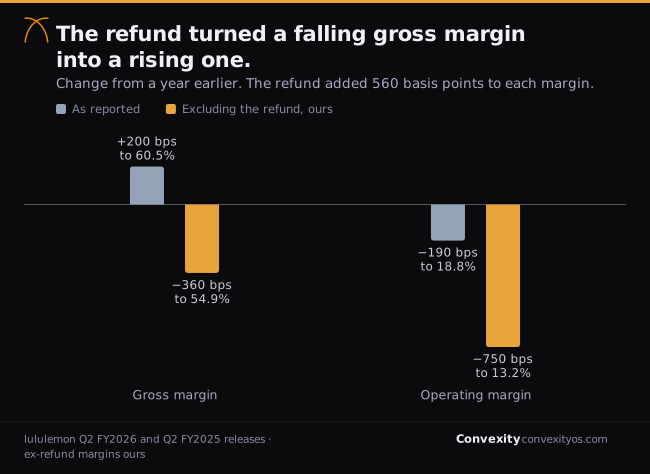
Reported gross margin rose 200 basis points to 60.5%, which reads like a company managing its costs well in a difficult quarter.
The release states that the $134.5 million refund increased gross margin by 560 basis points. Excluding it, gross margin was about 54.9% and fell roughly 360 basis points, on our arithmetic.
Reported operating margin fell 190 basis points to 18.8%. The same 560 basis points of refund sits inside that figure too. Excluding it, operating margin was about 13.2% against 20.7% a year earlier, a decline of roughly 750 basis points by our calculation.
Income from operations fell 13% to $453.7 million with the refund included. Without it the decline is far steeper.
The cleanest version of the same point uses last year rather than consensus. Second-quarter earnings per share were $3.10 a year ago. Reported at $2.92, this quarter is down 6%. At $2.06 excluding the refund, it is down 34%, on our arithmetic against the company's own prior-year figure.
Six percent is a company having a soft patch. Thirty-four percent is something else, and the two numbers describe the same three months.
None of this is hidden. The company disclosed the refund, quantified its basis-point effect on both margin lines, stated the $0.86 per share in the release itself, and Frank repeated it on the call. It is disclosed and it is still worth restating, because the headline that travels is $2.92 against $2.51, and the quarter underneath that headline is one where every profitability measure deteriorated. The refund also carried $4.1 million of associated interest, and the $0.86 covers both, net of tax.
The inventory is clean, and that matters
The obvious bear case for a retailer with falling comparable sales is a warehouse full of product nobody wants, discounted into the next two quarters. That is not this.
Inventories ended the quarter at $1.7 billion, down 1% against a year earlier in dollars and down 7% on a unit basis. Units falling faster than dollars is the shape of a company that has taken cost inflation and still shipped fewer things, which is disciplined rather than distressed.
This is the single most important fact arguing against a severe reading of the quarter, and it deserves to be stated before the guidance section rather than buried after it. lululemon is not sitting on a glut. The markdown guidance backs that up: 60 basis points of increase in the third quarter and roughly 40 for the full year is housekeeping, not a fire sale, and the company sat out promotional events in Australia rather than chase the traffic.
It also sharpens the diagnosis. A company with clean inventory and falling traffic has a demand problem, not a merchandising accident. You cannot discount your way out of people not walking in, and to the company's credit it does not appear to be trying.
The store base keeps growing into it
While Americas comparable sales fell 12%, lululemon opened nine net new company-operated stores, ending the quarter with 825.
The four-quarter progression is 796, then 811, then 816, then 825. Gross square footage over the same period went from 3,511 thousand to 3,630, then 3,736, then 3,788, and up again in this quarter.
So the selling base has grown by roughly 4% over a year in which total revenue fell 4% and Americas comparable sales fell in every quarter. Comparable sales exclude new stores by construction, which is exactly why the pairing matters: the reported revenue decline is being cushioned by square footage that the comp line does not see. Strip the new stores out and the underlying trend is worse than the headline revenue number suggests, which is the same relationship the comp figure is already telling you and which the store count quietly compounds.
The full-year plan comes down to roughly 35 openings from roughly 40, so the company is slowing. It is slowing, not stopping, into a home market it now expects to be down low double digits for the year.
Alongside that, the company repurchased 2.7 million shares for $330.0 million in the quarter, and ended with $1.4 billion of cash and $593.7 million of undrawn revolver. There is no liquidity question here. There is a capital allocation question, which is whether buying stock and adding square footage is the right use of cash in the fourth consecutive quarter of a brand problem, and reasonable people will answer it differently.
The guidance is the company's own verdict
Frank described the revised full-year outlook as a prudent approach. It is a large cut.
Start with the quarter in front of it, because that is the number that dates the deterioration. Third-quarter revenue is guided to $2.290 billion to $2.320 billion, a decline of 10% to 11%. The quarter just reported declined 4%. The company is telling the market that the next three months are more than twice as bad as the three just finished.
Third-quarter earnings per share are guided to $0.93 to $0.98, on an assumed 30% tax rate. Against the $2.92 just reported, or the $2.06 underneath it, that is a different order of business.
Full-year revenue is now guided to $10.35 billion to $10.5 billion, down 5% to 7% against fiscal 2025. Full-year earnings per share are guided to $9.48 to $9.73, against $13.26 in fiscal 2025. That is a decline of 27% to 29% by our arithmetic on the two figures.
North America is now expected to be down in the low double digits for the year. Store openings come down to roughly 35 from roughly 40.
A company guiding its own earnings down by more than a quarter, and its home market down by low double digits, is not describing a transitory external shock. It is describing a business it expects to be smaller next year than this year, and it is planning the store base accordingly.
What is actually being changed
The operational response is more specific than the language around it, and it is the most encouraging part of the call.
Stores in North America will carry about 15% fewer SKUs. The company is reordering into what works, with roughly 20% more volume in chase reorders than the prior year, and is compressing design-to-market lead times.
The product read underneath that is blunt. Leggings, the category the brand was built on, declined about 20%. The assortment is pivoting toward away-from-body silhouettes, which is a polite way of saying the customer has moved and lululemon did not move with her. Accessories fell 13% in the quarter and that assortment is being cut.
On markdowns, Frank said the goal has been to return to healthy full-price penetration, and the guidance carries a 60 basis point increase in the third quarter and roughly 40 basis points for the full year. That is restraint rather than a promotional reset. In Australia the company deliberately sat out local promotional events and accepted the traffic hit.
Cutting SKU density by 15% while chasing 20% harder into winners is a coherent response to inconsistent product, and it is the sort of thing that shows up in gross margin two or three quarters later rather than immediately. The question is whether it addresses traffic, and on the company's own diagnosis traffic is the problem. Assortment discipline fixes what happens after someone walks in.
A new chief executive inherits the guidance
Heidi O'Neill became chief executive on September 8, five days after the call, from a Nike career. She replaced an interim arrangement that had run since Calvin McDonald stepped down on January 31, 2026, in which Frank and Maestrini shared the role and chair Marti Morfitt took an expanded executive role alongside them.
Frank said O'Neill would take a deep dive into the business and evaluate the strategy and the current action plan.
That sentence is doing a lot of work. A guidance cut issued the week before a new chief executive arrives is a floor set by people who will not own it. Whatever O'Neill concludes in her first quarter, she has every incentive to conclude it early and completely, and the numbers she inherits are the numbers she will be measured from rather than the numbers she set. Anyone modeling the second half should treat this guidance as provisional in both directions.
What this note is not claiming
It is not claiming the brand is broken. lululemon earned $453.7 million of operating income on $2.4 billion of revenue in a quarter widely described as bad, and the international business grew. A gross margin near 55% excluding a one-off is still an extraordinary number for an apparel company, and most retailers would take an 18.8% operating margin in their best year.
It is not claiming tariffs are irrelevant to the company. They plainly cost real money, which is why there was $134.5 million to refund. The claim is narrower and unchanged from the draft this replaces: tariffs are not what is wrong with the business, and the quarter in which tariffs finally helped is the quarter in which that became impossible to miss.
It is not claiming the turnaround will fail. SKU reduction, faster chase, and a silhouette pivot are the right moves on the company's own diagnosis. They are simply not fast moves, and none of them directly addresses traffic.
What the draft got right, and what it missed
This note replaces a draft written before the print and held rather than published, on the rule that a company note should follow its subject's results instead of racing them. That rule exists because a companion note on Dell published on its own earnings morning and was falsified by that evening's release. It is worth saying what the holding actually bought.
Right: the diagnosis. The draft argued the damage was brand and product rather than tariffs, and that management's own commentary pointed there. Frank and Maestrini said as much on this call, in more direct terms than the draft used.
Right, and understated: the trajectory. No quarter in the draft's series had fallen by more than 5%. This one fell 12%, so the decline is steeper than the draft's own framing implied.
Wrong, and carried into the first version of this note: the count. The draft said eight consecutive declines and this note first said nine. Both read fiscal 2024's full-year figure as its fourth quarter, which lululemon's release puts at flat. The run is six, as the correction at the top explains.
Missed: the international picture. The draft treated international as the healthy half. On a constant-currency comparable basis it was down 6%, which the draft did not establish because those figures had not been published.
Missed entirely: the refund. Nothing in the draft anticipated that the quarter's headline would be set by a tariff recovery, which is the detail that makes the argument legible to anyone who reads only the first line.
What would prove this wrong
- Americas comparable sales inflect. Six consecutive declines inside ten quarters without growth is a trend, and a quarter of growth would break it. It would mean the decline was a product cycle rather than a brand condition, and this note is reading a cycle as a structure.
- Traffic recovers before the product does. The diagnosis here rests on Frank's statement that the pressure is predominantly traffic. If traffic returns while the assortment work is still in progress, then brand heat was never the binding constraint and the marketing spend was the lever all along.
- The guidance proves conservative. A cut issued the week before a new chief executive arrives is the easiest guidance in the world to beat. If the second half lands materially above $9.73, the cut was a reset rather than a forecast, and reading it as the company's verdict on itself was wrong.
- The refund recurs. This note treats the $134.5 million as one-off because it is a refund of tariffs already paid. If the IEEPA position produces further material recoveries, the ex-refund arithmetic here understates the run rate.
- International carries the company. International comparable sales fell only 3% and revenue grew. If the international base compounds fast enough, the Americas decline becomes a mix story rather than a brand story, and the geography that matters changes.
- The leggings decline is a category event. Leggings fell about 20%. If the whole category fell that much across every brand, this is a fashion cycle lululemon happens to be levered to rather than share loss, and the brand argument weakens considerably. That comparison needs competitor disclosure this note does not have.
- O'Neill finds something specific and fixable. A new chief executive with a clear read on assortment and marketing could restore traffic faster than a structural reading allows. The strongest argument against this note is that it is describing a moment rather than a condition.
lululemon's third-quarter report is expected around December 10, 2026. The lines worth finding first are Americas comparable sales against this quarter's negative 12%, gross margin excluding any further tariff recovery, and whether the traffic and conversion split Frank described has moved. The Form 10-Q filed alongside this release carries the segment detail and the tariff accounting, and is the place the refund is documented rather than characterized.
Primary sources
- 8-Klululemon athletica announces second quarter fiscal 2026 results, Exhibit 99.1Revenue, the comparable sales tables by geography including Americas at negative 12%, the gross and operating margin figures, the $134.5 million tariff refund and its stated 560 basis point effect on each margin, and the revised full-year outlookSeptember 3, 2026
- Calllululemon athletica Q2 fiscal 2026 earnings callThe management statements used here: Frank on pressure being predominantly in traffic, on conversion being negative but not worsening, on the refund adding $0.86 a share after tax, on returning to healthy full-price penetration, and on Heidi O'Neill taking a deep dive into the business; Maestrini on brand sentiment and product inconsistency; and the disclosures on SKU density, chase reorders, the leggings and accessories declines and the Australian promotional decision. Held September 3, 2026, the same day as the release. Read from a published transcript rather than the company webcastSeptember 3, 2026
- 10-Qlululemon athletica quarterly report for the period ended August 2, 2026Filed the same day as the release; the segment detail and the tariff accounting behind the refundSeptember 3, 2026
- 3Initial statement of beneficial ownership, Heidi O'NeillFiled as director and chief executive officer, giving September 8, 2026 as the date of the event requiring the statementSeptember 11, 2026
- 8-Klululemon athletica first quarter fiscal 2026 results, Exhibit 99.1Americas comparable sales down 5%June 4, 2026
- 8-Klululemon athletica fourth quarter and full year fiscal 2025 results, Exhibit 99.1Americas comparable sales down 1% in the fourth quarter; the 3% decline printed beneath it is the full yearMarch 17, 2026
- 8-Klululemon athletica third quarter fiscal 2025 results, Exhibit 99.1Americas comparable sales down 5%December 11, 2025
- 8-Klululemon athletica second quarter fiscal 2025 results, Exhibit 99.1Americas comparable sales down 4%; the year-earlier gross margin of 58.5%, operating margin of 20.7% and diluted earnings per share of $3.10September 4, 2025
- 8-Klululemon athletica first quarter fiscal 2025 results, Exhibit 99.1Americas comparable sales down 2%June 5, 2025
- 8-Klululemon athletica fourth quarter and full year fiscal 2024 results, Exhibit 99.1Americas comparable sales flat in the fourth quarter; the 1% decline printed beneath it is the full year, and is the figure this note first misread as the quarterMarch 27, 2025
- 8-Klululemon athletica third quarter fiscal 2024 results, Exhibit 99.1Americas comparable sales down 2%December 5, 2024
- 8-Klululemon athletica second quarter fiscal 2024 results, Exhibit 99.1Americas comparable sales down 3%August 29, 2024
- 8-Klululemon athletica first quarter fiscal 2024 results, Exhibit 99.1Americas comparable sales flatJune 5, 2024
- 8-Klululemon athletica fourth quarter and full year fiscal 2023 results, Exhibit 99.1Americas comparable sales up 7% in the fourth quarter, the last quarter of growth in the seriesMarch 21, 2024
Disclosure, again. Convexity builds research tools for public-market data. This note is analysis, not investment advice, and nothing in it is a recommendation to buy, sell, or short any security. We hold no position in lululemon athletica and no relationship with the company. Every reported figure is from the filings and the call cited above. The following are ours, derived by arithmetic on those figures and not reported by the company: the underlying earnings per share of about $2.06 and the resulting miss of about forty-five cents, both computed by subtracting the $0.86 Frank attributed to the refund from the reported $2.92 and comparing against consensus; the ex-refund gross margin of about 54.9% and its roughly 360 basis point decline; the ex-refund operating margin of about 13.2% and its roughly 750 basis point decline, both computed from the company's stated 560 basis point refund effect; and the 27% to 29% decline implied by full-year guidance against fiscal 2025 earnings per share. The consensus estimate of roughly $2.51 is a third-party figure, not a company disclosure, and different providers carry different numbers. The two Americas run lengths, six consecutive comparable sales declines and ten quarters without growth, are assembled from each quarter's own earnings release and are ours. Correction: this note was first published calling the second-quarter decline the ninth consecutive one, having read fiscal 2024's full-year figure as its fourth quarter; the note at the top of the page explains it. The characterization of the refund as non-recurring is our judgment about a refund of tariffs already paid, not a company statement about future recoveries.