







Disclosure. Not investment advice, and nothing here is a recommendation to buy, sell or hold any security. A member of the Convexity team holds the SPDR S&P 500 ETF (SPY), which holds McDonald's, Chipotle Mexican Grill, Starbucks, Yum! Brands, Domino's Pizza and Bank of America, whose research arm is cited below; no other position. Wendy's, CAVA, Shake Shack and Restaurant Brands International, which owns Burger King, are not in the S&P 500. Figures are from each company's earnings release and quarterly report, filed with the SEC, and from its earnings call, quoted only where two independently produced transcripts carry the same words; the CDC, the Bureau of Labor Statistics, the Bureau of Economic Analysis and the Federal Reserve supply the rest, apart from one industry traffic figure reported by the Associated Press and the Bank of America Institute's card data. The closing note lists what is our arithmetic.
For more than a year, McDonald's told investors, in numbers, how its poorest customers were doing. On its call in November 2025, Chris Kempczinski, its chairman and chief executive, described a split America at the counter: "QSR traffic from lower-income consumers declining nearly double digits in the third quarter, a trend that's persisted for nearly two years," while traffic from higher-income consumers was "increasing nearly double digits in the quarter." QSR is the trade's name for quick-service restaurants, which is to say fast food. When a chain that size, serving almost every kind of American, says the bottom of the market is shrinking, the rest of the industry listens.
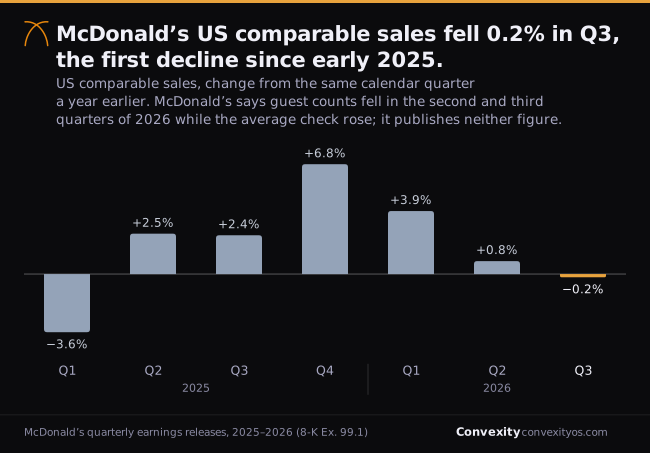
On November 4 McDonald's reported the third quarter of 2026. US comparable sales, the change in sales at restaurants open more than a year, fell 0.2%, the first decline since early 2025. The release says why in one line: "negative comparable guest counts were largely offset by positive check growth." Fewer people came; each spent a little more.
Then came the moment that made this quarter worth a closer look. An analyst on the call told management that peers had seen the lower-income cohort improve "for the first time all year," and asked what McDonald's was seeing. The answer was about the McDonald's app. Nobody on the call gave a reading on income at all, and the quarterly report McDonald's filed two days later does not give one either. The company that had put numbers on the low-income diner went quiet about her in the quarter she appears to have steadied.
That is the turn in this story. The usual reading of a McDonald's slump is that its poorest customers are pulling back. Most of the chains that spoke to the question this season say otherwise. Chipotle said its lower-income customers outperformed its higher-income ones for the first time this year. Domino's said orders grew "particularly among low-income consumers." Starbucks said growth was broad across income levels. Shake Shack disagrees, and we will come to it. But McDonald's own account of its traffic problem, given in August and repeated on November 4, is not about anyone's budget. It is about a trade it made in the spring: to pay for a new menu of items under $3, the US system pulled back the app deals and the buy-one-add-one offer that its most frequent customers used, and those customers came less often. Management called it "a bad trade."
What has not changed is who pays for the deal. McDonald's own US restaurants kept less of each sales dollar than a year earlier in four of the last five quarters, by our arithmetic, and the company expects food and paper costs to rise by a mid-single-digit percentage in 2027. Value buys visits. It is not free, and at McDonald's most of the bill lands on franchisees whose margins are not published anywhere.
- −0.2%
- McDonald’s US comparable sales, July to September, against +2.4% a year earlier
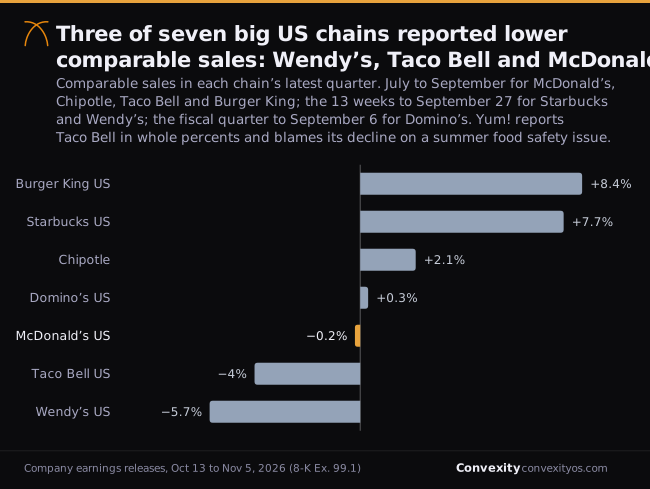
- 3 of 7
- big US chains whose comparable sales fell in their latest quarter: Wendy’s, Taco Bell and McDonald’s (our count)
- +0.8%
- Chipotle’s transaction growth, its third positive quarter in a row, as lower-income diners outpaced higher-income ones
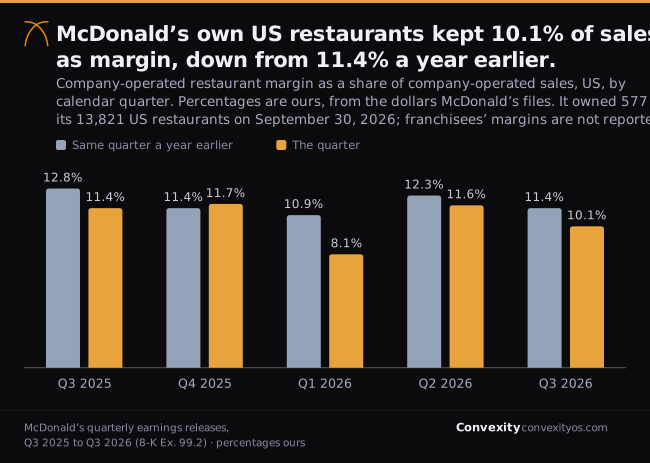
- 10.1%
- McDonald’s US company-operated margin as a share of sales, against 11.4% a year earlier (our arithmetic)
Earnings releases of McDonald's (Nov 4), Chipotle (Oct 28), Starbucks (Oct 29), Domino's (Oct 13), Yum! Brands (Nov 3), Restaurant Brands International (Oct 29) and Wendy's (Nov 5), 2026; the count and the margin percentages are ours.
The witness who stopped testifying
In November 2025, with US comparable sales up 2.4%, the bifurcation was the headline of the prepared remarks: lower-income fast-food traffic down nearly double digits, higher-income traffic up nearly as much. McDonald's had just relaunched Extra Value Meals, bundles of its best-known items at a set discount, and it said it would judge them first "by gaining share of lower-income consumer traffic."
In February 2026, reporting a fourth quarter in which US comparable sales rose 6.8% on both more guests and higher checks, Kempczinski could report a win on that measure: "we gained share with low-income consumers in December." He still expected the low-income consumer to "continue to be under pressure" through the year, with growth available among the better-off.
In May, on the first quarter (US comparable sales up 3.9%, driven by check), he was asked directly how the two groups were doing. The declines among lower-income customers were "not as pronounced" as the high-single-digit falls of six to twelve months earlier, he said, but "the low income is absolutely still declining." And he named the reason it might get worse: gasoline, whose rising price would "disproportionately impact" low-income consumers. By September gasoline was 34.2% dearer than a year earlier on the Bureau of Labor Statistics' index.
In August, on a second quarter in which US comparable sales rose only 0.8% and guest counts fell, the discussion moved from the customer to McDonald's own execution, which the next section takes up. And on November 4, asked outright, McDonald's gave no income reading at all. The analyst who asked, Brian Bittner of Oppenheimer, put the question with the peer evidence attached; Ian Borden, the chief financial officer, answered on the app's offers and their importance to loyalty members, and Kempczinski added that "That frequent customer is super sensitive to digital offers."
We do not read anything sinister into the silence; McDonald's may simply have had nothing new to say. But the one chain that used to quantify the low-income diner every quarter did not do so in the quarter when most of the chains that spoke up said she had steadied, and its own explanation for its weak traffic points somewhere else entirely.
A slump McDonald's says it caused
The story starts in late April. McDonald's added an "everyday affordable price" menu to its McValue program in the US: ten items for under $3, plus a $4 breakfast meal deal. On paper it was the entry-level value that management has said the lower-income customer most wants. In practice, by McDonald's own account on the August call, three things went wrong at once.
First, execution was uneven. Kempczinski said only about 60% to 65% of the system was running the recommended pricing on the under-$3 menu, and suggested why: an "under $3" label leaves room that a fixed "$5 meal deal" does not, and some operators "saw an opportunity to go take pricing." Second, customers did not notice; awareness came in below target. Third, and most costly, the system paid for the new menu by taking something else away. In Borden's words, the business "pulled back on digital offers and removed" the Buy One, Add One for $1 feature "to offset the investment behind McValue." Those offers lived in the app, and the app is where McDonald's most frequent customers are. The combination "negatively impacted visits from some of our most loyal customers," Borden said, and McDonald's estimated that these value missteps explained about "two-thirds of the customer traffic underperformance relative to our expectations" in the second quarter. Kempczinski's summary was blunter: it "ended up being a bad trade."
Hold that against the hypothesis that lower-income diners are pulling back. The customers McDonald's says it lost in the spring were its regulars, not a demographic. They may well skew toward lower incomes, since frequent fast-food visits and sensitivity to app coupons tend to go together, but McDonald's has not said so, and nobody outside the company can check. What McDonald's has said is that "Those frequent customers represent the majority of our sales," that its US loyalty program is "almost 30% of our customer base," and that about a third of its sales are digital. Pull the deals those customers count on and the traffic falls whatever their income.
The third quarter was the repair. McDonald's partly restored regional and national app offers, with examples including "a $2 breakfast sandwich and free fries with a $1 minimum purchase," and moved its marketing money back toward meal deals and the Extra Value Meals, whose top items have sold about 7% more units than a year earlier since the relaunch. The release credits these steps directly: "In the U.S., we're encouraged by improvement as the quarter progressed following our intervention on value." On the call, Kempczinski put the monthly shape on it: comparable sales turned positive in September, "following a slightly negative result in July and August."
| US comparable sales, change from a year earlier | |
|---|---|
| 2025-Q1 | −3.6% |
| 2025-Q2 | +2.5% |
| 2025-Q3 | +2.4% |
| 2025-Q4 | +6.8% |
| 2026-Q1 | +3.9% |
| 2026-Q2 | +0.8% |
| 2026-Q3 | −0.2% |
The chart shows how far the US business has drifted since the fourth quarter of 2025. Each quarter since has been weaker than the one before. The third quarter's 0.2% decline is small in itself, and it came against a 2.4% gain a year earlier. The composition is the problem. Every quarter of 2026 has been carried by the average check rather than by guests, and in the second and third quarters guest counts fell outright.
There is a useful yardstick for that check. The Bureau of Labor Statistics' index for limited-service meals and snacks, the official measure of fast-food menu prices, was 3.2% higher in September than a year earlier. McDonald's does not say how much its average check rose, but a chain whose sales were flat while fast-food prices rose about 3% was serving fewer meals, or smaller ones, or both.
The wider trade offers a second yardstick, and a caution. Revenue Management Solutions, a restaurant industry consultant, put the fall in US fast-food traffic at 2.6% in the third quarter, according to the Associated Press, which read it as Americans struggling with gasoline and the cost of living. McDonald's gives no guest-count figure, so we cannot say whether it beat its trade, but it was not losing visits alone.
Two cautions keep us from making too much of the September turn. The first is that McDonald's would not promise a better fourth quarter. When an analyst read the prepared remarks that way, Borden corrected him: "I did not say that fourth quarter U.S. comps would be better." What he would say was that baseline traffic had improved through September and into October, and that the US business should leave 2026 in a stronger position. The second is that the turn came from restoring deals. That is good evidence that the deals matter to McDonald's regulars. It is not evidence that anything has changed in their finances.
What the other counters saw
Set McDonald's beside the six other big US chains that reported this season and it finishes fifth of seven, ahead only of a chain caught in a food-safety scare and one that lost more than a tenth of its traffic. A note on dates first, because the quarters do not line up. McDonald's, Chipotle, Taco Bell and Burger King report calendar quarters, July through September. Starbucks' fiscal fourth quarter and Wendy's fiscal third quarter were each the 13 weeks to September 27. Domino's fiscal third quarter ended on September 6, so it covers most of the summer and almost none of September. The comparison below holds each chain to its own latest quarter and says which it is.
| Comparable sales, change from a year earlier | |
|---|---|
| Burger King US | +8.4% |
| Starbucks US | +7.7% |
| Chipotle | +2.1% |
| Domino’s US | +0.3% |
| McDonald’s US | −0.2% |
| Taco Bell US | −4% |
| Wendy’s US | −5.7% |
Three of the seven chains reported lower comparable sales, and not one of the three puts its decline down to its customers' wallets. Taco Bell's has the plainest explanation. Chris Turner, Yum! Brands' chief executive, said Taco Bell's US same-store sales fell 4% "owing to the industry-wide food safety issue." Nobody named it on the call, but the release's list of risks to Yum's forecasts includes "the impact of the July 2026 cyclospora outbreak." The Centers for Disease Control and Prevention's final update on a July outbreak of cyclosporiasis, an intestinal illness, counted 12,883 illnesses in 21 states, at least 570 hospitalizations and two deaths, and traced it to iceberg lettuce from Taylor Farms de Mexico; earlier updates on the same page noted ill people who reported eating at Taco Bell. Yum's release says Taco Bell US has outpaced the fast-food industry on same-store sales since the end of September.
Strip out the outbreak and the two chains whose sales fell are both burger chains, and the starker case reported the day after McDonald's. Wendy's US same-restaurant sales fell 5.7% in the 13 weeks to September 27, on top of a 4.7% fall a year earlier. Traffic fell 11.9%, the company said on its call, the largest decline any of the seven disclosed, while the average check rose 6.2%. Nobody on the call offered a reading on lower-income customers. Bob Wright, the chief executive, talked instead about what his own company had done to the balance of quality and value: "we've let it go by making cuts in the wrong places and making investments in too many discounts in the wrong places." In August, Wendy's had said its second-quarter fall in traffic, 12.5%, "included the impact of less discounting and reducing or eliminating breakfast operating hours at certain locations."
The details differ from McDonald's, but the genre is the same: a burger chain losing customers and blaming its own decisions about value. And Burger King, selling to the same country in the same months, rose 8.4%. If the burger customer's wallet were the whole story, it would not have spared Burger King.
What the chains said about income is the part that bears on our question.
| Chain | Latest quarter | Comparable sales | Traffic | What management said about lower-income customers |
|---|---|---|---|---|
| McDonald's | Jul–Sep | −0.2% | Guest counts down, no figure | No reading given; asked, it discussed app offers |
| Wendy's | 13 weeks to Sep 27 | −5.7% | Traffic −11.9%, check +6.2% | No reading given; blames its own execution |
| Chipotle | Jul–Sep | +2.1% | Transactions +0.8% | Outperformed higher-income customers for the first time this year |
| Starbucks | 13 weeks to Sep 27 | +7.7% | Transactions +2.4% | Growth "broad-based across income levels" |
| Domino's | Quarter to Sep 6 | +0.3% | Orders grew, no figure | Orders grew "particularly among low-income consumers"; fewer items per order |
| Taco Bell | Jul–Sep | −4% | Not disclosed | Value menu "resonates particularly well" among them; no reading on how they are faring |
| Burger King | Jul–Sep | +8.4% | Not disclosed | No reading given; value deals steady, fastest growth in premium items |
Chipotle's statement is the most precise of the season. Scott Boatwright, its chief executive, said: "we saw lower income cohorts outperform higher income cohorts for the first time this year, with the greatest strength in September when promotional activity was at its lowest." The second half of that sentence matters as much as the first. Chipotle finished September up 3.8%, Boatwright said, with "very little promo activity," so the lower-income customers it gained were not bought with discounts. There is a warning attached, though. Adam Rymer, the chief financial officer, said "October trends have softened, consistent with the broader industry."
Domino's tells a subtler story, and arguably a more important one for this question. Joe Jordan, its chief executive, said: "we're very pleased to continue to see order count growth, particularly among low-income consumers." The pressure showed up somewhere else. Customers were "still coming to us, but managing their ticket by managing items per order," he said, which is to say fewer things in each basket. US same-store sales rose just 0.3%, against 5.2% a year earlier, with prices up 1.2% by the count of Sandeep Reddy, the chief financial officer. That is the shape of a stretched household that has not given up eating out. It still comes; it buys less.
Starbucks is the outlier on the upside and the hardest to compare. US comparable sales rose 7.7%, with the average ticket up 5.2% and transactions up 2.4%, and Brian Niccol, its chairman and chief executive, said sales growth was "broad-based across income levels." Some of that growth was mechanical. Asked about store closures and transfers, Cathy Smith, the chief financial officer, said "About 200 basis points helped us there," which is the lift a chain gets when customers of closed coffeehouses move to nearby ones that count as comparable. A coffeehouse ticket says little about the fast-food customer, but nothing in Starbucks' numbers suggests a consumer in retreat.
Then there is the comparison McDonald's least wants. Burger King's US comparable sales rose 8.4%, against 3.2% a year earlier. Josh Kobza, chief executive of its parent, Restaurant Brands International, said Burger King had "widened our gap to Burger QSR peers to nearly 10 points" and had reclaimed second place in US burgers. The gap to McDonald's in the July-to-September quarter was 8.6 points, by our arithmetic. Kobza credited a mix that should interest anyone watching value: "$5 Duos and $7 Trios continue to support steady value incidents as we see outsized growth in more premium areas of the menu." Burger King does not disclose traffic, so we cannot say how much of its gain came from more visits. But its own description is of a customer who takes the deal and then trades up, which is not the behavior of someone who has stopped eating out.
Two smaller chains, outside our seven, pull in opposite directions, and one of them is the best evidence against us. At CAVA, up 3.1% in the quarter to October 4, Tricia Tolivar, the chief financial officer, said restaurants in lower-income markets had "the strongest and highest same-restaurant sales." At Shake Shack, up 2.5% in the quarter to September 30, Rob Lynch, the chief executive, said: "While higher-income guests continue to spend, lower-income guests remain under pressure," most of all in cities. Lynch says "we have less exposure to the low-income segment," so his is a narrower window than most, but it is a plain statement from a chain that looked, and it cuts the other way.
Put together, the season's evidence does not show a lower-income diner in general retreat from restaurants. Of the nine chains named here, five said how she was doing: four said steady or better, one said under pressure, and McDonald's, Wendy's, Taco Bell and Burger King gave no reading. That is a majority, not a consensus, and the tally is ours. Bank of America's card data, published in August, leans the same way: "Lower-income households are now posting the fastest restaurant spending growth among income groups," though the growth "appears strongest at independent restaurants, regional operators and other non-chain establishments." Set beside the fall in fast-food traffic, that suggests, on our reading, that she is still eating out and not always at a national chain. What the evidence shows is a diner who has steadied in how often she comes, spends carefully once she is there, and responds to a clear deal. That is consistent with what McDonald's itself says about its spring: take the deal away and she goes elsewhere.
Who pays for the deal
The second half of the hypothesis, that value buys traffic at the cost of margin, holds up better, with a twist that is particular to McDonald's.
Start with the restaurants McDonald's runs itself. In the third quarter its US company-operated restaurants earned a margin of $75 million on sales of $742 million, against $90 million on $790 million a year earlier. The release puts the decline at 16% in dollars and attributes it to "the impact of ongoing inflationary cost pressures." As a share of sales, that is 10.1% against 11.4%, by our arithmetic. The margin is what is left after food and paper, crew pay and benefits, and occupancy and other restaurant costs, before overhead.
| Same quarter a year earlier | The quarter | |
|---|---|---|
| Q3 2025 | 12.8% | 11.4% |
| Q4 2025 | 11.4% | 11.7% |
| Q1 2026 | 10.9% | 8.1% |
| Q2 2026 | 12.3% | 11.6% |
| Q3 2026 | 11.4% | 10.1% |
The margin was lower than a year earlier in four of the five quarters shown, and the exception, the fourth quarter of 2025, was the one quarter in which promotions brought in more guests. The first quarter of 2026 was the worst, at 8.1% of sales against 10.9%, and Borden told analysts in May that "our U.S. company-operated margins in the quarter were not acceptable." Take the line with caution all the same. McDonald's is selling company-run restaurants to franchisees, and on September 30 it ran 90 fewer US restaurants itself than a year earlier (577 against 667, our arithmetic), so the set of company-run stores is changing under the measure, and a shrinking sample of about 4% of the US system (our arithmetic) is not the whole business.
It is, however, the only window McDonald's opens onto what a US restaurant earns, and that is the twist. About 96% of McDonald's US restaurants are run by franchisees, who pay McDonald's rent and royalties calculated on their sales. In the third quarter McDonald's US franchised margin, the rent and royalties less the company's occupancy costs, rose 2% to $1,619 million, and it was 95.6% of all US restaurant margin dollars (our arithmetic). McDonald's earns on the franchisee's top line. The franchisee earns on what is left after food, labor and the discount.
That split explains the spring better than any income statistic. A menu of items under $3 costs the operator margin on every sale. Pulling the app deals to pay for it protected the operator's margin and cost the system traffic. McDonald's says franchisees now want entry-level value too, and they remain under cost pressure. Asked how franchisees' cash flow per restaurant compared with the $500,000 level McDonald's had cited at its September investor day, Kempczinski said he did not have the latest number but thought it "broadly in line with where we talked about." The quarterly report McDonald's filed on November 6 says it plans about $8.5 billion in cash support worldwide through 2036, in rent relief and capital. At the investor day it tied that money to new technology, kitchens and operations: help with the next remodel rather than the next discount. And Kempczinski was candid about pricing: "we've learned the lesson over the last 18 months that you need to proceed very cautiously."
The other chains that run their own restaurants show the same trade in their margins. Chipotle's restaurant-level operating margin, the share of sales left after food, labor, occupancy and other restaurant costs, fell to 23.3% from 24.5%. Rymer said marketing costs rose about 40 basis points "as we leaned into promotional activity to reengage guests." The Taco Bell division's company restaurant margin fell to 20.2% from 23.7%, through an outbreak quarter, and Chris Turner, Yum's chief executive, was explicit that value is the weapon: "With higher gasoline prices pressuring household budgets, Taco Bell's value architecture remains a critical advantage over its peers." Domino's, whose US stores are almost all franchised (187 of 7,257 were company-owned on September 6), has the McDonald's problem in miniature. Reddy said franchisee profits were under year-on-year pressure in dollars, and that the aim is "first to stabilize it and then to start it growing again." Wendy's shows the bill when the traffic does not come. Its US company-operated margin fell to 11.7% from 13.1%, and its quarterly report says "recent operating results have contributed to financial pressure for certain of our franchisees." One of them, Meritage Hospitality Group, with 314 restaurants and $27.4 million in overdue royalties and fees, got a termination notice on September 16 and filed for Chapter 11 the next day. Nobody this season described value as free.
The diner's budget
Step back from the counters and the macro data tell the same two-sided story the chains do.
On one side, the lower-income household is being squeezed. Real disposable income fell 0.3% in September, according to the Bureau of Economic Analysis, and the saving rate was 3.8%; our note on the Fed's October hold and third-quarter GDP shows that rate at its lowest since October 2022. The Federal Reserve's own minutes from September record that "low- and moderate-income households faced strains, with higher energy prices weighing disproportionately on their real disposable income." In grocery aisles, our note on packaged food volume found volumes down at seven of nine companies that report them, and General Mills describing the middle- and lower-income consumer as very stressed.
On the other side, the household is still paying its bills and still eating out. Our note on bank earnings and the consumer found card charge-off rates lower than a year earlier at all seven big card lenders, because people have jobs. Restaurant prices are rising, but not explosively: the Bureau of Labor Statistics' index for food away from home rose 3.5% in the year to September, 3.2% for fast food and 3.8% for full-service meals. A household in that position does not stop going to restaurants. It goes less often to the ones that stopped giving it a deal, buys one fewer item, and notices a $5 bundle.
That is the reconciliation of the strained macro picture with the steadier restaurant data. The lower-income diner has not left the market. She has become the most price-aware customer in it, and over the summer she rewarded the chains that kept their offers clear and punished those that did not, McDonald's, by its own account, among them.
What McDonald's is doing next
McDonald's answer is more entry-level value, done properly this time. In late October it began an eight-week test of two new everyday bundle formats across all dayparts in about 1,900 restaurants: mix-and-match bundles meant to replace the old buy-one-add-one habit, and fixed bundles at a set price. Franchisees running about 4,000 more restaurants chose to adopt similar bundles before the test ends. McDonald's says that together these cover more than 40% of the US system, and it plans a national launch in early 2027.
Kempczinski framed the gap the test is meant to close in terms of the very customer this note is about: "particularly for that low-income consumer, they're looking for great entry-level value, and we have not had that in place to the level that we are satisfied with."
The cost side will not make it easier. McDonald's expects mid-single-digit food and paper inflation in 2027, which it called higher than its long-term historical trends. That is a squeeze on the franchisee's margin at exactly the moment the system has agreed to cut entry prices. The spring showed what happens when operators fund value by quietly taking something else away. The test will show whether the system has found a way to fund it without doing that.
What would prove this wrong
- McDonald's gives an income split that shows lower-income traffic still falling. Our reading rests partly on what other chains said and on McDonald's own explanation of its spring. If McDonald's quantifies the cohort again and the decline among lower-income customers has deepened, the hypothesis we doubted would be right after all, at least at McDonald's.
- Chipotle's October softening and Shake Shack's dissent spread. Chipotle said October softened "consistent with the broader industry," and Shake Shack already reads its lower-income guests as under pressure. If more chains reporting fourth-quarter results in early 2027 describe that cohort weakening through the holidays, the summer's steadiness was a pause rather than a floor.
- Restored offers fail to lift McDonald's US guest counts. McDonald's attributes its traffic loss to removed deals. If its fourth-quarter guest counts stay negative now that many of those deals are back, the cause was something deeper than the bad trade.
- Burger King's lead proves to be mostly price. If Restaurant Brands discloses that its gain came from higher checks rather than more visits, the big chains' evidence on traffic narrows to Chipotle, Starbucks and Domino's.
- The October income report shows a sharper squeeze. The Bureau of Economic Analysis is scheduled to publish it on December 2. A further fall in real disposable income, especially if gasoline stays high, would raise the odds that the steadiness this note describes does not survive the winter.
The filings and documents this is built on
39 documents
- 018-KMcDonald’s, third quarter 2026 earnings release (Exhibit 99.1)US, IOM, IDL and global comparable sales; the guest count and check sentence; EPS; the chief executive’s quote on the intervention on valueNov 4, 2026sec.gov
- 028-KMcDonald’s, third quarter 2026 earnings release, supplemental information (Exhibit 99.2)US company-operated sales and margins, US franchised margins, gains on sales of restaurants, and US restaurants by typeNov 4, 2026sec.gov
- 0310-QMcDonald’s, quarterly report for the period ended September 30, 2026US comparable sales and guest counts; about $8.5 billion in cash partnering support through 2036; no reading on lower-income customersNov 6, 2026sec.gov
- 04CallMcDonald’s investor day 2026, transcript (StockAnalysis)What the partnering money is for; one transcript only, so paraphrased and not quotedSep 23, 2026stockanalysis.com
- 05CallMcDonald’s third quarter 2026 earnings call, transcript (StockAnalysis)One of two independent transcripts; every third-quarter quotation appears in bothNov 4, 2026stockanalysis.com
- 06CallMcDonald’s third quarter 2026 earnings call, transcript (Gloom)The second independent transcript, an audio transcriptionNov 4, 2026gloom.sh
- 078-KMcDonald’s, second quarter 2026 earnings release (Exhibits 99.1 and 99.2)US comparable sales of 0.8% and 2.5% a year earlier, the guest count sentence, US company-operated marginsAug 4, 2026sec.gov
- 08CallMcDonald’s second quarter 2026 earnings call, transcript (StockAnalysis)The under-$3 menu, the pulled digital offers and Buy One, Add One, the two-thirds estimate and the bad trade; every quotation also appears in the Gloom transcript belowAug 4, 2026stockanalysis.com
- 09CallMcDonald’s second quarter 2026 earnings call, transcript (Gloom)Second transcript for the August quotationsAug 4, 2026gloom.sh
- 108-KMcDonald’s, first quarter 2026 earnings release (Exhibits 99.1 and 99.2)US comparable sales of 3.9% and −3.6% a year earlier; US company-operated marginsMay 7, 2026sec.gov
- 11CallMcDonald’s first quarter 2026 earnings call, transcripts (StockAnalysis; Motley Fool)“the low income is absolutely still declining” and the gasoline remark, in bothMay 7, 2026fool.com
- 128-KMcDonald’s, fourth quarter and full year 2025 earnings release (Exhibits 99.1 and 99.2)US comparable sales of 6.8% on check and guest count growth; US company-operated marginsFeb 11, 2026sec.gov
- 13CallMcDonald’s fourth quarter 2025 earnings call, transcripts (StockAnalysis; Motley Fool)Share gains with low-income consumers in December, in bothFeb 11, 2026fool.com
- 148-KMcDonald’s, third quarter 2025 earnings release (Exhibits 99.1 and 99.2)US comparable sales of 2.4%; US company-operated marginsNov 5, 2025sec.gov
- 15CallMcDonald’s third quarter 2025 earnings call, transcripts (StockAnalysis; Motley Fool)Lower-income fast-food traffic down nearly double digits, higher-income up nearly double digits, in bothNov 5, 2025fool.com
- 168-KChipotle Mexican Grill, third quarter 2026 earnings release (Exhibit 99.1)Comparable restaurant sales, transactions, average check and restaurant level operating marginOct 28, 2026sec.gov
- 17CallChipotle third quarter 2026 earnings call, transcripts (Quartr via Fortune; Motley Fool)The lower-income cohort remark, September at 3.8%, the October softening; quotations appear in bothOct 28, 2026fool.com
- 188-KStarbucks, fourth quarter fiscal 2026 earnings release (Exhibit 99.1)13 weeks ended September 27, 2026: US comparable sales, ticket and transactionsOct 29, 2026sec.gov
- 19CallStarbucks fourth quarter fiscal 2026 earnings call, transcripts (Quartr via Fortune; Gloom; Motley Fool)Growth across income levels; about 200 basis points from closures and transfersOct 29, 2026fool.com
- 208-KYum! Brands, third quarter 2026 earnings release (Exhibit 99.1)Taco Bell US same-store and system sales, division margins, the end-of-September remark, and the July 2026 cyclospora outbreak among the forward-looking risksNov 3, 2026sec.gov
- 21CallYum! Brands third quarter 2026 earnings call, transcripts (Quartr via Fortune; Gloom; Motley Fool)The food safety issue, gasoline and value, heavy, medium and light usersNov 3, 2026fool.com
- 228-KDomino’s Pizza, third quarter 2026 earnings release (Exhibit 99.1)Fiscal quarter ended September 6, 2026: US same store sales and the year earlierOct 13, 2026sec.gov
- 23CallDomino’s third quarter 2026 earnings call, transcripts (StockAnalysis; Gloom)Order growth among low-income consumers, items per order, pricing of 1.2%; quotations appear in bothOct 13, 2026stockanalysis.com
- 248-KRestaurant Brands International, third quarter 2026 earnings release (Exhibit 99.1)Burger King US comparable sales of 8.4% and 3.2% a year earlierOct 29, 2026sec.gov
- 25CallRestaurant Brands International third quarter 2026 earnings call, transcripts (StockAnalysis; Gloom; Motley Fool)The gap to burger peers and the $5 Duos and $7 Trios remark, in all threeOct 29, 2026stockanalysis.com
- 268-KThe Wendy’s Company, third quarter 2026 earnings release (Exhibit 99.1)13 weeks ended September 27, 2026: US same-restaurant sales of −5.7% and −4.7% a year earlier; US company-operated margin of 11.7% and 13.1%Nov 5, 2026sec.gov
- 2710-QThe Wendy’s Company, quarterly report for the period ended September 27, 2026Financial pressure on franchisees; the Meritage Hospitality Group termination notice and Chapter 11 filingNov 5, 2026sec.gov
- 28CallWendy’s third quarter 2026 earnings call, transcripts (StockAnalysis; Motley Fool; Gloom)Traffic of −11.9% and check of +6.2%, in StockAnalysis and Motley Fool; the balance of quality and value quotation, in both; no reading on lower-income customers in any of the threeNov 5, 2026fool.com
- 29CallWendy’s second quarter 2026 earnings call, transcripts (StockAnalysis; Gloom)Traffic of −12.5%, less discounting and fewer breakfast hours; in bothAug 7, 2026stockanalysis.com
- 308-KCAVA Group, third quarter 2026 earnings release (Exhibit 99.1)Fiscal quarter ended October 4, 2026: same-restaurant sales of 3.1%Nov 4, 2026sec.gov
- 31CallCAVA third quarter 2026 earnings call, transcripts (StockAnalysis; Gloom)Strongest same-restaurant sales in lower-income markets, in bothNov 4, 2026stockanalysis.com
- 328-KShake Shack, third quarter 2026 shareholder letterQuarter ended September 30, 2026: same-Shack sales of 2.5%Nov 5, 2026sec.gov
- 33CallShake Shack third quarter 2026 earnings call, transcripts (StockAnalysis; Gloom)Lower-income guests under pressure, softness in urban markets, less exposure to that segment; quotations appear in bothNov 5, 2026stockanalysis.com
- 34PressAssociated Press (Dee-Ann Durbin), McDonald’s US foot traffic falls as more customers struggle with the high cost of livingRevenue Management Solutions’ figure for third-quarter fast-food traffic, −2.6%; retrieved 2026-11-09Nov 4, 2026ksat.com
- 35ReportBank of America Institute, restaurants and discretionary spendingBank of America card data: lower-income households and non-chain restaurants; retrieved 2026-11-09Aug 2026institute.bankofamerica.com
- 36AgencyCDC, Cyclosporiasis outbreak linked to iceberg lettuce, July 2026: final updateFinal update of September 11, 2026: 12,883 illnesses, 21 states, at least 570 hospitalizations, two deaths; retrieved 2026-11-04Sep 11, 2026cdc.gov
- 37AgencyBureau of Labor Statistics, Consumer Price Index, September 2026, Table 2Food away from home 3.5%, limited service meals 3.2%, full service meals 3.8%, gasoline (all types) 34.2%, 12 months to September; retrieved 2026-11-04Oct 14, 2026bls.gov
- 38AgencyBureau of Economic Analysis, Personal Income and Outlays, September 2026Real disposable income −0.3% in September; personal saving rate 3.8%Oct 29, 2026bea.gov
- 39AgencyFederal Reserve, Minutes of the Federal Open Market Committee, September 15–16, 2026Low- and moderate-income households and energy prices; released October 7, 2026, per the FOMC meeting calendar; retrieved 2026-11-04Oct 7, 2026federalreserve.gov
Not investment advice. This note is an analysis of public company disclosures and official statistics, published for research purposes, and not a recommendation to buy, sell or hold any security. A member of the Convexity team holds SPY, which holds McDonald's, Chipotle Mexican Grill, Starbucks, Yum! Brands, Domino's Pizza and Bank of America; no other position.
What here is ours rather than the companies'. As filed or stated by the companies: every comparable sales, traffic, transaction, ticket, check, pricing, sales, margin dollar, restaurant count and earnings figure; the Chipotle, Taco Bell and Wendy's margin percentages; the statements about income cohorts, guest counts, digital offers, the under-$3 menu, the bundle test and its restaurant counts, the 2027 inflation outlook, the cash partnering, the Meritage termination and per-restaurant cash flow; and every company quotation, each of which appears in two independently produced transcripts of the call or in the company's own filing. As published by the CDC, the Bureau of Labor Statistics, the Bureau of Economic Analysis and the Federal Reserve: the outbreak counts, the price indexes, real disposable income, the saving rate and the minutes. As reported by others: the 2.6% fall in fast-food traffic (Revenue Management Solutions, through the Associated Press) and the card-spending findings (the Bank of America Institute). Ours: the count of three chains in seven whose comparable sales fell, and McDonald's place fifth of the seven; the tally of nine chains named, five readings on lower-income customers, four steady or better and one under pressure; the 8.6-point gap between Burger King's and McDonald's US comparable sales; McDonald's US company-operated margin as a percentage of company-operated sales in each quarter, and the count of four quarters in five below the year before; the company-operated share of US restaurants (about 4%), the fall of 90 in company-operated US restaurants over the year, and the franchised share of US restaurant margin (95.6%); the reading that a chain with flat sales and rising menu prices served fewer or smaller meals; and the reading that falling fast-food traffic and rising lower-income restaurant spending together suggest a diner still eating out, and not always at a national chain.