








Disclosure, updated August 4, 2026. I am now long TE. I held no position when this was first published on July 29, 2026, and none when the July 30 update was added; the position was opened afterward. Nothing in the analysis below has been changed to fit it. This is not investment advice. Every figure here is cited to a filing. Where a number is company marketing rather than a filed disclosure, or is derived by arithmetic from filed figures rather than stated in one, I say so.
Update, July 30, 2026. The morning after this published, T1 agreed to sell $120 million of 4.75% convertible senior notes due 2031, which it calls a bridge to the fab financing rather than the financing. The same filing cuts the credit agreement's floor under Trina's stake from 9.9% to 5%, and its exhibit discloses that T1 plans to establish an at-the-market equity program. Both are covered at the end of the financing section below. Nothing else here has been changed.
I started this with a two-part working title: T1 Energy is the right company at the wrong time. It has the shape of a good argument. Here is an American company with a real solar factory in Texas, running at real volume, at the exact moment Washington decided to make domestic clean-energy manufacturing harder rather than easier. Bad luck, good asset.
The filings put a third part on the end, and it turns out to be the one that binds.
Take the halves in order. "Right company" is the one I cannot get the filings to support. T1's gross margin is a tax credit and nothing else: strip Section 45X out of 2025 and gross profit goes from positive $55.6 million to negative $90 million. Its only customer is the company that sold it the factory, and in May that company sold 42% of its own stake at more than twice today's share price. "Wrong time" is closer to true but too small a claim, because the policy that changed is the policy that created the arbitrage in the first place. You cannot be unlucky about the weather when the weather is the ground you are standing on.
And then there is the money, which is where this actually gets decided. G2_Austin, the cell fab that would give T1 a second source of margin and a domestic-content product to sell to somebody other than its supplier, now costs $510 million instead of $425 million, produces its first cells in 2027 instead of 2026, and does not have a financing. T1 has $79.1 million of unrestricted cash and owes $133 million for a patent portfolio by the end of October.
I want to be clear that this is not a doom note, because "the entire gross margin is a tax credit" invites a more dramatic conclusion than the evidence carries. T1 has a commissioned plant that works, a statute that pays it, a trade regime moving its way, and a management team that spent twelve months closing an existential regulatory hole and closed it. If the fab gets funded and built, the numbers on the other side are good enough that today's price is wrong in the other direction. That is a narrow, binary, high-variance bet rather than a dying company. It is just that the variance sits almost entirely in the third part of the title.
What T1 actually is
Start with the things that are true, because they are all true.
T1 Energy is the former FREYR Battery, renamed in February 2025. On December 23, 2024 it closed the acquisition of Trina Solar US Holding Inc. from Trina Solar (Schweiz) AG, an affiliate of a company T1's own 10-K describes as "a global solar company based in China," and with it a photovoltaic module plant in Wilmer, Texas that the company calls G1_Dallas. The plant has 5 GW of annual nameplate capacity across seven assembly lines, and T1 says it has run above nameplate. In 2025 it produced 2.79 GW of modules, inside a guidance range of 2.6 to 3.0 GW. In December 2025 T1 began building the first 2.1 GW phase of a solar cell fab in Milam County, Texas, called G2_Austin (Form 10-K, Dec 31 2025; Q4 and full-year 2025 results, Mar 31 2026).
The economics run on Section 45X of the tax code, the advanced manufacturing production credit created by the Inflation Reduction Act. It pays, for components made in the United States and sold to unrelated persons:
| Eligible component | Section 45X credit |
|---|---|
| Photovoltaic wafer | $12 per m2 |
| Photovoltaic cell | 4c per watt |
| Photovoltaic module | 7c per watt |
The credit runs through 2032 with a phase-down beginning in 2030. T1 expects roughly 7 cents a watt on its current module form factor, and today it earns only the module rate, because it buys its cells. G2_Austin is the plant that would let it claim the cell credit as well, which is the single most important number in the bull case and the reason the fab matters more than anything else in this note.
And the policy did change. The One Big Beautiful Bill Act, enacted July 4, 2025, added restrictions at sections 7701(a)(51), 7701(a)(52), 45X(d)(4), 45Y(b)(1)(E) and 48E(b)(6) that bar foreign and foreign-influenced taxpayers from claiming clean-energy credits, and bar unrelated developers from claiming credits on projects that lean too heavily on components made by such entities. T1's 10-K calls its response the "FEOC Restructuring" and notes that as of the filing, "No regulations under the PFE Restrictions have been proposed or finalized, and limited other formal guidance has been published."
So far, the working title holds. Everything after this is where it comes apart.
The gross margin is the credit
Here is the whole of 2025 in one column, before I take the gross line apart:
| Full-year 2025 | $M |
|---|---|
| Total net sales | 755.3 |
| Cost of sales | (699.7) |
| Gross profit | 55.6 |
| Selling, general and administrative | (235.3) |
| Impairment of intangible assets | (54.8) |
| Operating loss from continuing operations | (234.6) |
| Interest expense, net, and other | (106.2) |
| Net loss | (367.8) |
SG&A alone was 31% of revenue. But the line to look at is the third one, because of what is inside it.
Now the accounting policy for the credit, from the same document: "For income-based grants, we recognize a receivable and a reduction to the related cost of activities that generated the benefit." And the description of cost of sales: "These costs are offset by our generation of 45X Tax Credits." The credit does not sit in other income. It sits inside cost of sales, lowering it.
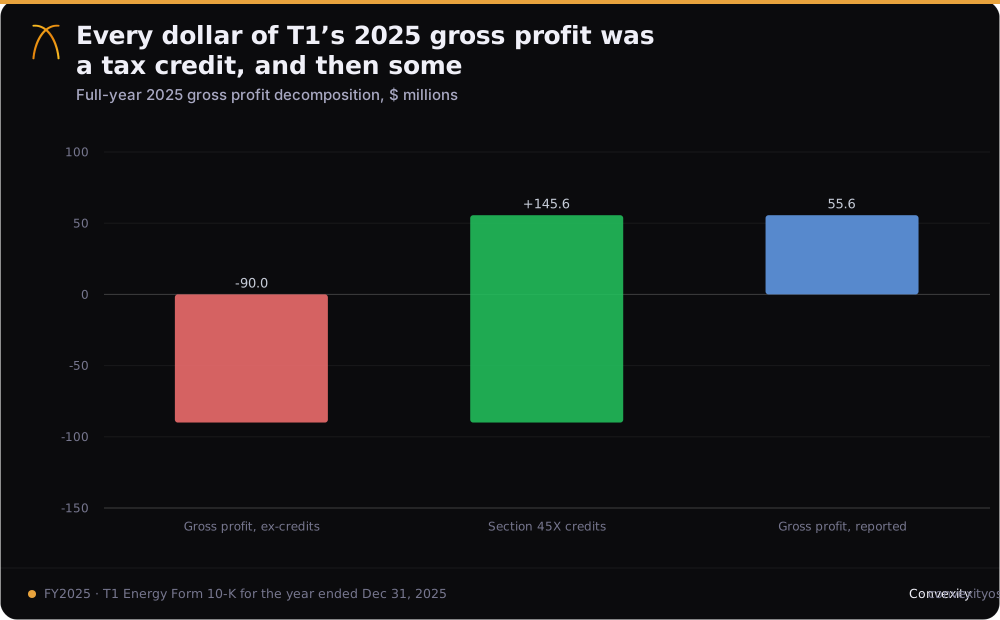
How much of it? The 10-K says: "In December 2025, we entered into an agreement for the sale of approximately $160.0 million of Advanced Manufacturing Production Credits, as defined in Section 45X of the Internal Revenue Code, we generated during 2025 for an aggregate purchase price of $145.6 million."
Take the lower of those two figures, the $145.6 million of cash actually contracted for, because the policy says grants expected to be transferred to a third party are carried at "the amount expected to be received from the transaction." Then 2025 gross profit excluding the credit is $55.6 million minus $145.6 million, or negative $90.0 million. On $755.3 million of sales that is a gross margin of negative 11.9%. At the credit's stated value of $160.0 million it is negative $104.4 million and negative 13.8%.
Quarter by quarter, that margin has been anything but stable:
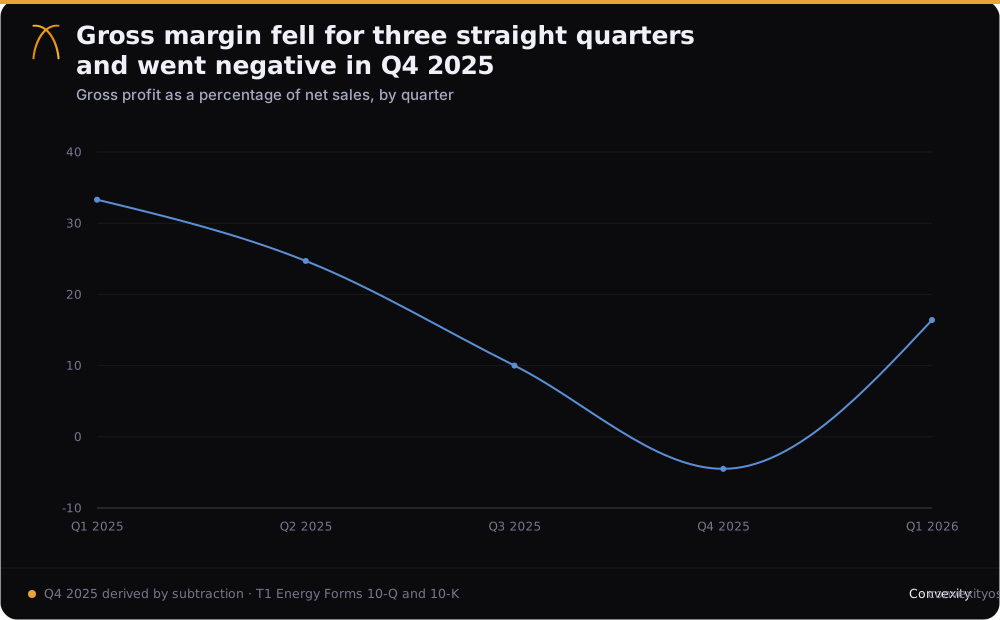
| Quarter | Net sales, $M | Gross profit, $M | Gross margin |
|---|---|---|---|
| Q1 2025 | 53.5 | 17.8 | 33.3% |
| Q2 2025 | 132.8 | 32.8 | 24.7% |
| Q3 2025 | 210.5 | 21.1 | 10.0% |
| Q4 2025 | 358.6 | (16.1) | (4.5)% |
| Q1 2026 | 177.6 | 29.1 | 16.4% |
The Q4 2025 row is derived by subtracting the nine-month figures in the Q3 10-Q from the full-year figures in the 10-K, because T1 does not file a fourth-quarter report. It says that in the quarter T1 produced a record 1.13 GW and booked record revenue of $358.6 million, it lost $16.1 million at the gross line, after the 45X credit. Treat that number with some care: the 10-K notes that service fee waivers under the Trina sales agency agreement were recorded within cost of sales as part of the December restructuring and analyzed together with the debt extinguishment, so the quarter carries restructuring effects that the others do not.
The credit is 2.6 times the entire reported gross profit. Per watt, across the 2.79 GW produced in 2025, that is roughly 27 cents of revenue, a gross loss of about 3.2 cents before the credit, about 5.2 cents of credit, and about 2.0 cents of gross profit left over. Those per-watt figures are approximate, because 2.79 GW is production and the credit attaches to modules sold, but the aggregate dollars are not approximate at all.
Two cents a watt is a thin thing to be left holding. For scale, under the sales agency agreement T1 inherited, Trina earns a commission of 2 cents a watt on the first 1.5 GW of Trina-branded modules where the cells come from outside the United States, rising to 3.5 cents a watt where the cells are American. That commission sits in operating expenses, below the gross line, and modules sold under T1's own brand are excluded from it following the December restructuring. But it is worth noticing that the fee to the sales agent, per watt, is about the size of the gross profit the manufacturer kept.
Below that line, 2025 operating expenses were $235.3 million of SG&A, 31% of revenue, plus a $54.8 million intangible impairment. Operating loss from continuing operations was $234.6 million. Net loss was $367.8 million, or $2.19 a share. Accumulated deficit at March 31, 2026 was $1.11 billion.
None of this is an accusation, and it is important to be careful about what it does and does not prove. Section 45X exists precisely because American module assembly cannot beat Chinese module prices unaided. A credit that carries a manufacturer through a ramp is the credit working exactly as designed, and every US module maker is leaning on it. Stripping the credit out and calling the remainder "the real economics" is a bit like valuing a regulated utility with the rate base removed: technically a number, but not the number the business is run against. The credit runs at full value through 2029 with a phase-down from 2030, so for the next several years it is as much a part of T1's cost structure as its electricity bill.
What the arithmetic does establish is narrower, and still worth knowing. There is no second engine. A manufacturer with a 15% product gross margin and a credit on top has two sources of margin and can survive losing one. T1 has one, and it is written in a statute that was amended against it twelve months ago. That is not the same claim as "the business does not work." It is the claim that everything rests on a single support.
Its only customer is its supplier
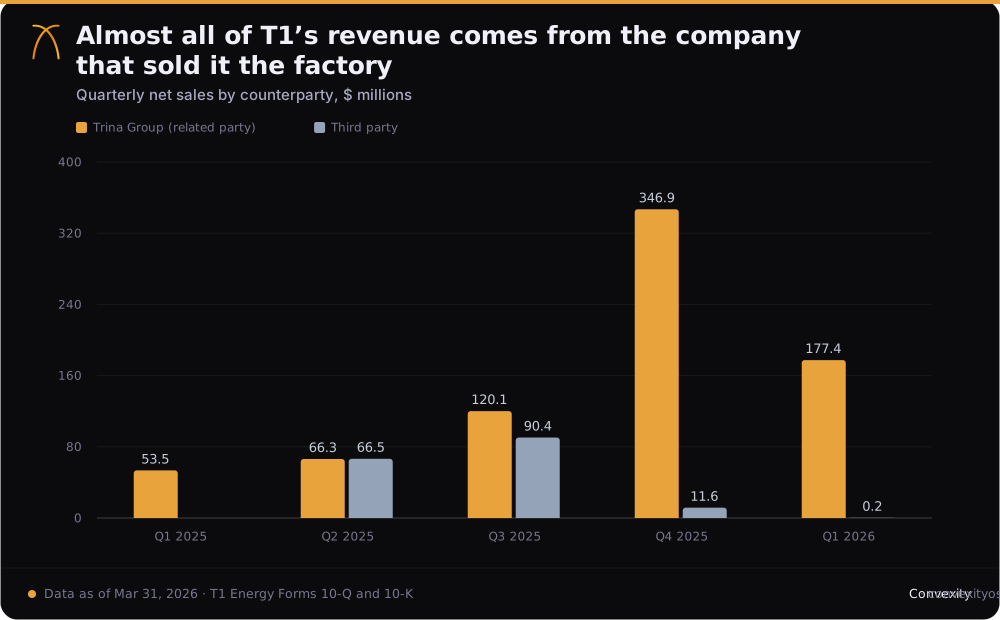
The 10-K discloses that one customer was 78% of 2025 net sales and 100% of trade accounts receivable. The Q1 2026 10-Q sharpens it: "One customer accounted for approximately 100% of our total net sales for the three months ended March 31, 2026 and 2025 and 100% of our aggregate trade accounts receivable, net as of March 31, 2026 and December 31, 2025. We are substantially dependent on a single customer."
The customer is the Trina Group. On the face of the income statement, Q1 2026 net sales were $177.6 million, of which $177.4 million was related party and $241 thousand was not (Form 10-Q, Mar 31 2026).
The related-party note is where the structure becomes clear. In Q1 2026 T1 sold $188.8 million of modules to the Trina Group, reported as $177.4 million after $11.3 million of amortization on a favorable acquired customer contract recognized in purchase accounting. In the same quarter it purchased $119.0 million of materials, components, operational support, sales agency and aftermarket services from the Trina Group, and incurred a further $8.5 million of commissions, royalty fees and selling costs under Trina arrangements.
Set out the whole relationship, all of it from the 10-K and the Q1 10-Q:
- Trina sold T1 the factory.
- Trina operates it, under a module operational support agreement covering technical support, quality, risk management, equipment maintenance, training, warehousing and logistics, for 5% of the plant's adjusted EBITDA plus costs.
- Trina supplies the components, at $119.0 million in the March quarter alone.
- Trina markets and sells the output as sales agent, for a per-watt commission, then a percentage of price, then half of any price above a target, then an EBITDA bonus.
- Trina licensed the technology, and until December 2025 the brand and the product warranty with it.
- Trina lent T1 $220.0 million, as a production reservation fee payable in $44.0 million annual installments.
- Trina holds anti-dilution rights letting it maintain its proportionate ownership at $1.70 a share through December 2027.
- And Trina buys approximately 100% of what comes out.
The contracts "require prepayment of 50% of the forecasted purchase price prior to the start of each quarter," which is why deferred revenue from Trina offtake was $90.0 million at March 31. T1's working capital is funded by its customer, which is also its supplier, its operator, its landlord of record for the technology, its sales channel and one of its lenders.
Netted out, one quarter of that relationship looks like this:
| Q1 2026 flows with the Trina Group | $M |
|---|---|
| Module sales to the Trina Group | 188.8 |
| Contract intangible amortization | (11.3) |
| Net sales, related party, as reported | 177.4 |
| Purchases of materials, components and services | (119.0) |
| Commissions, royalty fees and selling costs | (8.5) |
| Retained by T1 | 49.9 |
T1 booked $177.4 million of revenue from that quarter and kept $49.9 million of it after paying the same counterparty for the inputs and the selling. The subtotal and the retained line are arithmetic; every other line is disclosed in the related-party note.
What is genuinely American in that arrangement is the assembly step, the jobs, the Texas real estate, and the tax credit. The credit is the only part of it that is also the margin.
Trina sold 42% of its stake in May, at $8.46
On May 21 and 22, 2026, Trina Solar (Schweiz) AG sold 22,500,000 shares of T1 common stock. The Schedule 13D/A describes it as done "in the ordinary course of business," and the Form 4 filed with it gives the prices: five tranches at reported weighted averages from $8.13 to $9.20 a share, with the underlying transactions ranging from $8.07 to $9.06 (Form 4 and Schedule 13D/A, both May 26, 2026).
The tranches, as filed:
| Date | Shares sold | Weighted avg price |
|---|---|---|
| May 21, 2026 | 8,849,024 | $8.6229 |
| May 21, 2026 | 1,150,976 | $9.2011 |
| May 21, 2026 | 3,000,000 | $8.7080 |
| May 22, 2026 | 9,479,904 | $8.1347 |
| May 22, 2026 | 20,096 | $8.8000 |
| Total | 22,500,000 | $8.4582 |
That is roughly $190 million of gross proceeds at a blended average of $8.46. The tranche rows are as reported on the Form 4; the total and the blended price are my arithmetic across them. Trina's holding went from 53,152,664 shares, 19.6% of the class in its January amendment, to 30,652,664 shares and 11.0%. T1 closed at $3.72 on July 29.
There are two ways to read that and, again, both are supported.
The first is that this is precisely what everyone involved wanted. Every percentage point of Chinese-affiliate ownership is 45X exposure under the new rules. T1's 10-K notes that Trina's stake "never exceeded the 25% limit under the OBBBA," but 11% is a far wider margin of safety than 19.6%, and it arrives alongside the surrender of Trina's officer-appointment right and the March 2026 board resignation of Mingxing "Charles" Lin. The governance separation that the FEOC rules demanded is now substantially real rather than merely documented, and the float went up. If you are bullish, this is de-risking, and Trina taking its money off the table is the price of getting there.
The second is harder to wave away. The holder with the best information about this business, because it built the plant, staffed the plant, supplies the plant and buys its entire output, reduced its equity by 42% at an average of $8.46 while keeping every fee stream: the operating support fee, the sales commission, the component supply, the offtake, and $65.0 million of production reservation fee debt still owed to it. Selling the equity and keeping the rents is a specific ordering of preferences. It does not prove anything on its own, and a 13D/A that says "ordinary course of business" may mean exactly that. But it is the single most informative trade in the file, and the buyer of those 22.5 million shares is down about 56% eight weeks later.
One thing to watch, which is a disclosure question rather than an economic one. At 11% of the class, with no board seat and no right to appoint an officer, Trina's status as a related party for accounting purposes becomes arguable. If T1 reclassifies it in the second-quarter 10-Q, the "approximately 100% of net sales from one related party" line could simply disappear, with the same company buying the same modules on the same terms. That would be a change in the label, not in the concentration, and it is worth reading the next filing carefully for.
"A favorable sequential mix shift"
T1 did build a third-party business. In Q2 2025 merchant sales were $66.5 million against $66.3 million of related-party sales, a near-even split. In Q3 2025 they reached $90.4 million. The March 2026 results release described adding "two large utility-scale customers to its merchant sales base" in Q4, "underscoring the commercial traction T1 is gaining."
Then it went away. Third-party sales were $11.6 million in Q4 2025 and $241 thousand in Q1 2026.
Here is how the company explained the quarter in which that happened, announcing record profitability on May 12, 2026:
T1 achieves record quarterly Net Income from Continuing Operations of $3.9 million and record quarterly Adjusted EBITDA of $9.1 million in Q1 2026. Following the successful ramp of production at G1_Dallas in 2025, T1 achieved record quarterly profitability during the first quarter of 2026 due to higher than forecasted G1_Dallas production and sales, along with a favorable sequential mix shift of deliveries from merchant sales to fixed margin and cost-plus offtake contracts, and lower third-party fees.
T1 Energy, first quarter 2026 results, May 12 2026
Read that with the concentration note next to it. The company's best quarter was produced by shifting deliveries away from merchant customers and toward fixed-margin and cost-plus contracts. The March 2026 release describes the 2026 contracted book as "either cost plus or fixed margin." So the profitable channel is the one where the counterparty guarantees T1 a margin, and the thinner channel is the one where T1 has to win on price against the world market.
There are two honest readings of that sentence and they lead to different places.
The charitable one, which I think is at least half right: this is what an offtake agreement is for. Chinese overcapacity has been driving module prices below the cash cost of a lot of Western production. A manufacturer that holds contracted margin protection through that, and leans on it rather than selling into a bad spot market, is doing the sensible thing. Read that way, the mix shift is risk management working, and Q1 2026 is the evidence: net income from continuing operations of $3.9 million and adjusted EBITDA of $9.1 million, both positive, both records. The headline net loss of $21.4 million that quarter came from discontinued operations, the European wind-down, not from making modules in Texas.
The less charitable one, which I do not think can be dismissed: an offtake is protection against a bad market, but merchant sales at $90.4 million a quarter falling to $241 thousand is not protection, it is absence. And the contract doing the protecting is with the party that sold T1 the factory, supplies its cells and sells its output, so the margin being guaranteed is guaranteed by a counterparty whose own economics on the arrangement are not disclosed anywhere in T1's filings. A business that could clear the market on its own product would eventually want to prove it. Two more quarters of near-zero merchant revenue would settle which reading is right.
Sources: FY2025 10-K, Q1 2026 10-Q, Trina's Form 4 of May 26, and the July 28 results release. The blended price is computed.
The order book fell by more than half in a quarter
The revenue-recognition note carries T1's contracted future volume. The two most recent readings are three months apart.
From the 10-K, as of December 31, 2025: "we had entered into contracts with customers for the future sale of 6.0 GW of PV solar modules. We expect to recognize sales of 3.0 GW of PV solar modules in 2026, with incremental sales of 1.0 GW of PV solar modules in subsequent years through 2029."
From the 10-Q, as of March 31, 2026: "we had entered into contracts with customers for the future sale of 2.3 GW of PV solar modules. We expect to recognize sales of 2.3 GW of PV solar modules in 2026, with incremental sales of 1.0 GW of PV solar modules in subsequent years through 2029."
The headline contracted figure went from 6.0 GW to 2.3 GW in a quarter in which T1 recognized $177.6 million of revenue, on the order of half a gigawatt. Deliveries do not explain a 3.7 GW reduction. Something was amended, and the note tells you amendments are expected: these contracts "may also be subject to amendments as agreed to by the parties to the contracts which may increase or decrease the volume."
I would flag a second thing about those two paragraphs, and it cuts against my own argument as much as for it. Neither total reconciles with the components listed after it. At December 31, 6.0 GW total against 3.0 GW in 2026 plus 1.0 GW thereafter leaves 2.0 GW unaccounted for. At March 31, a 2.3 GW total is smaller than the 2.3 GW in 2026 plus 1.0 GW thereafter that the same sentence describes. One of those is arithmetically impossible as written.
That would be a pedantic observation about most companies. It is less pedantic here, because management identified two material weaknesses in internal control over financial reporting as of December 31, 2025, one of them new: "ineffective oversight, governance, and control ownership over certain internal controls over financial reporting processes and related information systems." Management concluded that internal control over financial reporting was not effective.
But I have to hold that consistently. If the disclosure is reliable, the contracted book fell by 62% in a quarter and that is a serious signal. If it is not reliable, then it is not reliable as evidence of a collapse either, and the honest position is that T1's contracted volume is currently not legible from the outside. I lean toward the first, because both figures are stated in the same sentence structure by the same filer one quarter apart, and because the note volunteers that amendments "may increase or decrease the volume." But a reader who wants to discount this section has a fair basis, and it is the weakest of the three findings in this note.
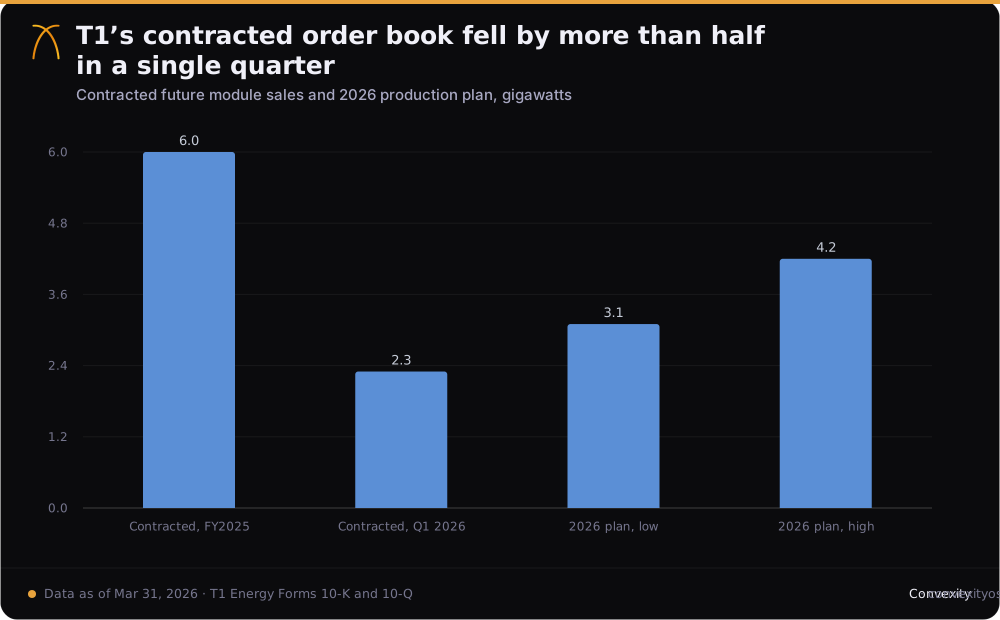
Against a 2.3 GW book, T1 kept 2026 production guidance at 3.1 to 4.2 GW and said in July that it expects the higher end. The high end implies an average of about 1.05 GW a quarter for the year. T1 shipped roughly 835 MW in the June quarter, an annualized 3.3 GW, and its record quarter remains the 1.13 GW of Q4 2025. First-quarter volume is not disclosed, so the required second-half run rate cannot be pinned down from the filings, but the high end of the range is asking the plant to sustain something close to its best quarter ever.
Set against that, the marketing figure. The May release reported that "Indicative customer demand for potential G1/G2 offtakes covers more than 100% of the Company's anticipated G1/G2 production capacity for 2027 - 2028." Indicative demand for potential offtakes is a real thing for a sales team to track. It is not the same category of object as the 2.3 GW in the revenue note, and only one of the two appears in a document an auditor reviews.
What the policy actually cost
Here is where the "wrong time" half of the thesis earns its keep, because the FEOC rules have cost real money, and the filings let you count it.
To stay eligible for 45X after the OBBBA, T1 had to demonstrate that Trina's equity stake, debt holdings, officer-appointment rights, control and intellectual property did not make T1 a prohibited foreign entity. The remedies, per the 10-K and the Q1 10-Q: it amended its certificate of incorporation to cap specified-foreign-entity ownership; it prepaid $155.0 million of the $220.0 million production reservation fee owed to Trina on December 29, 2025, using capital raised in late 2025 plus shares, to get Trina's share of its debt under the threshold; it paid Trina to give up its right to appoint a covered officer; it re-sourced cells to a supplier certifying non-prohibited status; and Trina sold the licensed patents to Evervolt Green Energy Holding Pte Ltd of Singapore, from whom T1 then licensed them, having concluded after diligence that "Evervolt is not an SFE."
Laid out against the statute, the restructuring closed every channel the new rules opened:
| OBBBA exposure | How T1 closed it |
|---|---|
| Equity ownership | Charter amended to cap specified-foreign-entity ownership; Trina since sold down to 11.0% |
| Debt held by a foreign entity | $155.0M of the $220.0M production reservation fee prepaid on Dec 29, 2025 |
| Right to appoint a covered officer | Surrendered by agreement; Trina's board designee resigned in March 2026 |
| Effective control | Concluded after diligence that no agreement confers it |
| Licensed intellectual property | Trina sold the patents to Evervolt; T1 bought them outright on Jul 28, 2026 |
| Material assistance in the supply chain | Cells bought from a supplier certifying non-prohibited status; US polysilicon, wafers and frames contracted |
Credit where it is due, because this is the part of the file that most argues against my own thesis. The OBBBA passed on July 4, 2025. Inside six months T1 had identified every channel through which the new rules could disqualify it, and closed all of them: equity, debt, governance, control, supply chain and intellectual property. In February, Treasury's initial guidance came out and T1 says it "validates the compliance plan that we developed and implemented." That is not a company being run over by policy. That is a management team that read a statute, understood it was existential, and executed a restructuring against a deadline. Whatever else the filings show, they show that.
On July 28, 2026, T1 bought those patents outright for $135 million: a $2 million option premium plus $133 million payable in four tranches, $60 million within three business days, then $25 million on September 30, $30 million on October 15 and $18 million on October 30 (Form 8-K, Jul 28 2026).
The press release explains the purchase as strategy. Owning the IP is "an important step to differentiate T1's competitive position as a vertically integrated crystalline silicon U.S. solar manufacturer," will be "accretive to T1 economically," and "eliminates future royalty payments." FEOC, OBBBA and Section 45X are not mentioned (press release, Jul 28 2026).
The 8-K is less coy. Among the seller's representations in the purchase agreement is "the Seller's status as a non-specified foreign entity as defined pursuant to Section 7701(a)(51)(B) and Section 7701(a)(51)(C) of the Internal Revenue Code." That is the prohibited-foreign-entity test. The same 8-K records that both existing license agreements, one dated July 16, 2024 and one dated December 23, 2024, were "terminated with immediate effect."
Both things are true at once, and the strategic reading is the stronger of the two. What T1 bought is the TOPCon patent estate underlying both products it intends to sell: the modules coming off G1 today and the cells coming out of G2 next year. Owning it outright, rather than licensing it from a Singapore holding company that acquired it from a Chinese manufacturer seven months earlier, means the technology layer of the vertical integration is now T1's property and cannot be transferred, repriced or encumbered by a licensor. The Amended IP License Agreement T1 had been operating under needed an explicit covenant restricting Evervolt from transferring the licensed IP to a specified foreign entity. Ownership makes that covenant unnecessary. For a company whose entire margin depends on being demonstrably free of foreign control, converting a license into a deed is a real asset, not just a compliance receipt.
What the filings will not tell you is whether $135 million was the right price. T1 discloses $8.5 million of combined commissions, royalty fees and other selling costs to the Trina Group for the March quarter without breaking out the royalty component, so the payback cannot be computed from the outside. And the sequencing is worth noting plainly: the press release says T1 "initially paid $2 million in cash to secure the right to acquire the IP," while the 8-K dates the call option letter agreement July 27, 2026 and the purchase agreement July 28, 2026. The option was granted and exercised in consecutive days.
Totting up what staying eligible for the credit has cost in cash and paper:
| Item | $M |
|---|---|
| Production reservation fee prepaid to Trina, Dec 29 2025 | 155.0 |
| Evervolt intellectual property purchase, Jul 28 2026 | 135.0 |
| Production reservation fee still outstanding | 65.0 |
| CBP duty bills on 2024 imports, disputed | 31.7 |
The first two are money spent to sever a linkage rather than to build capacity, and together they are $290 million against a market capitalization near $1.04 billion. The CBP bills are contested and T1 says they would be indemnified by Trina, so treat that row as an exposure rather than a cost.
Two more costs of the restructuring, both easy to miss. Trina's trademark license was terminated, and with it "Trina no longer provides product warranties for PV solar modules sold by the Company unless branded with the Trina trademark." T1 must now warrant its own modules, "supported by third-party warranty insurance." For a product sold on a 25-year performance promise into project finance, the identity of the warranty provider is not a detail.
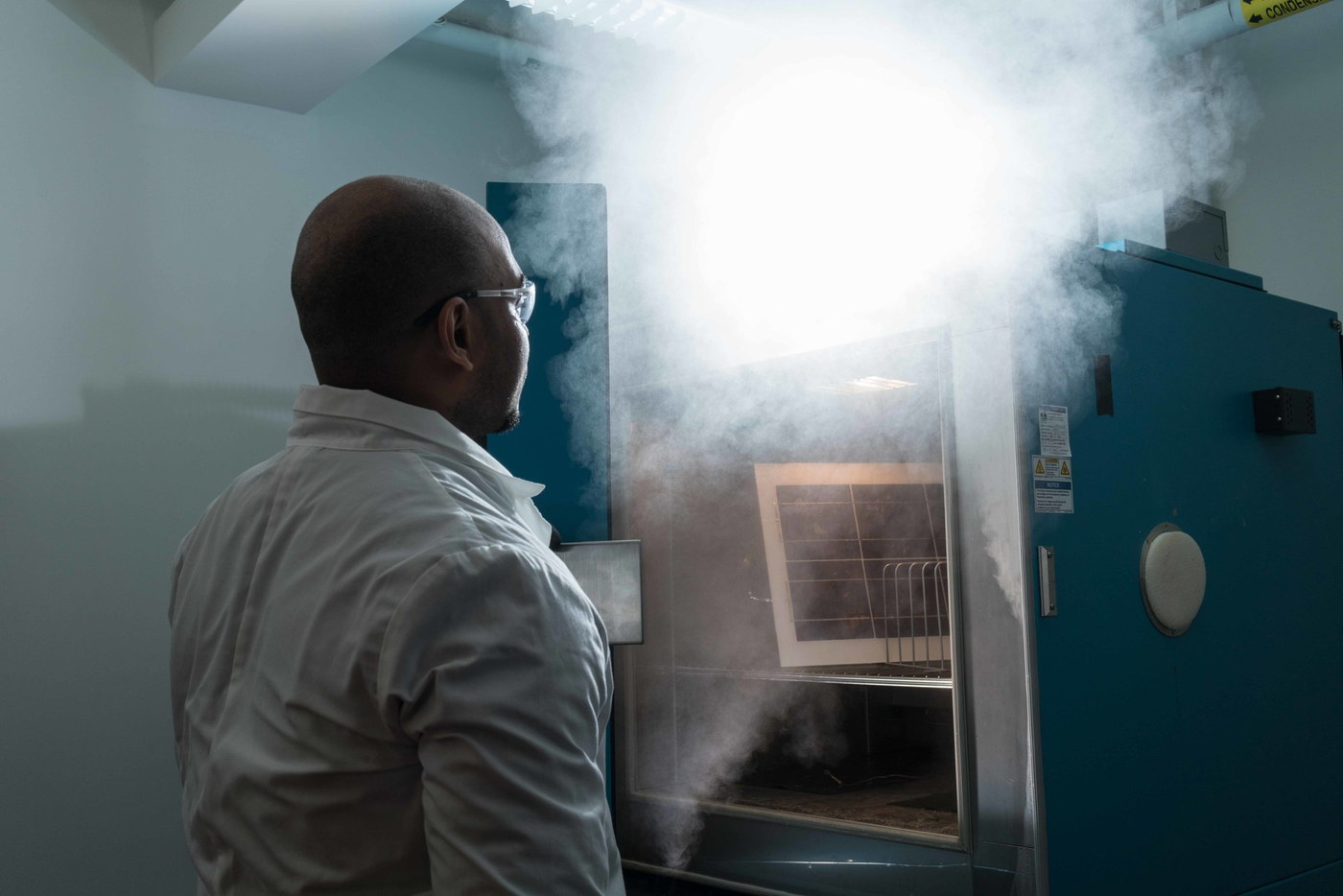
Who stands behind that promise matters more than it sounds, because a module warranty is a 25-year unsecured credit exposure to the manufacturer. A buyer comparing a Trina-warranted module to a T1-warranted one is comparing a balance sheet with decades of history to one carrying a $1.11 billion accumulated deficit and $79.1 million of unrestricted cash, which is why the third-party insurance wrapper is doing real work here. Separately, U.S. Customs and Border Protection has billed approximately $31.7 million of duties on goods imported in 2024 by an entity T1 acquired from Trina, which T1 disputes and says would be indemnified.
The financing that has not closed
The other half of "wrong time" is the cost of capital, and here the filings read as a slow retreat.
| Reported | G2 Phase 1 capex | Remaining to fund | First cells |
|---|---|---|---|
| Mar 31, 2026 | $400M to $425M | ~$350M | Q4 2026 |
| May 12, 2026 | $400M to $425M | ~$225M | Q4 2026 |
| Jul 28, 2026 | $510M | not restated | Q1 2027 |
The capex estimate rose 20% and the timeline slipped a quarter. The stated reason is worth quoting, because it is the most elegant irony in the file: the increase is "due to labor and materials costs associated with tightness in the Texas data center construction market." The AI buildout that is supposed to underwrite demand for T1's product is bidding away the labor it needs to build the plant.
The financing language moves the other way, which is to say hardly at all. In March, T1 was "targeting full financial close early in the second quarter." In May, it was "targeting a comprehensive financing solution in Q2 2026." On July 28, with the second quarter over, it "continues to target a comprehensive financing solution, which includes a significant debt component, in an amount sufficient to fund the remaining estimated capital expenditure required for G2_Austin Phase 1."
Meanwhile, from the preliminary second-quarter numbers released that day: sales of $245 million to $255 million on about 835 MW, a net loss from continuing operations of $34.0 million to $37.0 million, and adjusted EBITDA of negative $14.5 million to negative $11.5 million, which excludes about $24.4 million of tariff refunds. Cash was $156.4 million, of which $79.1 million was unrestricted (preliminary Q2 2026 results, Jul 28 2026).
That $79.1 million is the number to sit with. Unrestricted cash was $46.4 million at March 31. During the June quarter T1 took in $174.7 million of net proceeds from convertible notes issued in April and $39.1 million from selling the last of its 2025 credits at 93 cents on the dollar. Two disclosed inflows of $213.8 million, against an unrestricted balance that rose $32.7 million. At least $181 million left the unrestricted balance in a single quarter, and that is a floor, since any other inflow raises it.
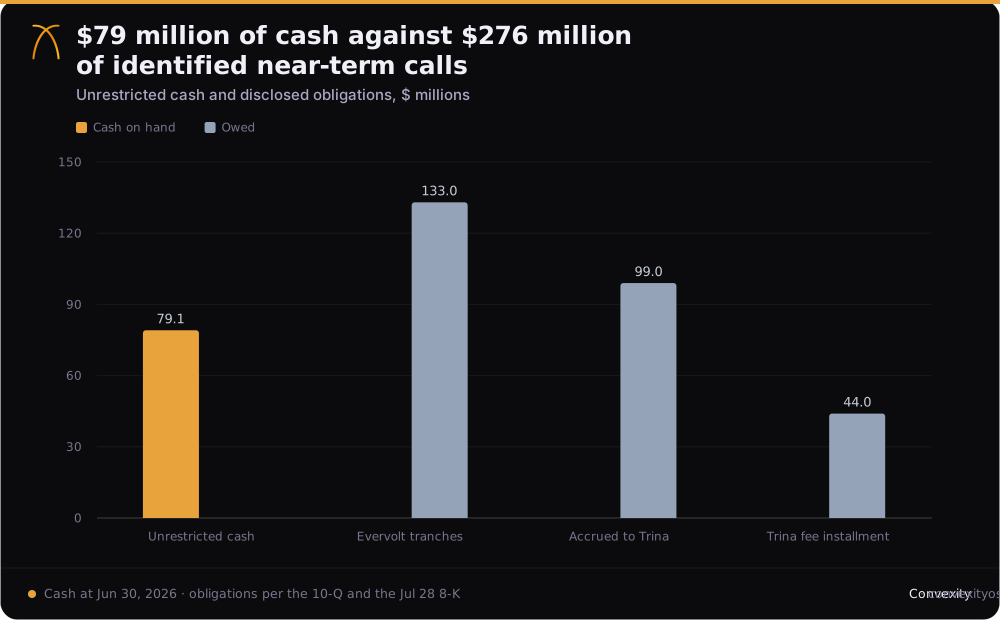
Against $79.1 million, the identified near-term calls include $133 million to Evervolt between now and October 30, deferred Trina service fees that come due on the earlier of receipt of 45X cash or August 15, 2026 (accrued liabilities due to related parties were $99.0 million at March 31), the next $44.0 million production reservation fee installment, and an unfunded balance on a $510 million fab. T1 intends to pay the first Evervolt tranche in stock, priced at a 15% discount to a five-day volume-weighted average, capped at 19.9% of shares outstanding. Both the 10-K and the 10-Q state the company has sufficient liquidity for twelve months, and neither carries going-concern doubt.
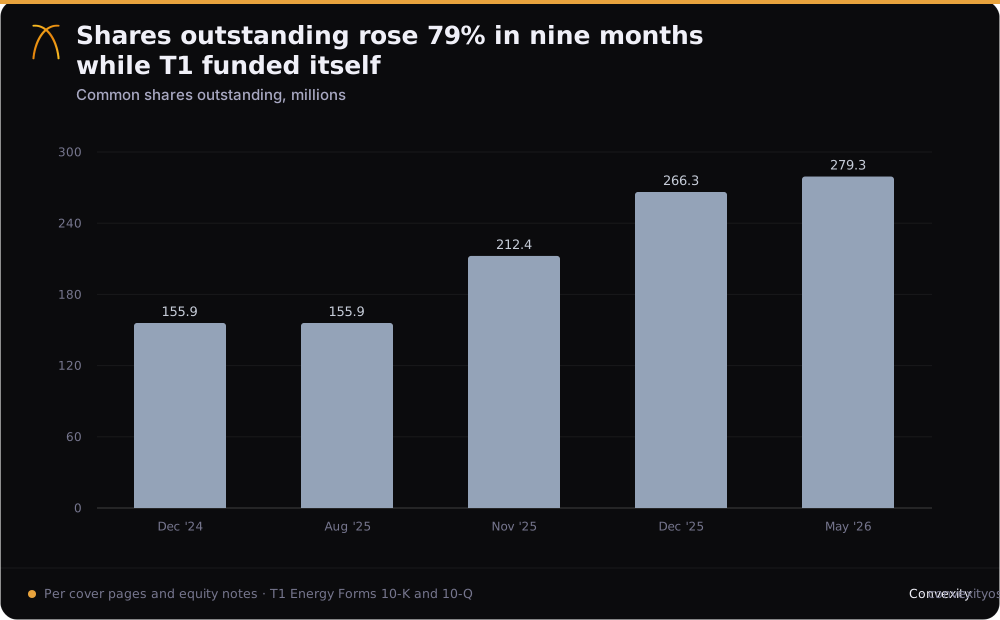
The equity has absorbed most of this already. Shares outstanding went from 155.9 million in August 2025 to 279.3 million by May 2026, a 79% increase in nine months, including 32.5 million sold at $4.95 in December. In April T1 issued $184.0 million of 4.00% convertible notes due 2031 on top of $161 million of 5.25% notes due 2030 issued in December. At the June 2026 annual meeting shareholders approved raising authorized common stock from 500 million to 1 billion shares. In the middle of all of it, on June 2, T1 agreed to buy KORE Power for about $32 million of equity, cash and assumed debt, with the closing consideration and both earn-outs payable in stock, to enter battery storage and data center infrastructure. It closed in July.
Update, July 30: a fourth raise, and the company calls it a bridge
The morning after this published, T1 disclosed that on July 29 it agreed to sell $120.0 million of 4.75% convertible senior notes due August 1, 2031, senior unsecured, privately placed with qualified institutional buyers, closing expected July 31 (Form 8-K, Jul 30 2026).
Read the use-of-proceeds sentence carefully, because it does the work of this whole section:
The net proceeds of the Offering are intended as a bridge to a comprehensive financing solution, which includes a significant debt component, to fund the remaining capital expenditures for Phase 1 of G2_Austin that the Company continues to target.
That is the company's own characterization, in a filed document. The fab financing still has not closed. This is the money to keep going until it does, and the phrase "continues to target" is now four months old.
| Convertible raised | Coupon | Due | Amount |
|---|---|---|---|
| December 2025 | 5.25% | 2030 | $161M |
| April 2026 | 4.00% | 2031 | $184M |
| July 2026 | 4.75% | 2031 | $120M |
| Total | $465M |
Three converts in eight months, and the coupon went the wrong way: 75 basis points more expensive than the April issue, three months later. The conversion price is $4.4640, a 20% premium to the $3.72 close on July 29, which puts 26,881,716 shares behind the notes at the initial rate and up to 32,258,064 at the maximum rate the indenture allows, or 9.6% to 11.6% of the 279.3 million shares outstanding.
Set against the near-term calls in the chart above, $120 million of gross proceeds roughly covers the wall: the Evervolt tranches, the deferred Trina fees and the December installment. Set against the fab, it is not the answer and is not offered as one. The market took it well: the stock was up about 13% at $4.19 in the July 30 morning session, with trading still open (retrieved 2026-07-30 12:28 EDT), and still below the $4.4640 conversion price.
The same filing puts a 5% floor under Trina, and telegraphs an ATM
The second item in that 8-K is the one I would not have predicted, and the exhibit is a great deal more specific than the summary of it.
Amendment No. 8 to the HSBC senior secured credit agreement, dated July 27, is filed in full as Exhibit 10.1. It records that clause (d) of the facility's "Change of Control" definition required Trina Solar Energy Development Pte. Ltd, directly or indirectly, to satisfy both of two conditions: retain at least 9.9% of T1's common stock, and keep at least one Trina-appointed director on T1's board. Failing either was a Change of Control and an Event of Default.
So the lenders who financed G1_Dallas underwrote it partly on the continued sponsorship of the counterparty that built the plant, supplies its cells and buys its output. The board leg was already gone, removed in the December FEOC restructuring. The ownership leg is what needed fixing, and the amendment restates clause (d) so that it "consists solely of a requirement that TED retain, directly or indirectly, at least 5%" of the stock, with the lenders waiving any resulting default "whether occurring before, on or after the Effective Date."
Now the part I would not have found without opening the exhibit. The recitals explain why the floor had to move, and it is not because Trina is selling:
the Borrower has advised the Administrative Agent and the Lenders that the Sponsor intends to consummate certain debt or equity financings ... (a) an issuance and sale of one or more series of convertible notes ... (b) an underwritten or non-underwritten public or private offering of shares of the Sponsor's common stock ... or (c) the issuance and sale of shares of the Sponsor's common stock under an "at-the-market" offering program that the Sponsor plans to establish ... and that the Specified Equity Transactions may, individually or collectively, reduce TED's ownership of the Sponsor's common stock below 9.9%
T1 has told its lenders it intends to issue enough new stock to dilute Trina through the old covenant floor. An at-the-market program is open-ended, continuous issuance, and as of this filing it is something T1 "plans to establish" rather than something it has. That is its first appearance anywhere in these filings.
The arithmetic sizes the runway. Trina's 30,652,664 shares are 11.0% of the 279.3 million outstanding. Diluting that below 9.9% takes only about 30 million new shares, which the $120 million convertible roughly does by itself. Diluting it to the new 5% floor takes roughly 613 million shares outstanding, more than double today's count. Set against June's shareholder vote lifting authorized common from 500 million to 1 billion, the pieces line up: the authorization, the covenant headroom and the planned ATM are one preparation.
It also dates the package. The Evervolt call option (July 27), this credit amendment (July 27), the preliminary results and IP purchase (July 28) and the note agreements (July 29) were one coordinated week, not four separate events.
One loose end I could not close. The 10-K twice describes 45X as available for components "manufactured in the United States and sold to unrelated persons." The same filings disclose that one related party was 78% of 2025 net sales and approximately 100% of Q1 2026 net sales. Section 45X permits a taxpayer to elect to treat sales to a related person as sales to an unrelated person, which is very likely the answer, and the 2025 credits were in fact sold to a third-party buyer for cash. But the filings never make the connection, and a reader holding only the risk factor and the concentration note cannot reconcile them.
The case against this note
I want to put the strongest version of the other side in its own section, because compressing it into a concessive clause would be cheating, and because on the evidence it is not a weak case.
The asset is real and it works. G1_Dallas is 5 GW of commissioned nameplate that has run above nameplate, produced 2.79 GW in its first full year inside guidance, and set a quarterly record of 1.13 GW. Almost nothing about building a solar factory in America has gone well for anyone in the last decade. This one is built, staffed and running.
The credit is policy, not a crutch, and the vertical integration math is arithmetic rather than hope. G2_Austin makes cells. A cell earns 4 cents a watt under 45X and a module earns 7. Integrated production therefore earns 11 cents a watt instead of 7, and simultaneously removes the purchased-cell line that is currently the largest item in cost of sales. That is why management's 2027 run-rate adjusted EBITDA guidance of $375 million to $450 million is not a fantasy number: it is what the same plant looks like with the cell step insourced and the credit stacked. Against a market capitalization near $1.04 billion, if it arrives, the equity is cheap.
The trade backdrop is moving toward T1, not away. T1 has long-term supply agreements for American polysilicon from Hemlock Semiconductor and American wafers from Corning, and it is openly lobbying for anti-dumping and countervailing duties in the Solar 4 case and for a Section 232 tariff on imported polysilicon. It also collected about $24.4 million of IEEPA tariff refunds in the June quarter. A company positioned long domestic content in a tightening trade regime is positioned correctly, and the domestic-content adder under Section 48E gives its customers a direct reason to pay up for a high-domestic-content module once G2 exists.
The related-party concentration has a structural explanation and a declared exit. You cannot buy a factory from a manufacturer, inherit its offtake and its sales agency, and then report a diversified customer base in year one. The Treaty Oak agreement, a three-year contract for a minimum of 900 MW built with domestic cells from G2, is a genuine third-party offtake, and it is contingent on the fab precisely because what customers want is the domestic content the fab produces.
The foreign-control problem is closer to solved than to open. Trina's stake is down to 11.0% from 19.6%, its board designee has resigned, its officer-appointment right is gone, its debt was cut from $220.0 million to $65.0 million, and the patents are now owned rather than licensed. Each of those was a channel through which the OBBBA could have disqualified T1 from the credit that constitutes its margin, and each is now shut. Twelve months of that work is also evidence about management quality, which is usually the variable that decides whether a company in this position survives.
Sources: FY2025 10-K, the March 31 results release, and Trina's 13D/A. The EBITDA figure is management's guidance, not mine.
Put together, the bull case is coherent: a real asset, a real credit, a real trade tailwind, and one hard thing left to do. My disagreement is not that this is wrong. It is about what has to be true for it to pay, and in what order.
Which clause actually binds
The market's answer over two sessions was clear enough. TE closed at $4.15 on July 28, down 15.3% on the day of the two announcements, and at $3.72 on July 29, down another 10.4%, for a market capitalization near $1.04 billion against a 52-week range of $1.15 to $12.49 (prices retrieved 2026-07-29). Four analysts carry a median target of $8.50 (stockanalysis.com, retrieved 2026-07-29).
But the thesis deserves a real answer, not a price.
"Wrong time" is not wrong, exactly. It is too small. It treats the policy as weather the company is standing in. The policy is the ground the company is standing on. FREYR did not become a solar company because it had a solar capability. It became one by buying a 45X-eligible asset from a manufacturer that could not claim 45X itself, while writing off the battery business it came from: discontinued operations cost $383.8 million in 2024 and a further $46.5 million in 2025. The entire enterprise is the spread between a statute that pays 7 cents a watt for American modules and a supply chain that can make them more cheaply than any American can. Take the statute away and there is no business. So the statute tightening is not bad luck arriving from outside. It is the identified risk of the only trade the company was ever making.
"Right company" is the half that actually fails on the evidence. Judge it on the three things the phrase is meant to promise. Real capacity: yes, 5 GW of nameplate and 2.79 GW produced, and this is the strongest part of the case. Domestic manufacturing: partly, and improving, with American polysilicon and wafers contracted and G2_Austin under construction, but the cells that make the modules were imported through 2026 and the fab that fixes that now starts in 2027. Real offtake: no. The offtake is one related party at approximately 100% of sales, on cost-plus and fixed-margin terms, and the company's own explanation of its best quarter is that it sold less to everyone else.
So what is it, if not the right company at the wrong time?
It is a policy arbitrage that has been asked, by the same policy, to turn itself into a real manufacturer, on a deadline, with someone else's balance sheet. The bill for that transition has so far come to $155 million prepaid to its counterparty, $135 million for patents it already licensed, a charter amendment, a governance change, a new cell supply chain, a warranty framework built from scratch, a 79% increase in shares outstanding, and a fab whose cost is up 20% and whose financing has not closed.
That is not the same thing as doomed, and I want to be precise about the difference, because "the gross margin is entirely a tax credit" is a sentence that invites a more dramatic conclusion than the evidence supports. T1 has a commissioned plant, a statute that pays it, a trade regime moving its way, and a management team that has already executed one existential restructuring competently. What it does not have is a second source of margin, an independent customer base, or the money to finish the thing that would give it both.
So the honest description is high variance rather than terminal. Two events decide it, in this order. First, whether the G2_Austin financing closes, and on terms that leave the equity with something: at $79.1 million of unrestricted cash against a $510 million project and $133 million owed to Evervolt by October, this is a financing question before it is an industrial one, and it has slipped two quarters already. Second, if it closes, whether integrated cell and module production can clear the market at a profit with the credit rather than only because of it.
Get both and the 2027 guidance is roughly the answer and today's price is wrong in the other direction. Miss the first and the rest never gets tested. That is a genuinely open question, and I would rather own the uncertainty than pretend the filings resolve it.
Which is why the third clause is the one doing the work. "Right company" is unproven and "wrong time" is a description of the business model rather than a misfortune that befell it, but neither of those is what settles this. What settles it is $79.1 million of unrestricted cash, a $510 million fab, $133 million owed by October, and a financing that has been two quarters from closing for two quarters.
What would make me wrong
I am wrong if T1 closes the G2_Austin financing on terms that do not gut the equity. That is the single load-bearing event, and it is binary and near-term. (Partly answered on July 30: $120 million of convertible notes, which the company itself calls a bridge to that financing rather than the financing. It buys runway at 9.6% to 11.6% dilution. The test stands as written.)
I am wrong if third-party revenue recovers to a meaningful share of the total in the next two quarters. Q2 2025's near-even split proves merchant sales are possible at some price; the question the filings raise is whether they are possible at a profit, and two quarters answers it.
I am wrong if the contracted book rebuilds. A move from 2.3 GW back toward 6.0 GW, with the components reconciling to the total this time, would say the quarterly collapse was a scheduling artifact rather than demand.
I am wrong, on the sharpest point in this note, if Trina buys back in. A holder that sold 42% at $8.46 and then re-acquired stock at $3.72 would have converted the most damaging fact in the file into the most reassuring one. Watch the 13D.
I am wrong if 2026 gross margin holds up once the 45X credits are struck out. G2 cells would add a 4 cent per watt credit on top of the 7 cent module credit and cut the cost line at the same time, and if that arrives while product gross profit turns positive on its own, the central objection in this note dissolves.
And I am wrong, in the way that matters most, if Treasury's final rules land where T1 has bet they will. The company says the February 2026 initial guidance "validates the compliance plan that we developed and implemented." No regulations have been finalized. If they come out clean, T1 keeps a credit that is worth more than its entire gross profit, and gets to spend the rest of the decade trying to build a business underneath it.
Most of that resolves on a schedule, which makes this an unusually datable thesis:
| What to watch | Date |
|---|---|
| Deferred Trina service fees fall due | Aug 15, 2026 |
| Second-quarter 10-Q, and whether Trina is still a related party | Aug 2026 |
| Evervolt tranche two | Sep 30, 2026 |
| Evervolt tranche three | Oct 15, 2026 |
| Evervolt tranche four | Oct 30, 2026 |
| Next production reservation fee installment to Trina | Dec 23, 2026 |
| G2_Austin first cell production | Q1 2027 |
The financing has no date on it, which is the point. Everything else in that table arrives whether or not it closes.
Only the first of those is really in the company's control, and the honest summary of the quarter is that it did not happen. A company whose only customer is its supplier paid $135 million for patents it was already licensing, raised its fab budget by a fifth, pushed first production into next year, and reported that it still does not have the money to finish. It also, in the same twelve months, closed every FEOC exposure it had and turned its first profitable quarter on continuing operations. Both of those are in the file. Which one turns out to have been the important one is a question about the financing, and the financing is not done.
The filings this is built on
- 10-KYear ended December 31, 2025$755.3M sales and $55.6M gross profit; the $160.0M of 45X credits sold for $145.6M; 78% single-customer concentration; the 6.0 GW contracted book; the FEOC Restructuring; two material weaknessesMar 31, 2026
- 10-QQuarter ended March 31, 2026Approximately 100% of net sales and receivables from one related party; $188.8M of module sales to and $119.0M of purchases from the Trina Group; the 2.3 GW contracted bookMay 12, 2026
- 8-K$120M convertible notes, and the Trina covenant waiverProceeds "intended as a bridge to a comprehensive financing solution"; Amendment No. 8 waiving the requirement that Trina hold stock and keep board seatsJul 30, 2026
- 8-KEvervolt intellectual property purchase$135M total consideration in four tranches, and the seller representation of non-specified-foreign-entity status under section 7701(a)(51)Jul 28, 2026
- 8-KPreliminary second quarter 2026 results$245M to $255M of sales on ~835 MW; $79.1M of unrestricted cash; G2_Austin capex to $510M and first cells to Q1 2027Jul 28, 2026
- 8-KFirst quarter 2026 resultsThe "favorable sequential mix shift" away from merchant sales, and indicative 2027-2028 offtake demandMay 12, 2026
- 8-KFourth quarter and full-year 2025 results2.79 GW produced in 2025; the $160M credit sale at $0.91; 3 GW of cost-plus or fixed-margin 2026 contracts; 2027 run-rate EBITDA guidanceMar 31, 2026
- 13D/ATrina Solar (Schweiz) AGThe sale of 22,500,000 shares on May 21 and 22, 2026, cutting the stake from 19.6% to 11.0%May 26, 2026
- 4Trina Solar (Schweiz) AGThe five tranches and prices behind that sale, from $8.07 to $9.06 a shareMay 26, 2026
- 10-QQuarter ended September 30, 2025The nine-month split of related-party and third-party sales used to derive the fourth quarterNov 14, 2025
- 8-KAnnual meeting resultsAuthorized common stock raised from 500 million to 1 billion sharesJun 17, 2026
Disclosure, again. I am long TE as of August 4, 2026. I held no position when this piece was published on July 29, 2026, or when the July 30 update was added, and the analysis was not revised after the position was opened. Read what follows knowing I now own the thing I argued was a narrow, binary, high-variance bet; I still think it is one. Not investment advice, and nothing here is a recommendation to buy, sell or short any security. Figures come from T1 Energy's SEC filings and press releases as cited. Q4 2025 revenue split and gross profit, the 2025 gross margin excluding credits, the per-watt figures, the second-quarter cash outflow floor, and the blended price and gross proceeds of Trina's May share sale are arithmetic on filed figures rather than disclosures, and are labeled as such where they appear. Trina's stated reason for that sale was "the ordinary course of business," and I have no information about its motives beyond the filings. Market prices and the analyst target in the body were retrieved on 2026-07-29, and the July 30 update's price on 2026-07-30; all of them are stale the moment you read this. The July 30 update was added after publication and is marked as such; nothing in the original text was altered to fit it. I have no relationship with T1 Energy, Trina Solar, Evervolt or any party named here.