
Disclosure. No position in ORCL, long or short, at publication. This is not investment advice. Every figure here comes from an Oracle filing, from the US Treasury's published yield curve, or from a named index series, all linked at the bottom. Where a number is our arithmetic rather than a figure Oracle reported, we say so at the point of use and collect the list at the end. Oracle's fiscal year ends May 31, so the quarter discussed here, the first quarter of fiscal 2027, is the three months ended August 31, 2026. This note follows our September 10 note on the same quarter, written from the earnings release and the call, and scores the things that note said this filing would settle.
Oracle filed its Form 10-Q for the August quarter on September 11, the day after the earnings release and the call. We wrote about that release, and closed with a short list of things the filing would decide that the release could not. It decided them. Two went Oracle's way and one did not move at all.
The filing also carries a sentence that was in no press release, appears in no coverage we can find, and is the most interesting thing in the document. It sits in the fair value note, and it reads like boilerplate, because in most quarters it is.
Based on the trading prices of the $125.0 billion and $128.1 billion of senior notes and other long-term borrowings and the related fair value hedges, if any, that we had outstanding as of August 31, 2026 and May 31, 2026, respectively, the estimated fair values of the senior notes and other long-term borrowings and the related fair value hedges, if any, using Level 2 inputs at August 31, 2026 and May 31, 2026 were $105.7 billion and $114.4 billion, respectively.
Form 10-Q, quarter ended August 31, 2026
Strip the accounting language and it says this. Oracle's books carry its borrowings at $125.0 billion, which is broadly what the company has to repay. Investors who own that debt were collectively willing to pay $105.7 billion for it on August 31. The gap is $19.3 billion, and three months earlier it was $13.7 billion.
If you have never had reason to read a fair value note, the useful way to hold this is that a bond is a tradeable thing with a price, much like a share. A company records what it owes. The market separately decides what that promise is worth today. The two are rarely equal, and the information is not in the gap itself but in how the gap behaves over time.
The quarter underneath this
The argument below is about a financing detail, and it does not survive if the business is weak. It is not weak, and the 10-Q confirms every operating figure the release gave.
Revenue was $19,345 million, up 30%. Cloud infrastructure revenue was $7,388 million, up 121%, the fourth consecutive quarter in which that line's growth rate has increased while its own base was tripling. Diluted earnings per share were $1.56 against $1.01 a year earlier. Interest expense was $1,428 million, covered comfortably by operating income. Nothing in this note is an argument that the operating business is not working, and the sections on the backlog below are the opposite of that argument.
What follows is about the price of Oracle's money, which is a separate question from how well Oracle is spending it.
A discount is normal, and this one stopped being normal
The first thing to say is the thing that disarms most of this, so it should come first rather than in the objections at the end.
A large discount to carrying value is not by itself a credit signal. Oracle has $4.5 billion of 3.60% notes due 2050 and $3.5 billion of 3.85% notes due 2060, both issued in April 2020. A bond paying 3.6% is simply worth less than an otherwise identical bond paying 5%, so its price falls until the two offer a buyer the same return. Anything issued at 3.6% in 2020 therefore trades well below par, meaning below the 100 cents on the dollar the issuer repays at maturity, in a world of 5% long yields. That is arithmetic about coupons rather than a market opinion about Oracle, and every issuer with a long low-coupon book shows the same thing. If the $19.3 billion gap were the whole argument, there would be no argument.
What makes it worth a note is not the level. It is that the level had been sitting still for two years, through a period when Oracle was doing something that should have moved it, and then moved sharply in a quarter when Oracle did nothing at all.
It is worth being precise about what this disclosure is, because "fair value" can mean a model output and here it does not. Oracle says the figures rest on "the trading prices" of the notes. It measures them with what the accounting rules call Level 2 inputs, which means observable market data for the instrument or for something close to it, rather than the issuer's own assumptions. Oracle's own description names "non-binding market consensus prices that were corroborated by observable market data" and "quoted market prices for similar instruments" among its techniques.
So this is closer to a price screen than to a valuation model. It is also the same method applied in every period, which is what makes a comparison across periods mean anything.
Oracle discloses this pair every quarter, which makes a series worth looking at. Dividing the second figure by the first puts every period on one scale: cents of market value for each dollar Oracle owes, so 90 means the debt changes hands at 90% of face value. That division is ours; both inputs are Oracle's.
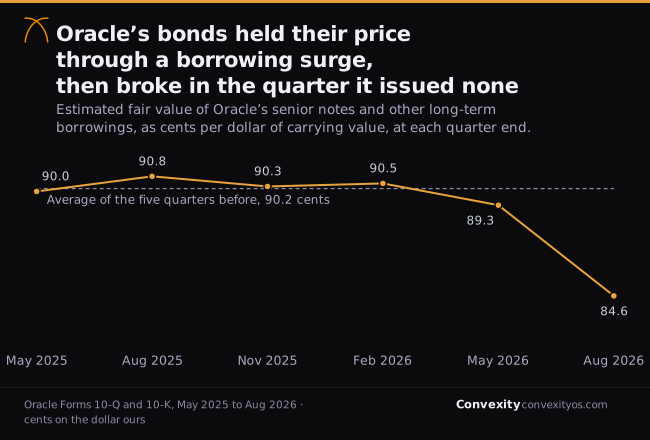
Five quarter ends, from May 2025 to May 2026, fall in a band 1.51 cents wide: 90.03, 90.82, 90.29, 90.45, 89.31. The August 2026 reading is 84.56. The single quarter's move is more than three times the width of the entire preceding band.
Now put the borrowing beside it. Across those same five quarters Oracle's carrying value went from $89.3 billion to $130.9 billion, a 47% increase, as it issued $43.0 billion of senior notes during fiscal 2026. The market absorbed all of that without repricing the existing paper by more than a cent and a half.
Then, in the quarter just reported, Oracle issued no senior notes at all. It repaid $3.1 billion of scheduled maturities and $1.1 billion of commercial paper. Total notes payable and other borrowings fell from $129,541 million to $125,337 million.
The bonds fell 4.75 cents.
How much of that is Oracle
This is the part that decides whether the paragraph above is an observation or an argument, so it gets done carefully and with the inputs in the open.
Two things move an investment-grade bond price that have nothing to do with the issuer: the risk-free curve and the general price of corporate credit. Both moved in the quarter, and both moved against Oracle.
The first is the government yield, the return available with no credit risk at all. The 20-year Treasury yield, the maturity closest to the average length of Oracle's own borrowings, went from 4.98% on May 29 to 5.24% on August 31. That is a rise of 26 basis points, a basis point being one hundredth of a percentage point. When the risk-free return rises, every existing bond paying a fixed coupon is worth a little less.
The second is what lenders charge companies on top of that, the compensation for the risk that a company and not a government is the borrower. The standard gauge is the ICE BofA US Corporate index spread, the average extra yield demanded across investment-grade American corporate bonds, and it went from 0.73% to 0.80%. That is 7 basis points wider. Corporate credit in general got more expensive in the quarter, but only slightly.
To turn those two moves into cents you need one more number, and it is the one piece of bond mathematics this note cannot avoid. Duration measures how much a bond's price moves when yields move, expressed in years: a bond with a duration of 8 loses roughly 8% of its price when yields rise by one percentage point. Long bonds have high duration, short bonds have low duration, and a portfolio has the blended duration of what is in it.
Oracle does not publish the figure for its own book, so we computed it from the fiscal 2026 Form 10-K, which lists every series with its coupon and maturity. There are 54 fixed-rate senior note series totalling $122,500 million, and that figure reconciles exactly to the filing's own $130,105 million of total borrowings once the two floating-rate notes, the term loan and the commercial paper are removed. Weighted average maturity is 15.09 years. Modified duration works out between 8.13 and 8.79 years depending on the discount yield assumed.
We used 8.5 years, near the top of that range, on purpose. A longer duration attributes more of the price fall to rates, which makes the residual this section is about smaller. The conservative choice is the one that argues against us.
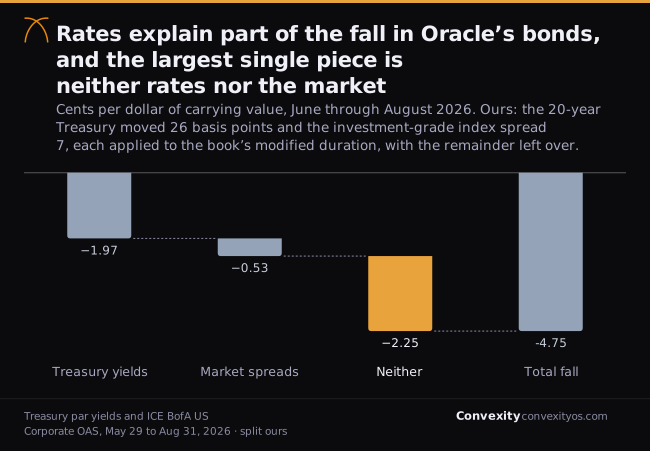
Rates explain about 1.97 cents. Market-wide spread widening explains about another 0.53. Together that is 2.50 cents of the 4.75, and the remaining 2.25 cents is not explained by either. On $125.0 billion of carrying value, that residual is roughly $2.8 billion of market value.
Put plainly: rates and the general mood of the credit market account for a little over half the fall. Something about Oracle in particular accounts for the rest.
A single-factor duration model is a rough instrument, and we would not lean on one reading of it. What makes this one persuasive is the control sitting right behind it in the same series.
In the preceding quarter, rates moved more and the bonds fell far less. Between February 28 and May 31, 2026, the 20-year Treasury rose 41 basis points, more than the 26 that followed, and the corporate index spread actually tightened by 12. The same model predicts a 2.47 cent fall. The bonds fell 1.14. Oracle's paper outperformed the market explanation by more than a point.
So across two consecutive quarters, on a portfolio that changed only by scheduled repayment, the Oracle-specific component swung from roughly plus 1.2 cents to roughly minus 2.3. That swing is not a duration assumption. You can move the duration anywhere in the computed range and the sign and rough size of it survive.
It helps to put the residual back into the units a credit investor would use. Running the same duration backwards, 2.25 cents on a starting price of 89.31 is about 30 basis points of spread widening specific to Oracle, on top of the 7 the whole investment-grade market took. The quarter before, the same calculation gives about 14 basis points of tightening. Both figures are ours and inherit every limitation of the model that produced them, but the order of magnitude is the point: this is a move of tens of basis points, not hundreds. It is not a distress signal and we are not presenting it as one. It is the market charging Oracle modestly more than it did in May, in a quarter when it charged almost everyone else the same as before.
The quarter Oracle did not borrow
Set the mark against how the quarter was funded, because the two facts are usually discussed as though only one of them happened.
Oracle fully drew its at-the-market equity program inside the quarter, issuing 141 million shares for $19,909 million net of issuance costs. An at-the-market program is a standing authorisation that lets a company sell new shares into the open market gradually at prevailing prices, rather than in a single announced offering. The program had been authorised in February 2026 and stood entirely undrawn at the end of fiscal 2026. It is now finished. On a basic weighted average count of 2,966 million shares for the quarter, those 141 million shares are about 4.8% of the company, which is our arithmetic on Oracle's figures.
So in one quarter Oracle sold a twentieth of itself and repaid debt. That is a complete reversal of fiscal 2026, when it raised $43.0 billion of senior notes and $5.0 billion of mandatory convertible preferred and sold no common stock at all.
Our September note read that shift as a mark in Oracle's favour, and said so: equity is permanent capital with no coupon, so the financing looked more reversible than our August note had argued. We still think that is right about the instrument. What the 10-Q adds is a fact about the environment the choice was made in, and it changes the tone of the sentence rather than its content. A company whose existing paper has just been repriced by roughly $2.8 billion beyond what the market did to everyone is a company with a more expensive bond market than it had in May.
We are not claiming Oracle could not have issued. It plainly could; it is investment grade and it repaid on schedule. We are saying the order of events is worth noticing. The mark moved in the quarter the issuance stopped, and the press release's framing of the same period runs the other way:
Based on the structuring of those new contracts, the Company confirms there is no incremental impact on its plans to raise capital.
Q1 fiscal 2027 earnings release, September 10, 2026
That sentence is about the new AI contracts and it is almost certainly true as written. It is also the only thing in the release that touches Oracle's cost of capital at all. A reader who took it as the whole picture would not know that the company's outstanding bonds had just had their worst quarter in the disclosed series.
What the filing settled from our last note
Our September note closed with seven triggers. Two of them named this 10-Q specifically.
| Named on September 10 | What the 10-Q says | Read |
|---|---|---|
| Interest on financing components | Still "immaterial" | Unchanged, against our expectation |
| The twelve-month conversion share | 13%, up from 12% | Better |
| Half the backlog inside 36 months | 13% plus 37%, exactly 50% | The call was precise |
| Debt issuance resuming | None, and $4.2 billion repaid | Confirms the funding shift |
The first row is the one where we were wrong, or at least early. We wrote that a cost the annual report called immaterial "will not stay immaterial" and put it in the high hundreds of millions a year. The 10-Q says: "We recognize interest expense related to significant financing components separately from revenue. During the first quarter of fiscal 2027, such amounts were immaterial."
That is a fair answer for this quarter and we should have expected it. The $11.4 billion arrived during the three months rather than before them, so only a fraction of a quarter's interest could accrue on it. The $4.6 billion carried over from the prior year accrues perhaps $65 million in a quarter, which is our estimate, against pretax income of several billion. Our sentence was about the run rate and the filing is about the period. The claim is still live, and the second-quarter filing in December is the first one where the word disappearing would mean anything.
The second and third rows go the other way, and they matter more than the first.
The backlog is converting sooner, not later
This is the strongest thing in the filing for Oracle, and it is the half of the 10-Q that nobody had before, because the release gives a backlog total and no schedule at all.
Remaining performance obligations, which Oracle and most readers shorten to backlog, is the total value of work customers have contracted and paid for or committed to, and that Oracle has not yet delivered. It is not revenue and it is not cash in hand. It is a promise on both sides, and the thing that matters about a promise that size is when it turns into revenue.
Oracle states that timing every quarter, in one sentence. At August 31 the backlog was $664 billion, of which it expects to recognise 13% within twelve months, 37% in months 13 to 36, 34% in months 37 to 60, and the remainder after that.
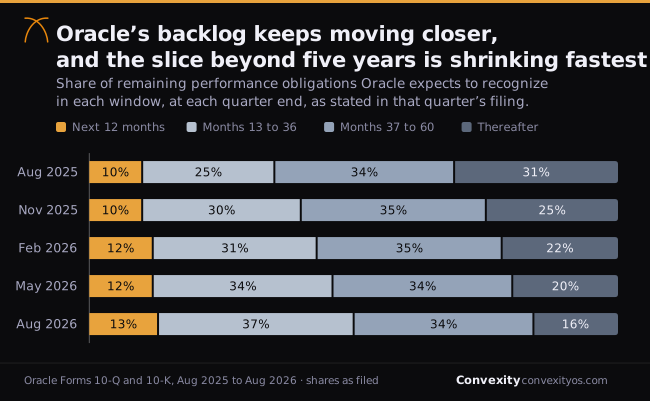
Every window inside five years has grown or held, and the slice beyond five years has fallen from 31% to 16%. The share converting inside 36 months has gone 35, 40, 43, 46, 50 across those five quarters. On the call, Oracle's chief financial officer said the company expects "around half of our RPO to convert into sales over the next 36 months," and the filing puts it at exactly half.
In dollars the near-term number is better still, because the base grew while the share did. The twelve-month bucket went from about $46 billion at August 2025 to about $86 billion at August 2026, which is our arithmetic on the filed share and the filed total.
Our August note made a good deal of the twelve-month share collapsing from 33% to 12%, and treated it as the central problem with a backlog that size. On the evidence of five quarters, that collapse was the moment the giant multi-year AI contracts landed, and the schedule has been pulling forward steadily ever since. That is what a backlog converting normally looks like, and it is a real answer to the argument we made.
Where the prepayment actually went
One more thing the 10-Q carries that the release does not: when the prepaid work is owed.
The release puts $11,363 million of customer prepayments on the face of the cash flow statement, under a heading naming what the accounting rules call a significant financing component. That is the label for a prepayment large enough and early enough that the standard treats part of it as, in substance, a loan from the customer to the seller. Our September note took that line apart at length.
What the release does not say is how much of the resulting obligation is due inside a year. The balance sheet and Note 5 do.
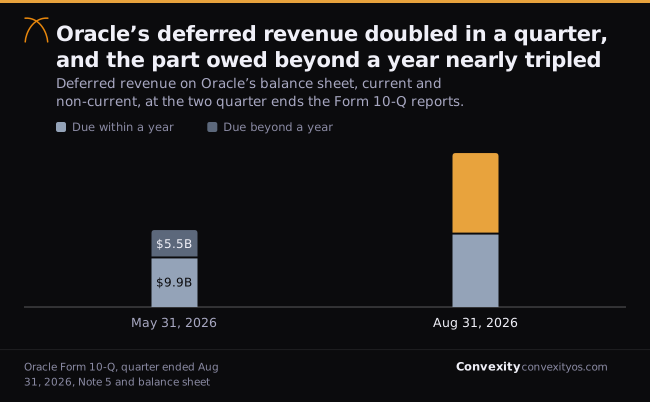
Deferred revenue non-current went from $5,479 million to $16,103 million, a rise of $10,624 million that fits inside the quarter's $11,363 million of prepayments. Total deferred revenue exactly doubled, from $15,395 million to $30,789 million, and for the first time the majority of it is owed beyond a year.
This is neither good nor bad on its own, and we want to be careful not to imply otherwise. It is the expected shape: a customer prepaying for capacity that has to be built is prepaying for delivery well out in time. What it does is put a number on something the cash flow line leaves implicit. Oracle has taken $16.0 billion of customer money across two quarters, most of the resulting obligation is long-dated, and it accrues interest for as long as it sits there.
The case against this note
The counterarguments are strong and two of them are in the filing we are reading.
The discount is mostly old coupons, and we have said so. The single largest contributor to a $19.3 billion gap is that Oracle borrowed tens of billions at 3.6% to 4.1% in 2020 and 2021. That is not the market's view of Oracle in 2026. Anyone quoting the $19.3 billion as though it were a credit judgement is misreading it, and this note's argument is confined to the change.
Our decomposition is one model with one duration. A 54-series book does not really have a single duration, and two features Oracle discloses complicate it further: make-whole call provisions, which let Oracle repay early at a price that compensates the lender, and cross-currency swaps on the Euro-denominated notes. Nor did the yield curve move in parallel, since the 10-year rose 30 basis points while the 20-year rose 26. A more careful attribution using Oracle's own curve could land somewhere else. The reason we believe the residual anyway is the preceding quarter's control, which used the identical method on the identical book and produced the opposite sign.
The backlog schedule is genuinely good news and it is in the same filing. The document that shows the bonds marked down also shows the backlog converting sooner for the fifth quarter running, with half of $664 billion landing inside three years. Those two readings sit in real tension. The second one is filed rather than derived, which makes it the sturdier of the pair.
Fair value of debt is a disclosure every issuer makes and almost nobody reads. We are drawing attention to a number partly because it is unfamiliar, and unfamiliarity is not significance. A reader entitled to be sceptical would point out that no rating agency has acted, no covenant is in question, interest cover was comfortable at 4.7 times in the September quarter, and the company repaid debt rather than needing to roll it.
Equity funding is the conservative choice and it worked. Oracle sold $19.9 billion of stock rather than adding to $125 billion of debt. That is the prudent instrument, the dilution is about 4.8%, and a company that chooses equity at a high share price is doing right by its balance sheet whatever its bonds did.
And rates could simply reverse. Two quarters is a short series. If the 20-year gives back 26 basis points, most of this unwinds and the residual we are pointing at becomes a rounding error in a noisy signal.
What would change the read
Named in advance so it can be scored rather than argued.
| Trigger | When | Why it matters |
|---|---|---|
| The fair value pair in the next 10-Q | Dec 2026 | The whole note rests on one quarter's move. A price back near 89 or 90 cents on a flat curve says this was noise |
| Oracle issues senior notes again | Any time | The cleanest refutation. A large deal placed at a normal concession says the bond market was never closed |
| Interest on financing components | Dec 2026 | The word "immaterial" disappearing is still the tell, one quarter later than we said |
| A rating action or outlook change | Any time | Would move this from an inference off marks to a stated view. None so far, which cuts against us |
| The twelve-month conversion share | Quarterly | It has risen five quarters running. If it keeps rising, the backlog argument in our August note is finished |
| The prepayment line | Dec 2026 | Oracle guided to $20 billion to $25 billion of fiscal 2027 capital spending funded by others; a quarter near zero would mean the year rests on one contract |
| Deferred revenue non-current | Quarterly | The obligation the prepayments create, and the balance the financing cost accrues on |
The honest summary is narrow. Oracle had an excellent operating quarter, its backlog is converting sooner than it was, and it funded a $28.5 billion capital programme without adding a dollar of debt. In the same three months, its outstanding bonds were marked down by more than the market alone accounts for, by roughly $2.8 billion on our arithmetic, and that is the first time in the disclosed series that has happened. Both of those are in the same filing. Anyone who has read only the release has seen one of them.
Primary sources
- 10-QQuarterly report for the quarter ended August 31, 2026The fair value sentence quoted in full, the $664 billion backlog and its 13/37/34 conversion schedule, the immaterial interest on significant financing components, Note 5 deferred revenues, the balance sheet, the ATM Program note and the 141 million shares, and the management discussion on the quarter repaymentsFiled Sep 11, 2026
- 8-KQ1 fiscal 2027 earnings release, exhibit 99.1The $19,345 million of revenue, the $11,363 million prepayment line, and the sentence on no incremental impact on plans to raise capital. Carries no conversion schedule and no fair value of debt, which is the gap this note is aboutFiled Sep 10, 2026
- CallOracle Q1 fiscal 2027 earnings callChief financial officer Hilary Maxson: "We now expect around half of our RPO to convert into sales over the next 36 months", which the 10-Q filed the next day puts at exactly 50%, and "We continue to anticipate $90 billion to $95 billion in CapEx for the full year with not more than $70 billion in net cash CapEx". The same call gives net cash capital expenditure of $18 billion for the quarter, which is the figure the release's own supplemental table reaches by deducting the customer prepaymentHeld Sep 10, 2026
- 10-KAnnual report for the fiscal year ended May 31, 2026The May 31, 2026 and May 31, 2025 fair value pair, the 12%/34%/34% conversion schedule, and the senior notes table listing every series with its coupon and maturity, from which the 15.09 year weighted average maturity and the 8.13 to 8.79 year modified duration range are computedFiled Jun 22, 2026
- 10-QQuarterly report for the quarter ended February 28, 2026The $130.9 billion carrying and $118.4 billion fair value pair, and the 12%/31%/35% conversion schedule. This is the control quarter in the decompositionFiled Mar 11, 2026
- 10-QQuarterly report for the quarter ended November 30, 2025The $106.1 billion carrying and $95.8 billion fair value pair, and the 10%/30%/35% conversion scheduleFiled Dec 11, 2025
- 10-QQuarterly report for the quarter ended August 31, 2025The $89.3 billion carrying and $81.1 billion fair value pair, and the 10%/25%/34% conversion scheduleFiled Sep 10, 2025
- 10-KAnnual report for the fiscal year ended May 31, 2025The May 31, 2025 fair value pair that opens the series, and the 33%/41%/23% conversion schedule from before the large AI contracts landedFiled Jun 18, 2025
- DataDaily Treasury Par Yield Curve Rates, 2026The 20-year constant maturity at 4.57% on Feb 27, 4.98% on May 29 and 5.24% on Aug 31, 2026. May 29 is used for the May 31 balance sheet date because May 31, 2026 was not a business dayRetrieved Sep 15, 2026
- DataICE BofA US Corporate Index Option-Adjusted Spread, series BAMLC0A0CMThe market-wide investment grade spread at 0.85% on Feb 27, 0.73% on May 29 and 0.80% on Aug 31, 2026, published by the Federal Reserve Bank of St LouisRetrieved Sep 15, 2026
Not investment advice. This is a reading of public filings, published for research purposes. It is not a recommendation to buy or sell any security, and it is not a price target. We hold no position in ORCL. Anyone acting on any of it should read the filings themselves, which are linked above.
What here is ours rather than Oracle's. Oracle states a carrying value and an estimated fair value for its borrowings each period; expressing the pair as cents on the dollar is ours, and so is every comparison across periods built from it. The modified duration of 8.5 years is ours, computed from the 54 fixed-rate series in the fiscal 2026 annual report, and it ignores the make-whole call provisions and the cross-currency swaps that report discloses. The decomposition of the price move into rates, market spreads and a residual is ours and is an estimate rather than a disclosure: the first two components are each a benchmark move applied to that duration, and the third is defined as what they leave unexplained. The preceding quarter's control calculation is ours on the same basis. The dollar figures for the twelve-month backlog bucket are ours, being the filed share applied to the filed total. The 4.8% dilution is ours, being the 141 million shares issued over the basic weighted average share count Oracle reports. The estimate of roughly $65 million of quarterly interest on the prior year's prepayment balance is ours and is an approximation. Every conversion share, every deferred revenue figure, the backlog total, the share counts, the interest expense and the borrowings balances are as filed.
On our own earlier claim. Our September 10 note said the interest cost on customer prepayments would not stay immaterial and put it in the high hundreds of millions a year. This filing says it was immaterial in the quarter, and that note's watch table named this filing as the place to check. We were early rather than right, for the reason given above, and the claim stands unresolved rather than confirmed.