








Disclosure. Not investment advice, and nothing here is a recommendation to buy, sell or hold any security. A member of the Convexity team holds the SPDR S&P 500 ETF (SPY), which holds Target, TJX, Lowe's and McDonald's; no other position. Figures are from each company's earnings release and quarterly report, filed with the SEC, and from the earnings calls. Quotations from the August calls come from Target's own published transcript and, for TJX and Lowe's, only from words that two independently produced transcripts both carry. When this was published each November 18 call had one transcript, so what was said on those calls is reported in our words and not quoted. Share prices are official closes. The closing note lists what is our arithmetic.
On Wednesday, November 18, TGT reported that its comparable sales rose 5.6% in the quarter to October 31, faster than the 4% at TJX: the first time in seven quarters that Target grew the faster of the two. Almost all of Target's growth was shoppers coming more often, with traffic up 5.0%. LOW grew 1.8% the other way, on bigger tickets, with fewer customers paying than a year earlier, as in every quarter since early 2025.
- +5.0%
- Target's traffic, quarter to October 31, against -2.2% a year earlier
- +4%
- TJX consolidated comparable sales, against a plan of 2% to 3%
- -1.7%
- Lowe's comparable customer transactions, against -3.0% a year earlier
A year ago the American shopper split cleanly in two at the checkout. In the three months to November 1, 2025, TJX, the owner of T.J. Maxx, Marshalls and HomeGoods, sold 5% more at its established stores than a year earlier. Target's comparable sales fell 2.7%, and 2.2 points of that fall was fewer transactions. TJX sells brand-name clothes and home goods below the prices department stores charge; Target sells many of the same kinds of goods at its own everyday prices. The distance between the two, 7.7 percentage points, was the trade-down measured in a single number.
By the summer that distance had all but closed. Target's comparable sales rose 5.6% in the quarter to May 2 and 3.8% in the quarter to August 1, almost all of it traffic, after four straight quarters in which its traffic fell. TJX grew 6% and then 4%, but its largest division, Marmaxx, which is T.J. Maxx and Marshalls in the United States, grew just 1% in the second quarter, on fewer transactions. Investors read the August reports, all three released before the open on August 19, as two retailers trading places. By Friday, November 13, Target's shares stood 5.9% above their close of August 18 and TJX's 10.9% below it. Lowe's, which cut its full-year outlook to the bottom of its range that morning, was up 5.6%.
This note asks all three one question, measured with one yardstick: is the shopper coming back more often, or only spending more when she comes? It is the question this site has been asking of the American consumer all autumn, from the holiday forecasts that rest on volume to the diner McDonald's lost and the card borrowers the banks say are fine while the jobs hold.
The answer depends on where she shops. At Target she came more often: traffic rose 5.0%, the biggest gain of the seven quarters drawn below, while the average ticket rose 0.6%. At Lowe's she came less often and spent more each time, with transactions down 1.7% and the ticket up 3.5%. TJX, which prints no traffic figures, said both rose across the company, but at Marmaxx the growth came from bigger baskets, with transactions about level. On one year Target now leads TJX by 1.6 points. On two years TJX is still 6.1 points ahead, exactly where it was in the summer, so Target has won the year without yet closing the longer gap.
One yardstick: trips and baskets
A retailer's comparable sales are the change in sales at stores and websites that were open in both years, which strips out the growth that comes from opening more stores. They split, near enough, into two parts. One is the number of transactions, which retailers call traffic: how many times shoppers came through the registers, in a store or online. The other is the average transaction, called the ticket or the basket: how much each of those trips was worth. Add the two percentage changes and you get, to within a rounding, the change in comparable sales.
Only one half says much about whether shoppers prefer a store. A rising ticket can mean shoppers are buying more on each trip, and it can also mean the same things cost more; prices of the goods that stores sell were only 1.4% higher in September than a year earlier, as our holiday note found, so in this stretch a ticket gain is not simply inflation. But a chain whose transactions fall while its ticket rises is serving fewer shoppers, however its sales look. Target's chief executive ranks the two the same way. "When I think about healthy indicators of sustainable long-term growth, traffic is at the top of that list," Michael Fiddelke told analysts in August.
The three disclose the split in three different ways. Target prints both halves in a table in every earnings release. Lowe's prints both in its quarterly report, and this quarter in a results summary filed with its release. TJX prints neither number. It says in words which of the two drove each division's sales, and it counts at the register: as Ernie Herrman, its chief executive and president, put it in August, "We don't have people counters." So for TJX this note can say which way traffic moved, never by how much. All three count purchases, so a shopper who walks the aisles and leaves with nothing is not a transaction anywhere.
There is a second half to the yardstick, which is what the sales cost. A chain can buy traffic with price cuts, and when it does, it shows in the gross margin rate, the share of each sales dollar left after the cost of the goods. That rate has been bent this year by refunds of the tariffs the Supreme Court struck down, and most companies left the refund in their adjusted earnings, so each margin below is read with the refund taken out wherever the company says how much it was.
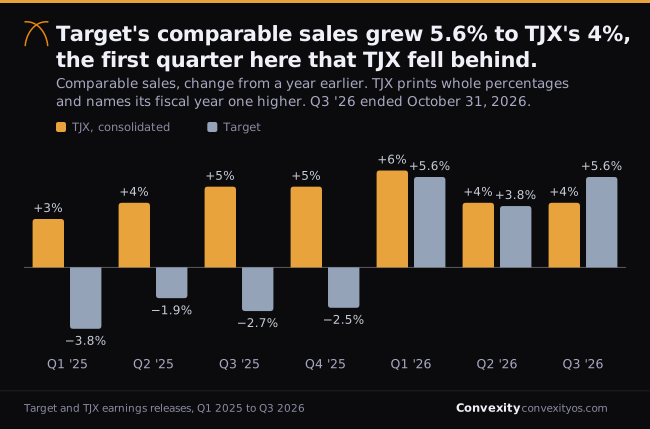
| TJX, consolidated | Target | |
|---|---|---|
| Q1 '25 | +3% | −3.8% |
| Q2 '25 | +4% | −1.9% |
| Q3 '25 | +5% | −2.7% |
| Q4 '25 | +5% | −2.5% |
| Q1 '26 | +6% | +5.6% |
| Q2 '26 | +4% | +3.8% |
| Q3 '26 | +4% | +5.6% |
Target: the shoppers came back
Target's recovery this year is a traffic recovery. Through 2025 the chain lost trips in every quarter: traffic fell 2.4%, 1.3%, 2.2% and 2.9%. Then it rose 4.4% in the quarter to May 2 and 3.6% in the quarter to August 1, while the average ticket barely moved.
On the measure this note cares about most, the quarter to October 31 was the best of the seven. Comparable sales rose 5.6%, and traffic rose 5.0%, the third rise in a row and the biggest on the chart below, while the average ticket added 0.6%. The stores did the accelerating: comparable sales that began in a store grew 4.6%, against 2.7% in the summer quarter, and those that began online grew 9.8%, against 8.7%. Sales grew in every month of the quarter. Fiddelke told analysts on Wednesday that they slowed a little in October and picked up again in November, and that traffic grew in stores, online and across several categories.
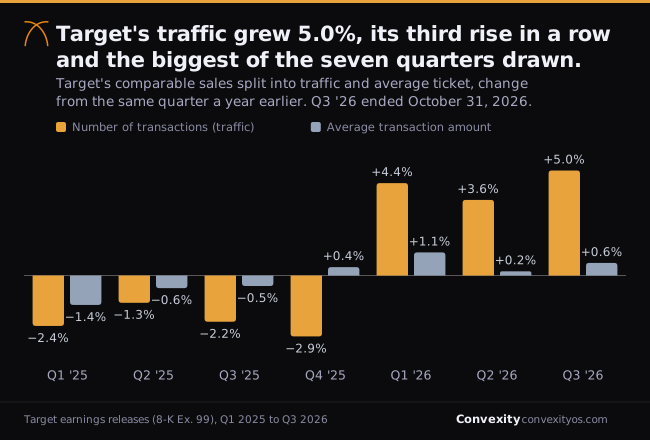
| Number of transactions (traffic) | Average transaction amount | |
|---|---|---|
| Q1 '25 | −2.4% | −1.4% |
| Q2 '25 | −1.3% | −0.6% |
| Q3 '25 | −2.2% | −0.5% |
| Q4 '25 | −2.9% | +0.4% |
| Q1 '26 | +4.4% | +1.1% |
| Q2 '26 | +3.6% | +0.2% |
| Q3 '26 | +5.0% | +0.6% |
Two cautions hung over the recovery after August, and the quarter answered one of them. The first was that Target was only winning back shoppers it had lost: its spring and summer gains, added to the falls they lapped, left it 1.8 and 1.9 points above where it stood two years earlier. The third quarter, added to the 2.7% fall it laps, leaves it 2.9 points above, and traffic on the same sum is up 2.8 points, after 2.0 and 2.3, all by our arithmetic. Target made the point in its release: "On a two-year basis, net sales and traffic growth accelerated relative to the first half of the year." For the first time in these figures, Target is winning trips it never had.
The second caution was where the growth was not. Home and apparel, the two categories in which Target's goods compete most directly with TJX's, had grown at a "flattish" pace by Fiddelke's account in August. On Wednesday he said home had moved to positive comparable sales in the quarter, in a recovery he expects to take years, and that apparel had been flat for the year so far. Cara Sylvester, the chief merchandising officer, traced the apparel problem to women's clothing and shoes.
The margin shows no sign that the traffic was bought. The gross margin rate was 30.5%, against 28.2% a year earlier, and $301 million of tariff refunds, booked as a reduction in the cost of sales, supplied 1.1 points of it. Without them, Target says, the rate would have risen about 1.2 points, helped by "the comparison against last year's elevated markdowns and tariff rates" and held back by "continued investments in value." Fiddelke said Target had cut prices on thousands of items over the past year. This time a soft year-ago quarter paid for the price cuts; next year's third quarter will not have one. Earnings per share were $2.65, against $1.78 on an adjusted basis a year earlier, and without the refunds' 50 cents Target puts the growth at 21%.
Target raised its outlook again, to net sales growth "in a range around 6 percent, one percentage point higher than the prior guidance range," and earnings per share of $10.65 to $11.40, including about $2.14 from the refunds recognized so far. Take the refunds out of both ranges and the new one runs from $8.51 to $9.26, against $8.25 to $9.25 in August, by our arithmetic: the floor rose 26 cents and the ceiling held. November so far, the release says, is "in line with the Company's guidance and expectations, accelerating from October sales trends."
TJX: a better quarter, a smaller lead
TJX has been one of the steadiest growers in American retail. Its consolidated comparable sales rose 3%, 4%, 5%, 5%, 6% and 4% in the six quarters to August, and in each of the last five it had planned growth of 2% to 3% and finished above the top of that range. The wobble came at Marmaxx, which grew just 1% in the quarter to August 1, "driven by a higher average basket, partially offset by a decrease in customer transactions," TJX's quarterly report says: the first of five quarters on file in which TJX said any division served fewer transactions.
Herrman blamed the company, not the shopper. "We are convinced that the issues were self-inflicted and within our control," he told analysts, and price was not the problem: "Nobody is underselling us." When Paul Lejuez of Citi asked whether the missing transactions were shoppers who stayed away or shoppers who came and did not buy, Herrman said what had been missing was the right goods: "I don't think the customer knew we didn't have it, but they probably came in and weren't able to buy it." It is the register count's blind spot in a single sentence. A company that counts no one through its doors cannot tell, from its own figures, a shopper it lost from a sale it missed. TJX's shares fell 4.2% on August 19.
The third quarter beat the plan again. Consolidated comparable sales rose 4%, "above the Company's plan" of 2% to 3%, the sixth quarter in a row above the top of it. HomeGoods grew 5%, TJX Canada 6% and TJX International 8%, and Marmaxx improved to 2%, on top of 6% a year earlier. That is still the slowest of the four divisions, but on two years Marmaxx is now 8 points ahead, against 4 in the summer, by our arithmetic. John Klinger, the chief financial officer, told analysts that Marmaxx's growth came from a bigger average basket with transactions about level with a year earlier, and that its sales strengthened through the quarter. Across the whole company, he said, transactions and the basket both rose.
Profit beat the plan too. The pretax profit margin was 13.0%, against a plan of 12.8% to 12.9%. Without a 0.5-point net benefit from tariff refunds it was 12.5%, above the plan of 12.3% to 12.4% and 0.2 points below a year earlier. Higher freight and fuel costs took the adjusted gross margin down 0.5 points, the release says, and Klinger said they were the main reason Marmaxx's segment margin fell 1.1 points.
For the fourth quarter TJX again plans comparable sales up 2% to 3%, with a margin outlook that "now assumes additional fuel costs versus its prior guidance." It raised the bottom of its full-year range for adjusted earnings per share to $5.17, from $5.15, and kept the top at $5.20. "We expect further improvement at Marmaxx in the fourth quarter," Herrman said in the release, and on the call he said he expected the division's execution problems to be largely behind it by the end of the year. He also named a reason the quarter might start slowly: "we believe the unseasonably warm weather in the U.S. and Canada has been holding back consumer demand in some categories."
Lowe's: bigger tickets, fewer trips
Lowe's answers the yardstick most plainly of the three, and the answer has not changed since early 2025. In each of the six quarters to July its comparable customer transactions fell, by 3.8%, 1.8%, 3.0%, 2.3%, 0.9% and 2.1%, and in each its comparable average ticket rose. The lost trips were mostly the do-it-yourself customer's. Asked in August where the missing transactions came from, Brandon Sink, the chief financial officer, said "it is largely centered around DIY." Housing is the backdrop: "Elevated mortgage rates continue to suppress new home construction activity and pressure larger Pros and home builders," Sink said. July brought a second pressure, from rivals' prices in seasonal goods, and Marvin Ellison, the chairman and chief executive, thought he knew what paid for it: "We think it's the result of competitors having tariff refund dollars and looking for different ways to use those dollars to drive the top line." Lowe's did not match. In August Lowe's cut its full-year forecast to comparable sales "flat," and guided third-quarter adjusted earnings per share to "approximately 7% below" the prior year's $3.06, which is about $2.85, by our arithmetic.
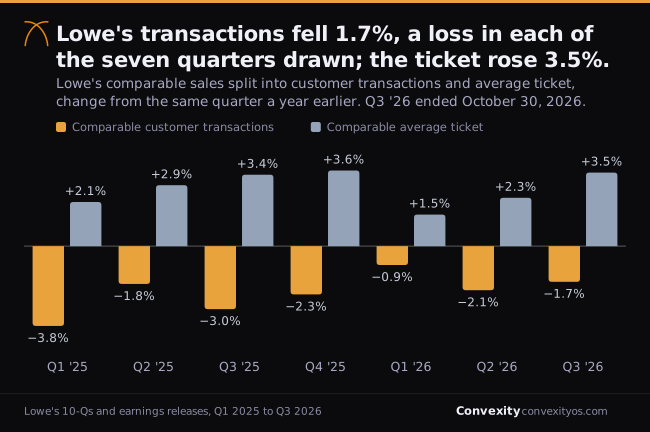
| Comparable customer transactions | Comparable average ticket | |
|---|---|---|
| Q1 '25 | −3.8% | +2.1% |
| Q2 '25 | −1.8% | +2.9% |
| Q3 '25 | −3.0% | +3.4% |
| Q4 '25 | −2.3% | +3.6% |
| Q1 '26 | −0.9% | +1.5% |
| Q2 '26 | −2.1% | +2.3% |
| Q3 '26 | −1.7% | +3.5% |
The quarter to October 30 extended the run. Comparable sales rose 1.8%, "our sixth consecutive quarter of positive comp sales," Ellison said in the release. But comparable transactions fell 1.7% and the average ticket rose 3.5%, so once again fewer customers paid, and on average each paid more. Set against the 3.0% fall a year earlier, Lowe's transactions are 4.7% below where they stood two years ago, by our arithmetic. Sink put the bigger ticket down to more sales to professionals and of appliances, and to higher prices for lumber and electrical cable. Every month of the quarter grew, though October's 2.0% came on top of a 2.6% fall a year earlier, and online sales rose 17.4%.
The earnings beat the guide, and the tariff refund is why. Adjusted earnings per share were $3.10, up 1.3% from $3.06, against the roughly $2.85 Lowe's had pointed to. The $3.10 includes 34 cents from about $250 million of refunds, which the August outlook had left out; without them it was $2.76. Sink told analysts that Lowe's had spent about a third of the refund within the quarter on keeping its offer to customers competitive, which is what Ellison had said in August that rivals were doing with theirs. Add that third back and the quarter comes to about $2.87, close to the guide, all by our arithmetic. Lowe's plans to spend the rest in the fourth quarter, and Sink said the refund would net out to nothing on the year.
The margin shows what the quarter cost. The gross margin rate fell 124 basis points, to 32.95%, the fourth decline in a row and the largest of the four. Sink said the refund added about 120 basis points to it, so without the refund the rate fell about 2.4 points, by our arithmetic. He named the causes: fuel and transportation, about 30 basis points of it; the Foundation Building Materials acquisition, whose effect Lowe's says it has now lapped; the mix of what sold; and the third of the refund already spent. The adjusted operating margin was 11.74%, against 12.41% a year earlier.
The new outlook carries the same pattern across the year. Lowe's now expects sales of about $92.5 billion, up from $92.0 billion, comparable sales "up approximately +0.5%" rather than flat, an adjusted operating margin of about 11.5% rather than 11.6%, and adjusted earnings per share unchanged at about $12.25. With the refund washing out across the year by Lowe's account, that is more sales at a thinner margin for no more profit. For the fourth quarter Sink expects comparable sales to be slightly positive. Lowe's has also named a new head of merchandising: Margrethe Vagell, who runs its supply chain and keeps it, succeeded William Boltz on November 14, according to a filing made on November 17, as he moves toward retirement and the presidency of the Lowe's Foundation.
What would prove this wrong
The claim in the title is narrow: over one year, Target grew faster than TJX for the first time in the seven quarters drawn here, and it did so with traffic. Here is what the print could have shown instead, and what it did show.
If Target's growth had come from a bigger ticket rather than more trips, the claim would be about prices, not shoppers. It did not: 5.0 of the 5.6 points was traffic. If the traffic had been bought with margin, the gross margin rate without refunds would have fallen. It rose about 1.2 points, though against a weak year-ago quarter that will not come round again.
If Marmaxx had recovered to its old pace, TJX would have kept its lead. It grew 2%, and TJX's 4% fell short of Target's 5.6%. But Target's lead is one year deep. TJX was lapping growth of 5% and Target a fall of 2.7%, and on two years TJX is 6.1 points ahead, the same gap as in the summer. A quarter in which Target's two-year figure gains on TJX's would be the stronger proof, and this was not it.
If Lowe's transactions had risen, the do-it-yourself shopper would be coming back before housing does. They fell again, and Lowe's guided the fourth quarter as more of the same.
And the comparison itself has limits. TJX rounds to whole percentages and gives no traffic figures, so its side of the yardstick is words. All three count purchases rather than visits. The fiscal quarters line up within two days but are not identical. A two-year stack is a sum of two percentages, not a compounded figure.
What comes next
Lowe's holds its Analyst and Investor Conference in New York on December 9. Target's and TJX's fourth quarters run through the holidays, which TJX says began slowly in warm weather, and both will report them in the new year.
The filings and documents this is built on
41 documents
- 01CallTarget, third quarter 2026 earnings call (roic.ai transcript)Fiddelke on the months of the quarter, November, traffic, home and apparel, and price cuts; Sylvester on apparel. One transcript when this was published, so reported in our words, not quotedNov 18, 2026roic.ai
- 028-KTJX, third quarter fiscal 2027 earnings release (Exhibit 99.1)Comparable sales by division against the plan; the chief executive on Marmaxx and the weather; pretax and gross margins and the tariff refund benefit; the fourth-quarter and full-year outlookNov 18, 2026sec.gov
- 03CallTJX, third quarter fiscal 2027 earnings call (Gloom transcript)Klinger on what drove comparable sales at Marmaxx and across the company, and on the Marmaxx margin; Herrman on the end of the year. One transcript when this was published, so reported in our words, not quotedNov 18, 2026gloom.sh
- 04CallLowe's, third quarter 2026 earnings call (roic.ai transcript)Sink on the average ticket, the gross margin, the share of the tariff refund reinvested and the fourth quarter. One transcript when this was published, so reported in our words, not quotedNov 18, 2026roic.ai
- 058-KTarget, third quarter 2026 earnings release (Exhibit 99)Comparable sales, traffic and average transaction amount; stores and digital comparable sales; gross margin rate and the $301 million of tariff refunds; the full-year outlook; November to dateNov 18, 2026sec.gov
- 068-KLowe's, third quarter 2026 earnings release (Exhibit 99.1)Comparable sales, gross margin rate, adjusted earnings per share and the $0.34 of tariff refunds, the full-year outlookNov 18, 2026sec.gov
- 078-KLowe's, third quarter 2026 results summary (Exhibit 99.2)Comparable transactions and average ticket, monthly comparable sales against the year before, the Labor Day shift, online sales growthNov 18, 2026sec.gov
- 088-KLowe's, appointment of an executive vice president of merchandising (Item 5.02)Margrethe Vagell succeeds William Boltz, effective November 14, 2026Nov 17, 2026sec.gov
- 098-KTarget, second quarter 2026 earnings release (Exhibit 99)Comparable sales, traffic and average transaction amount; stores and digital comparable sales; gross margin rate; the $994 million of tariff refunds; the full-year outlookAug 19, 2026sec.gov
- 108-KTarget, first quarter 2026 earnings release (Exhibit 99)Comparable sales, traffic and average transaction amount, with the prior-year column for the first quarter of 2025May 20, 2026sec.gov
- 118-KTarget, fourth quarter 2025 earnings release (Exhibit 99)Comparable sales, traffic and average transaction amount for the quarter to January 31, 2026Mar 3, 2026sec.gov
- 128-KTarget, third quarter 2025 earnings release (Exhibit 99)Comparable sales, traffic and average transaction amount for the quarter this one laps; gross margin rateNov 19, 2025sec.gov
- 138-KTarget, second quarter 2025 earnings release (Exhibit 99)Comparable sales, traffic and average transaction amount for the quarter to August 2, 2025Aug 20, 2025sec.gov
- 14CallTarget, second quarter 2026 earnings call, transcript published by TargetFiddelke on traffic, demographics and apparel and home; Sylvester on price cuts and the work ahead in home and apparel; Lee on income brackets, the margin without refunds and the refunds still to comeAug 19, 2026corporate.target.com
- 158-KTJX, second quarter fiscal 2027 earnings release (Exhibit 99.1)Comparable sales by division; the chief executive on Marmaxx and the other divisions; pretax profit margin and the tariff refund benefit; the third-quarter and full-year planAug 19, 2026sec.gov
- 1610-QTJX, quarterly report for the quarter ended August 1, 2026What drove comparable sales at each division, including the decrease in customer transactions at MarmaxxAug 28, 2026sec.gov
- 178-KTJX, first quarter fiscal 2027 earnings release (Exhibit 99.1)Comparable sales by division and pretax profit margin for the quarter to May 2, 2026, against a plan of 2% to 3%May 20, 2026sec.gov
- 1810-QTJX, quarterly report for the quarter ended May 2, 2026What drove comparable sales, consolidated and by divisionMay 29, 2026sec.gov
- 198-KTJX, fourth quarter fiscal 2026 earnings release (Exhibit 99.1)Comparable sales by division and pretax profit margin for the quarter to January 31, 2026Feb 25, 2026sec.gov
- 208-KTJX, third quarter fiscal 2026 earnings release (Exhibit 99.1)Comparable sales by division and pretax profit margin for the quarter this one lapsNov 19, 2025sec.gov
- 2110-QTJX, quarterly report for the quarter ended November 1, 2025What drove comparable sales, consolidated and by division, in the quarter this one lapsDec 2, 2025sec.gov
- 228-KTJX, second quarter fiscal 2026 earnings release (Exhibit 99.1)Comparable sales by division and pretax profit margin for the quarter to August 2, 2025Aug 20, 2025sec.gov
- 2310-QTJX, quarterly report for the quarter ended August 2, 2025What drove comparable sales, consolidated and by divisionAug 29, 2025sec.gov
- 248-KTJX, first quarter fiscal 2026 earnings release (Exhibit 99.1)Comparable sales by division, which it put at the high end of its plan, and pretax profit margin for the quarter to May 3, 2025May 21, 2025sec.gov
- 2510-QTJX, quarterly report for the quarter ended May 3, 2025What drove comparable sales, consolidated and by divisionMay 30, 2025sec.gov
- 26CallTJX, second quarter fiscal 2027 earnings call (StockAnalysis transcript)Herrman on Marmaxx, conversion, prices and the start of the third quarter, and on counting transactions; Klinger on the months of the quarter and the third-quarter margin; quoted only where the Gloom transcript carries the same wordsAug 19, 2026stockanalysis.com
- 27CallTJX, second quarter fiscal 2027 earnings call (Gloom transcript)The second, independently produced transcript used to check every TJX quotationAug 19, 2026gloom.sh
- 288-KLowe's, second quarter 2026 earnings release (Exhibit 99.1)Comparable and total sales; the chief executive on five consecutive positive quarters; gross margin; the 11 cents of tariff refunds; the updated full-year outlookAug 19, 2026sec.gov
- 2910-QLowe's, quarterly report for the quarter ended July 31, 2026Comparable customer transactions and average ticket; the gross margin and its causes; segment sales and the retail segment operating margin; when acquisitions enter comparable salesAug 27, 2026sec.gov
- 3010-QLowe's, quarterly report for the quarter ended May 1, 2026Comparable customer transactions and average ticket; the gross margin and its causesMay 28, 2026sec.gov
- 318-KLowe's, fourth quarter 2025 results summary (Exhibit 99.2)Comparable transactions and average ticket for the quarter to January 30, 2026, the only filing that splits that quarter; gross marginFeb 25, 2026sec.gov
- 328-KLowe's, third quarter 2025 earnings release (Exhibit 99.1)Adjusted diluted earnings per share of $3.06 for the quarter this one lapsNov 19, 2025sec.gov
- 3310-QLowe's, quarterly report for the quarter ended October 31, 2025Comparable customer transactions and average ticket and the gross margin rate for the quarter this one lapsNov 26, 2025sec.gov
- 3410-QLowe's, quarterly report for the quarter ended August 1, 2025Comparable customer transactions and average ticket; the description of Artisan Design GroupAug 28, 2025sec.gov
- 3510-QLowe's, quarterly report for the quarter ended May 2, 2025Comparable customer transactions and average ticketMay 29, 2025sec.gov
- 368-KLowe's, agreement to acquire Foundation Building Materials (Exhibit 99.1)Lowe's description of FBMAug 20, 2025sec.gov
- 37CallLowe's, second quarter 2026 earnings call, transcript published by Lowe'sEllison on promotions, refunds and the second half; Sink on housing, DIY, refunds and the third-quarter outlookAug 19, 2026corporate.lowes.com
- 38CallLowe's, second quarter 2026 earnings call (StockAnalysis transcript)Checked against the Gloom transcript; quoted only where both carry the same wordsAug 19, 2026stockanalysis.com
- 39CallLowe's, second quarter 2026 earnings call (Gloom transcript)The second, independently produced transcriptAug 19, 2026gloom.sh
- 40DataNasdaq, Target, TJX and Lowe's historical quotesOfficial closes of August 18 and 19 and November 13, 2026; retrieved 2026-11-14 and matched against our brokerage data feedNov 14, 2026nasdaq.com
- 41DataState Street, SPDR S&P 500 ETF Trust (SPY) daily holdingsHoldings as of November 12, 2026, for the disclosure; retrieved 2026-11-14Nov 12, 2026ssga.com
Not investment advice. This note is an analysis of public company disclosures, published for research purposes, and not a recommendation to buy, sell or hold any security. A member of the Convexity team holds SPY, which holds Target, TJX, Lowe's and McDonald's; no other position.
What here is ours rather than the companies'. As filed or stated by the companies: every comparable sales, traffic, transaction, ticket, basket, margin rate, refund, sales, earnings and outlook figure, the words describing what drove TJX's comparable sales, and every company quotation, each from a filing, from Target's own transcript, or from two independently produced transcripts of the August TJX and Lowe's calls; what was said on the November 18 calls is reported from one transcript each, in our words. Ours: the one-year gaps between TJX's and Target's comparable sales, including Target's lead of 1.6 points, the two-year stacks (each a simple sum of two years' changes) for both companies, Marmaxx and Target's traffic, Lowe's two-year change in transactions, Lowe's implied third-quarter guide of about $2.85, Lowe's adjusted earnings per share without the refund ($2.76) and with the third it reinvested added back (about $2.87), Lowe's gross margin rate without the refund (down about 2.4 points, from the 120 basis points its finance chief gave), Target's earnings outlook with its refunds taken out ($8.51 to $9.26, against $8.25 to $9.25), TJX's margin over its own plan in each quarter, and the share price changes, all computed from the filed figures, the calls and official closes, most of them in the checks that ship with this note's charts.